Shown here is a 1950 era propaganda produced by the U.S. Signal Corp highlighting the then new B-36 intercontinental nuclear bomber.
Playing in the U.S. movie theatres of the era, the film served the dual purpose of not only informing the U.S. public about U.S. air power but to also serve notice to the Soviets about what awaited them should they step out of line.
Built by Convair, the B-36 “Peacemaker” was a strategic bomber operated solely by the United States Air Force (USAF) from 1949 – 1959.

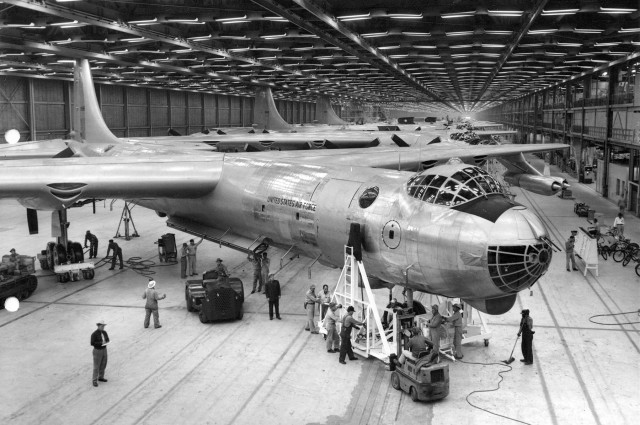
With four bomb bays, a range of 10,000 miles and a maximum payload of 87,200 lbs, the B-36 was the world’s first manned bomber with intercontinental range capabilities without the need to refuel.
The B-36 was the USAF Strategic Air Command’s (SAC) primary nuclear weapons delivery arm until it 1955 when it was replaced by the jet-powered Boeing B-52 Stratofortress.
The first of its kind, the B-36 set the standard in terms of range and payload for all future U.S. intercontinental bombers.
In 1947 the United States Air Force
became an independent service, carved from the Army and placed under the
control of the newly created National Military Establishment. The new
service faced daunting challenges. There was the threat from a new
adversary, the Soviet Union. But there were challenges at home as well:
from the Navy, which viewed those in the new uniforms as rivals for
diminishing defense funds; and from within, as the Air Force struggled
to introduce jet-powered aircraft into operational service.

In the spring of 1949, the country got a new secretary of
defense: Louis Johnson, a wealthy lawyer, aspiring politician, and
former official with the Convair Corporation, which was a longtime
supplier of U.S. military aircraft. That last connection, which today
would seem a scandal worthy of a special prosecutor, was common at the
time. Who knew more about weapons than the men who built them?

When President Harry Truman ordered Johnson to economize, he obliged in April by canceling the 65,000-ton super-carrier United States, the keel of which had been laid only a week before. But the carrier was the linchpin of the Navy's plan to equip itself for the strategic nuclear mission. Carrying aircraft able to deliver atomic bombs to a target 1,000 miles away, the United States would have projected naval air power across the world's oceans, just the mission the Air Force wanted for its land-based bombers. Johnson's order, though only two sentences long, set off an interservice squabble the likes of which the nation had rarely seen.
Relations between the Army and Navy had first soured in the 1920s over which service should defend the U.S. coast, and World War II had only sharpened their rivalry. Now the Navy viewed the postwar creation of the Air Force and the Department of Defense as twin political threats to its primacy as the defender of U.S. shores. The spat that followed cancellation of the United States became known as "the revolt of the admirals," and it pitted the Navy's aircraft carrier against the Air Force's strategic bombing force--more specifically, Convair's monster six-engine bomber, the B-36, which had entered service in the summer of 1948.


When President Harry Truman ordered Johnson to economize, he obliged in April by canceling the 65,000-ton super-carrier United States, the keel of which had been laid only a week before. But the carrier was the linchpin of the Navy's plan to equip itself for the strategic nuclear mission. Carrying aircraft able to deliver atomic bombs to a target 1,000 miles away, the United States would have projected naval air power across the world's oceans, just the mission the Air Force wanted for its land-based bombers. Johnson's order, though only two sentences long, set off an interservice squabble the likes of which the nation had rarely seen.
Relations between the Army and Navy had first soured in the 1920s over which service should defend the U.S. coast, and World War II had only sharpened their rivalry. Now the Navy viewed the postwar creation of the Air Force and the Department of Defense as twin political threats to its primacy as the defender of U.S. shores. The spat that followed cancellation of the United States became known as "the revolt of the admirals," and it pitted the Navy's aircraft carrier against the Air Force's strategic bombing force--more specifically, Convair's monster six-engine bomber, the B-36, which had entered service in the summer of 1948.

Now it was a year later, and matters
were coming to a head. The first shot in the battle was fired by Cedric
Worth, a civilian assistant to Navy Undersecretary Dan Kimball for
"special study and research," as he later described his duties under
oath. It came in the form of a nine-page memo for the Navy's internal
use (though he admitted giving copies to three members of Congress and
to aircraft manufacturer Glenn Martin). The document condemned the B-36
as "an obsolete and unsuccessful aircraft" and charged that the Air
Force had acquired it only after Convair had contributed $6.5 million to
various Democratic politicians. See Revolt of the Admirals
The theme was picked up by the Navy League, which spent $500,000 trashing the mega-bomber. (That amount, at least, was the estimate of the rival Air Force Association. If these sums don't seem exciting, consider that in 1949, the minimum wage in the aircraft industry was 50 cents an hour.) The B-36 was described as a "lumbering cow" and a "billion-dollar blunder," and the Navy claimed it had at least three jet fighters that could leave the monster behind at 40,000 feet. The admirals wanted a matchup, but they would never get one.
The Joint Chiefs of Staff told Johnson the test was a bad idea. And the Air Force said it had already demonstrated that fighters couldn't maneuver at that altitude. Simulated B-36 attacks on bases in Florida and California were met by three front-line fighters: a North American F-86A Sabre,
 a Lockheed F-80C Shooting Star,
 and a Republic
F-84 Thunderjet.
and a Republic
F-84 Thunderjet.
 Radar picked up the intruder 30 minutes out; the
fighters took 26 minutes to climb to 40,000 feet and another two minutes
to find the B-36. The fighters were faster than the big bomber, but
their wing loading (the ratio of aircraft weight to area of the wings)
was so high that they couldn't turn with the bomber without stalling in
the thin air. Even if a B-36 were detected and Soviet fighters caught
it, the pilot could evade them by making S-turns, said the Air Force.
Radar picked up the intruder 30 minutes out; the
fighters took 26 minutes to climb to 40,000 feet and another two minutes
to find the B-36. The fighters were faster than the big bomber, but
their wing loading (the ratio of aircraft weight to area of the wings)
was so high that they couldn't turn with the bomber without stalling in
the thin air. Even if a B-36 were detected and Soviet fighters caught
it, the pilot could evade them by making S-turns, said the Air Force.

Of course, the Russians wouldn't have been flying USAF jets, as British engineer Harold Saxon argued in an edition of Aviation Week that appeared in mid-summer. While the Americans valued speed and therefore reduced the span and area of their jets' wings, the British built fighters that could maneuver at stratospheric heights, beginning with the de Havilland Vampire, which had been designed for the first British turbojet engine, and which by 1949 had done "a lot of development flying since 1947 between 50,000 and 60,000 feet," according to Saxon.

By early June, the battle had moved into the halls of Congress when James Van Zandt, a Republican Congressman from Pennsylvania and captain in the Navy reserve, took up the charges leaked by Worth's memo. On the House floor, Van Zandt demanded an investigation of the "ugly, disturbing reports" that the bomber project would have been canceled a year ago if not for wheeling and dealing by Louis Johnson, other Convair officials, and Stuart Symington, the civilian head of the Air Force.
 Symington, in a speech at Brookline, Massachusetts, had summed up
the final judgment on the B-36: The bomber could "take off from bases
on this continent, penetrate enemy defenses, destroy any major urban
industrial area in the world, and return non-stop to the point of
take-off." Symington's claim was preposterous, but it was widely
believed. So Congress did what it does best: It scheduled hearings. But
they were delayed until August, infuriating Van Zandt, and also
broadened into a debate about the strategic roles of the Air Force and
Navy. During the dramatic proceedings, a browbeaten Cedric Worth was
unmasked as the author of the memo that had incited the ruckus and
forced to recant everything. "I think I was wrong," he told the
committee.
Symington, in a speech at Brookline, Massachusetts, had summed up
the final judgment on the B-36: The bomber could "take off from bases
on this continent, penetrate enemy defenses, destroy any major urban
industrial area in the world, and return non-stop to the point of
take-off." Symington's claim was preposterous, but it was widely
believed. So Congress did what it does best: It scheduled hearings. But
they were delayed until August, infuriating Van Zandt, and also
broadened into a debate about the strategic roles of the Air Force and
Navy. During the dramatic proceedings, a browbeaten Cedric Worth was
unmasked as the author of the memo that had incited the ruckus and
forced to recant everything. "I think I was wrong," he told the
committee.
"You made a grave error, did you not?" he was asked.
"Yes."

U.S. bombers had been getting steadily bigger, so the enormity of the B-36 may have seemed part of an American pattern, but the bomber actually owed its immense bulk to a succession of hostile dictators, starting with Adolf Hitler. In the spring of 1941, German troops held most of western Europe and seemed likely to conquer Britain next. The U.S. Army asked airframe builders for an airplane that could take off from American soil, bomb Germany, and fly home.
The most promising design came from Consolidated Aircraft in San Diego, builder of the B-24 Liberator, which was just entering service with U.S. and British air forces. Consolidated proposed a quantum leap over the B-17 and B-24 heavy bombers as well as Boeing's next-generation "very heavy" B-29 Superfortress. The B-36 was to be a mega-bomber, spanning 230 feet from wingtip to wingtip. It would cross the Atlantic, enter German airspace at 300 mph, and drop 10,000 pounds of bombs from 40,000 feet, too high for flak or fighters to trouble it. Impressed, the Army ordered a pair of prototypes on November 15, 1941.

Three weeks later, the Japanese attacked Pearl Harbor, and the U.S. suddenly found itself fighting a two-ocean war. The B-36 went on the back burner while Consolidated turned out thousands of its proven Liberators. The B-36 suffered another setback when its facilities were moved to Texas, and yet another when the designers were asked to build a transport based on the bomber.
While Europe was pounded from bases in England, Japan was to be targeted by the Boeing Superfortress flying from China. The Japanese set out to capture the Chinese airfields--and thereby moved the B-36 back to the front burner. From Hawaii, it could bomb Tokyo as it had once been expected to bomb Berlin. In June 1943 the Army asked for 100 copies of the mega-bomber, with the first to arrive in the summer of 1945.
The U.S. Marine Corps moved faster than Convair (Consolidated merged with Vultee in 1943, and the new name was coined then). Shortly after Guam, Saipan, and Tinian were in U.S. hands, the Superforts began their terrible punishment of the Japanese home islands. The Pacific war ended six months earlier than expected--and six days before the rollout of the first B-36, its nose jacked up to lower its tail, which was too tall for the hangar door. It debuted as the Peacemaker, but the name never took, and even today it is better remembered simply as the B-36.

In a country celebrating peace, the prototype would have been the last of the line, but the Soviet Union turned out to be as land-hungry as Nazi Germany and Imperial Japan. Nonetheless, the U.S. military packed for home in a stand-down so thorough that it was "Not a demobilization"," as General Leon Johnson noted in a 1954 interview, "it was a rout." The spring of 1946 became a replay of 1941, with a hostile dictator swallowing pieces of Europe and the Americans unable to do anything about it. The "strategic" card--the threat of wholesale destruction by nuclear weapons--seemed the only one that a demobilized, budget-cutting United States could play. But which of the services would play it?
When Congress had created the independent air force in 1947, the new service had been organized around two combat arms: a Tactical Air Command (TAC) to support the ground troops and a Strategic Air Command (SAC) to take the war to the enemy. The Air Force would have a fleet twice the size of the Navy's--24,000 aircraft to 11,500--and only the Air Force would have heavy bombers.
Following the U.S. withdrawal to the continental United States and the emergence of Joseph Stalin's ambitions, SAC's strategic mission was in the ascendant and there was no longer any question who the "enemy" was. By happenstance, the long-distance payload of the B-36 equalled the weight of one atomic bomb--roughly 10,000 pounds--and its combat radius equalled the great-circle route from Maine to Leningrad. Pending the arrival of its new $5.7-million-dollar baby, SAC made do with 160 veteran B-29 Superforts, and it was these aircraft that answered the call to deploy to European bases when the Russians shut off ground access to Berlin in the summer of 1948.

It was a colossal bluff. In all of SAC, only 27 Superforts had the "Silver Plate" modifications needed to carry an atomic bomb, and these were all assigned to the 509th Bomb Group, which stayed home. As for bombs, the U.S. "stockpile" contained exactly 13, controlled by the Atomic Energy Commission, and President Harry Truman refused to say if he'd ever release them to the military. Even if he had given the order to launch an attack, the 509th would have needed five days to pack up, fly to an AEC depot, load the nukes, and move overseas.

Perhaps the reality of the situation didn't matter to the Soviets. As they demonstrated again and again during the cold war, their pattern was to push until they met a determined response, then back off and wait for the next opportunity. They could easily have prevented an airlift by jamming U.S. radio beacons, but they didn't. And when General Curtis LeMay, to everyone's astonishment, fed and heated Berlin by air, the Russians quietly reopened land routes in the spring of 1949. The blockade succeeded only in burnishing LeMay's reputation, heightening American fear of Russia, and confirming the belief that the B-36 was America's best hope to contain Communism.
In June 1948, Convair delivered the first operational B-36A to SAC's 7th Bomb Group at Carswell Air Force Base, across the runway from its Fort Worth plant. Big as the B-29 Superfort was, it could nearly fit beneath one wing of a B-36. Despite the difference in size, the two airplanes had similar vertical tails, and they had slim fuselages, like cigarettes, round in cross-section, with two pressurized crew cabins separated by two bomb bays and connected by a tunnel.

But the wings were different. The Superfort's were thin, straight, and glider-like, while the B-36's wings were more than seven feet thick at the root, enough for a crewman to crawl in and reach the engines or the landing gear in flight. The wings were tapered, with the leading edges swept back, and the effect of that, combined with the wings' location so far back on the fuselage, made the airplane appear out of balance. Strangest of all, the B-36's six Pratt & Whitney Wasp Major engines were faired into the trailing edges, with the propellers located aft in the pusher configuration. Although it was supposed to reduce the propeller swirl's turbulence over the wing, the pusher design was rarely used on U.S. aircraft. Apparently it worked, though, because the B-36 had very low drag. The main drawback was that air for cooling the engines was ducted from intakes in the leading edge of the wing, and there was never enough of it, especially at high altitude.

The propellers were 19 feet in diameter, and to keep the tips from going supersonic they were geared to turn less than half as fast as the engines. The engines and propellers produced an unforgettable throbbing sound when the B-36 flew overhead. A friend of mine remembers the sound from his boyhood as a "captivating drone. The noise went down to your heels, it was so resonant. It just stopped you in your tracks. You looked up into the sky to try to find this thing, and it was just a tiny cross, it was so high." Others remember that it rattled windows on the ground from 40,000 feet.
The airplane's most eye-catching feature was the Plexiglas canopy that enclosed a flight deck, which, while ample for a crew of four, seemed small on such a whale of a plane. A dome below the nose housed a radar antenna, and two transparent blisters allowed the crew to aim the guns and observe any mechanical breakdowns. The effect was a face like a prairie dog's peering from a burrow, with the flight deck for eyes, the scanning blisters for ears, and the radome for tucked-up paws.
The ailerons, flaps, rudder, and elevators had a combined total surface area greater than both wings of a B-24. The pilot's control input moved a trim tab in the opposite direction, forcing the control surface in the desired direction.
 Two flight engineers monitored the six
4,360-cubic-inch engines, each with four rows of seven cylinders, a
configuration that earned the nickname "corncob." The bombardier,
navigator, radioman, and gunners brought the population of the forward
cabin to 10.
Two flight engineers monitored the six
4,360-cubic-inch engines, each with four rows of seven cylinders, a
configuration that earned the nickname "corncob." The bombardier,
navigator, radioman, and gunners brought the population of the forward
cabin to 10.
You could visit the aft cabin by lying supine on a wheeled cart and pulling yourself along an overhead rope through a tunnel 85 feet long and two feet in diameter. The cart also served as a dumbwaiter, sending hot entrees from the galley to the forward cabin. The aft compartment accommodated five men and was equipped with bunks, an electric range, and the world's smallest urinal, which had to be voided to the outside at intervals. B-36 veterans like to tell the story of the new captain who came aft to relieve himself but didn't ask for instructions and, as a result, peed on his boots.

Later models had larger crews, up to 22 in reconnaissance versions. And everyone had a job to do--two jobs, in the case of the gunners. It took the ground crew six hours to prepare the bomber for a mission, and the flight crew needed another hour for a preflight check involving 600 steps, beginning with climbing the landing gear and removing the clamps that kept the gear from folding accidentally.
The B-36A couldn't fight--the electrically operated cannon were so trouble-prone they were simply eliminated--much less scramble to retaliate, and it ended up becoming little more than a crew trainer. Twenty-two were delivered, each virtually handmade, and "so flimsily built," says Jim Little, who served on one after it was converted to an RB-36E, "that the upper wing skin would actually pull loose from the wing ribs." Sometimes, Little recalls in the book RB-36 Days at Rapid City, "you would meet [the plane] with a crew of 30 or 40 sheet metal men."

The propellers were reversible for braking on landing, but sometimes they reversed in flight or while the airplane was straining to take off--at least once with fatal consequences. The stainless steel firewalls enclosing the engines cracked. The cylinders overheated. Lead in the gasoline fouled the spark plugs at cruising speed. Each airplane had 336 spark plugs, and after a flight lasting a day and a half, a mechanic would have to haul a bucket of replacement plugs to the airplane to service all six engines. The engines leaked oil, and sometimes a flight engineer had to shut one down because it had exhausted its allotment of 150 gallons.

Then there was the "wet wing." The outboard fuel tanks were formed by the wing panels and sealed at the junctions, and after the wing flexed for a few hundred hours the sealant was apt to fail. Jim Little recalls that one airplane leaked so badly "the ground underneath was just purple [from the dye in the high-octane gasoline]--it was raining fuel under that airplane."
Pilot opinion of the B-36 tended to run to the extremes, but most crew members loved it--"this big, wonderful old bird," Jim Edmundson calls it. As a colonel in the early 1950s, Edmundson commanded a B-36 group at Fairchild Air Force Base near Spokane, Washington. But even he admitted that the airplane could be a chore for its pilot--"like sitting on your front porch and flying your house around."

Of course most of the pilots were young and eager, and the older men had flown worse contraptions during the war. "It was a noisy airplane; it was big," former radioman/gunner Raleigh Watson recalled at a B-36 reunion at the Castle Air Museum in Atwater, California last September, "but it was comfortable, and I think we felt it was a safe airplane, a very well-built airplane." Moxie Shirley, a pilot with more than a thousand hours in the B-36, loved the airplane, declaring that it "kept the Russians off our backs." But he went on to add, "Every crew that ever flew that airplane had stories that would make your hair stand on end."
Ed Griemsmann expressed another view in Thundering Peacemaker: "A horrible, lazy beast to fly," he told the book's author. Griemsmann survived a fiery crash in 1956. Most B-36 crashes were fiery because of the magnesium used in its construction. Rather than fly another, he said, he'd join the infantry.

If the B-36A was ineffective, the Strategic Air Command was little better. Its first commander, General George Kenney, didn't believe in the B-36, arguing in 1947 that the bomber was too slow to survive over enemy territory, with engines and an airframe that couldn't withstand an 8,000-mile flight. Kenney urged the Air Force to put its money into bombers that could fly at the speed of sound, even if that meant depending on overseas bases.
Kenney was right, of course. But at the time, his advice seemed disloyal, and he compounded the offense by letting his deputy run SAC while he himself campaigned for the top job in the Air Force. Not long after the first B-36A arrived, Kenney was fired. SAC's new commander was General Curtis LeMay, the pudgy, ferocious, cigar-smoking general famed for his B-29 tactics in the Pacific and for the more recent and successful Berlin airlift.

"We didn't have one crew, not one crew, in the entire command who could do a professional job," LeMay wrote of the SAC he inherited. He challenged his crews to stage a practice bomb raid on Dayton, Ohio, from 30,000 feet, using photographs taken in 1941--the best they'd have for the Soviet Union. (All SAC had were captured photographs the Germans had taken during the occupation of western Russia. Of the country beyond Moscow, there were no photographs available at all.) After the fiasco that ensued, LeMay whipped the crews into shape. He moved the best people from other groups to make the nuclear-capable 509th combat-ready, then did the same for the next most promising group.
 By the fall of 1948 an improved B-36B had arrived, armed with
pairs of 20-millimeter guns in the nose and tail, and six turrets that
opened out like flowers in a slow-motion film; the gunners aimed from
remote blisters. On December 7, the seventh anniversary of the Japanese
raid on Pearl Harbor, Lieutenant Colonel John Bartlett took off in a
B-36 from Carswell Air Force Base in Texas, flew to Hawaii, dropped a
10,000-pound dummy bomb, and returned without being spotted on the
island's radar. LeMay must have bitten through his cigar when he got the
news. If he could reach Hawaii from Texas, he could hit the Soviet
Union from Maine. And if he could figure out how to operate the B-36 in
the cold of Alaska, all of Siberia would fall under its shadow.
By the fall of 1948 an improved B-36B had arrived, armed with
pairs of 20-millimeter guns in the nose and tail, and six turrets that
opened out like flowers in a slow-motion film; the gunners aimed from
remote blisters. On December 7, the seventh anniversary of the Japanese
raid on Pearl Harbor, Lieutenant Colonel John Bartlett took off in a
B-36 from Carswell Air Force Base in Texas, flew to Hawaii, dropped a
10,000-pound dummy bomb, and returned without being spotted on the
island's radar. LeMay must have bitten through his cigar when he got the
news. If he could reach Hawaii from Texas, he could hit the Soviet
Union from Maine. And if he could figure out how to operate the B-36 in
the cold of Alaska, all of Siberia would fall under its shadow.
The B model also had the "Grand Slam" modifications needed for carrying a hydrogen bomb, which was 30 feet long and weighed 43,000 pounds and had been created in such secrecy that Convair didn't have the dimensions in time for the A models.

The B-36B was the last true reciprocating-engine bomber in the U.S. strategic bomber force. In hindsight, it seems obvious that the mega-bomber should have been jet-powered from the start. But the turbojet had been developed during World War II for fast-climbing, high-flying interceptors, and they gulped fuel at a prodigious rate. Nobody dreamed they could cross an ocean. Two developments changed everything: a new generation of twin-spool turbojets with markedly improved fuel consumption and, more significantly, the advent of inflight refueling. By 1949, Boeing's B-47 Stratojet was entering production, and the B-52 Stratofortress, an intercontinental giant, was making progress on paper.

Even before the uproar started in Congress in the summer of '49, the Air Force was apparently worried about the vulnerability of the B-36, and as an interim measure asked Convair to hang a pair of jet pods near the B-36's wingtips. By March, a B-36B had flown with four Allison J35s installed. On the production versions that emerged in July, each pod housed two General Electric J-47-GE-19s modified to run on gasoline--tiny compared to the Wasp Majors, but effectively doubling the airplane's installed horsepower. The jets were employed for takeoff, climbing to extreme altitudes, and dashing across hostile territory. With "six turning and four burning," as the saying went, a B-36 could finally top 400 mph. But fighter jockeys were flirting with the sound barrier in their North American F-86 Sabre jets, and whatever the Americans deployed--nukes, missiles, supersonic jets--the Russians matched, beginning with copies and sometimes ending with improved weapons.
For the benefit of Congress, the Air Force then released what Aviation Week described as "sensational new performance figures" on the jet-assisted B-36D: 435-mph top speed, 50,000-foot ceiling, range of up to 12,000 miles. LeMay added his personal pledge: "I believe we can get the B-36 over a target and not have the enemy know it is there until the bombs hit."
Even George Kenney came out of exile from his post as commander of the officer training center, Air University, to praise the airplane. "The B-36 went higher, faster, and farther than anybody thought it would," he said, "and the pilots liked it. It was a lucky freak." However, Kenney guessed that both the U.S. Navy Banshee and the Royal Air Force Vampire could intercept the B-36 in daylight; he recommended that it be used only on night raids.

On September 5, Aviation Week reported "Symington and Defense Chiefs Exonerated," as the House Armed Services Committee gave a clean bill of health to Johnson, Symington, the Air Force, and Convair. There wasn't "one iota, not one scintilla, of evidence...that would support charges or insinuations that collusion, fraud, corruption, influence, or favoritism played any part whatsoever in the procurement of the B-36 bomber," the committee concluded. Even Congressman Van Zandt voted for the absolving resolution.
At 4 a.m. local time on June 25, 1950, North Korean troops stormed across the 38th parallel. In November they were joined by Chinese "volunteers." These developments marked the end of President Truman's defense economy drive. First Germany, then Japan, then Russia, and now events in Korea had succeeded in advancing the cause of the B-36. Suddenly plenty of money was available for mega-bombers, and for super-carriers as well.

The Korean war produced another milestone for SAC: Truman released nine atomic bombs to the military. They probably didn't leave the country, but the B-36 did, flying from Texas to airfields in Britain and Morocco in the spring and fall of 1951. Only six airplanes were involved and their visits were short, but the message couldn't have escaped Moscow's attention. However briefly, the capital and most of the territory of the Soviet Union had come within the combat radius of the B-36.
Altogether, 1951 was a good year for mega-bombers. Margaret Bourke-White rhapsodized over the B-36 in a photo-essay for Life magazine, with photographs taken at 41,000 feet, where the sky "was a color such as I've never seen, the darkest blue imaginable, yet luminous like the hottest cobalt, too brilliant for the eyes to bear." She photographed fluffy white contrails streaming from the reciprocating engines, a 55-foot scaffold used to repair the rudder, and (from both ends) the marvelous flying boom that refueled bombers in flight.

An alert reader might have noted some oddities in Bourke-White's essay. The bomber being refueled was a Superfort, not a B-36, none of which was ever equipped for inflight refueling. She rode in a B-47, its raked tail clearly visible in one photograph. And the accompanying map depicted a Soviet Union surrounded by small bombers based in Alaska, Canada, Europe, North Africa, the Middle East, and Japan: the Peacemaker hunkered at home.

But if Superforts were on the Russian border, and if midair refueling allowed them to fly indefinitely, and with the Stratojet coming on line, why bother with the B-36? The jet pods had added so much weight and gobbled so much fuel that the combat radius had dropped first to 3,525 miles, then to 3,110. What was LeMay planning? From Maine, South Dakota, and Washington, the B-36 could barely scratch the edges of the Soviet empire, and even at those bases it faced hard sledding in the winter. At Rapid City, mechanics had to build a repair dock with sliding doors and cutouts for the fuselage so they could work on the engines while the tail stayed out in the snow. There were SAC bases in Alaska and Greenland, but the climate was so forbidding that LeMay never stationed any B-36s there. The Arctic airfields were used as staging points, with the bombers returning to the south 48 after each mission. Another ploy was the shuttle mission, with a takeoff from Fairchild Air Force Base near Spokane, Washington. After bombing Irkutsk, in central Siberia, the bombers would have refueled at Okinawa before returning home.

But to do any real damage, LeMay had to launch it from an overseas base or order a one-way mission. He would have scoffed at this latter-day quarterbacking, of course. "The B-36 was often called an interim bomber," he wrote in his memoir, Mission With LeMay. "For my dough, every bomber which ever has been or ever will be is an interim bomber." He had a point: at the time, SAC even considered the B-52 nothing more than a fill-in for the supersonic B-70.
LeMay may have been loyal to his hardware, but there were signs that General Kenney wasn't alone in his initial doubts about the B-36. One scheme would have equipped it with a pilotless drone to fight off enemy interceptors. Then the Air Force experimented with a manned parasite--the XF-85 Goblin--which would ride to war in a bomb bay. Still later, Republic adapted its F-84 to snuggle into the belly of the beast. By 1953 this last concept had changed from one of defending the B-36 to replacing it: The mother plane would linger offshore while the Thunderjet dashed in to take photographs or drop a bomb.

Finally, in 1955, Convair took a different approach, stripping the mega-bomber to the essentials. Just as LeMay had gambled his B-29s in 1945, sending them low and fast over Tokyo armed only with tail guns, SAC got a "featherweight" B-36 with only two guns, a smaller crew, no stove or other luxuries, and, in the bargain, a longer range. Many of the earlier models were modified to the new standard, especially the reconnaissance versions. Indeed, it's possible that LeMay's fondness for the B-36 may have had less to do with its potential as a bomber than its value as a spyplane. SAC ended up with 369 of the jet-recip hybrids, including modified versions, and more than a third were reconnaissance bombers. The RB-36 could carry an atomic bomb, but its principal weapon was a camera the size of a Geo Metro, set in a photo studio that replaced the forward bomb bay. Loaded with a roll of film 18 inches wide and 1,000 feet long, this great camera once photographed a golf course from 40,000 feet, and in the contact print, on display at the Air Force Museum in Dayton, an actual golf ball can be seen. If an RB-36 could see a golf ball from eight miles up, it could see tanks, airplanes, missiles, and factories. Surely this was the task that LeMay saw for the Peacemaker: With its enormous wings and extra fuel, who knows how high and how far it could fly? B-36 crews speak of 45-hour missions, presumably with fuel cells instead of nukes in the rear bomb bays; at cruise speed, a "featherweight" could travel almost 9,000 miles in that period. The official ceiling was 41,300 feet, but again, crews say that they routinely flew higher than 50,000 feet, and one man--John McCoy, quoted in Thundering Peacemaker--boasted of soaring to 58,000 feet. On missions over China, McCoy said, his RB-36 was chased by MiG fighters that couldn't climb anywhere near it. U.S. fighter pilots of that period also recall B-36s cruising comfortably well above their own maximum altitude. Not until the advent of the "century series" fighters--the F-100 and up--would the B-36 be challenged. Whether the RB-36 ever overflew Russia is anyone's guess, but it was the U.S. altitude and distance champ until the Lockheed U-2 came on line toward the end of the decade.

In the end, the B-36 turned out to be a place holder for the B-52 Stratofortress. Convair attempted to stave off Boeing's intercontinental jet bomber with the YB-60, which premiered as the YB-36G, with eight jets, a five-man crew, completely redesigned swept wings, a speed of 508 mph, and a 2,920-mile combat radius--in short, a knock-off that was inferior in every respect to its competitor. Boeing's bombers had the advantage of having been designed for jet power from the start. The Air Force didn't even bother to supply engines for the second YB-60 prototype.
Though obsolescent, the B-36 still had some momentum. Before descending into retirement, it made its first overseas deployment with a USAF unit in 1955, to Britain and Guam. In the same year, it starred in a Hollywood epic, Strategic Air Command--though in Jimmy Stewart's final scene with Frank Lovejoy, who played the LeMay-like general, a model of an early B-52 can be seen on the general's desk. The B-36 remained in the inventory for four more years, while the new Stratofortress was being tweaked to its full potential.

The B-36 was nowhere near as durable as the B-52 would prove to be, but it did the work asked of it. And eventually, the inter-service rivalry that led to the Congressional eruption over the big bomber's strategic mission died down, with the Navy's missile-submarine fleet garnering a permanent place in the strategic "triad" along with bombers and land-based missiles. Perhaps the best thing that can be said about the Peacemaker is that it lived up to its name. The B-36 never went to war, never dropped a bomb in anger, nor (so far as we know) even fired its cannon at an enemy airplane. Created at a time when the atomic bomb redefined strategic air power and the turbojet redefined performance, its career spanned the crossroads that divided two era
The theme was picked up by the Navy League, which spent $500,000 trashing the mega-bomber. (That amount, at least, was the estimate of the rival Air Force Association. If these sums don't seem exciting, consider that in 1949, the minimum wage in the aircraft industry was 50 cents an hour.) The B-36 was described as a "lumbering cow" and a "billion-dollar blunder," and the Navy claimed it had at least three jet fighters that could leave the monster behind at 40,000 feet. The admirals wanted a matchup, but they would never get one.
The Joint Chiefs of Staff told Johnson the test was a bad idea. And the Air Force said it had already demonstrated that fighters couldn't maneuver at that altitude. Simulated B-36 attacks on bases in Florida and California were met by three front-line fighters: a North American F-86A Sabre,


Of course, the Russians wouldn't have been flying USAF jets, as British engineer Harold Saxon argued in an edition of Aviation Week that appeared in mid-summer. While the Americans valued speed and therefore reduced the span and area of their jets' wings, the British built fighters that could maneuver at stratospheric heights, beginning with the de Havilland Vampire, which had been designed for the first British turbojet engine, and which by 1949 had done "a lot of development flying since 1947 between 50,000 and 60,000 feet," according to Saxon.

By early June, the battle had moved into the halls of Congress when James Van Zandt, a Republican Congressman from Pennsylvania and captain in the Navy reserve, took up the charges leaked by Worth's memo. On the House floor, Van Zandt demanded an investigation of the "ugly, disturbing reports" that the bomber project would have been canceled a year ago if not for wheeling and dealing by Louis Johnson, other Convair officials, and Stuart Symington, the civilian head of the Air Force.

"You made a grave error, did you not?" he was asked.
"Yes."

U.S. bombers had been getting steadily bigger, so the enormity of the B-36 may have seemed part of an American pattern, but the bomber actually owed its immense bulk to a succession of hostile dictators, starting with Adolf Hitler. In the spring of 1941, German troops held most of western Europe and seemed likely to conquer Britain next. The U.S. Army asked airframe builders for an airplane that could take off from American soil, bomb Germany, and fly home.
The most promising design came from Consolidated Aircraft in San Diego, builder of the B-24 Liberator, which was just entering service with U.S. and British air forces. Consolidated proposed a quantum leap over the B-17 and B-24 heavy bombers as well as Boeing's next-generation "very heavy" B-29 Superfortress. The B-36 was to be a mega-bomber, spanning 230 feet from wingtip to wingtip. It would cross the Atlantic, enter German airspace at 300 mph, and drop 10,000 pounds of bombs from 40,000 feet, too high for flak or fighters to trouble it. Impressed, the Army ordered a pair of prototypes on November 15, 1941.

Three weeks later, the Japanese attacked Pearl Harbor, and the U.S. suddenly found itself fighting a two-ocean war. The B-36 went on the back burner while Consolidated turned out thousands of its proven Liberators. The B-36 suffered another setback when its facilities were moved to Texas, and yet another when the designers were asked to build a transport based on the bomber.
While Europe was pounded from bases in England, Japan was to be targeted by the Boeing Superfortress flying from China. The Japanese set out to capture the Chinese airfields--and thereby moved the B-36 back to the front burner. From Hawaii, it could bomb Tokyo as it had once been expected to bomb Berlin. In June 1943 the Army asked for 100 copies of the mega-bomber, with the first to arrive in the summer of 1945.
The U.S. Marine Corps moved faster than Convair (Consolidated merged with Vultee in 1943, and the new name was coined then). Shortly after Guam, Saipan, and Tinian were in U.S. hands, the Superforts began their terrible punishment of the Japanese home islands. The Pacific war ended six months earlier than expected--and six days before the rollout of the first B-36, its nose jacked up to lower its tail, which was too tall for the hangar door. It debuted as the Peacemaker, but the name never took, and even today it is better remembered simply as the B-36.

In a country celebrating peace, the prototype would have been the last of the line, but the Soviet Union turned out to be as land-hungry as Nazi Germany and Imperial Japan. Nonetheless, the U.S. military packed for home in a stand-down so thorough that it was "Not a demobilization"," as General Leon Johnson noted in a 1954 interview, "it was a rout." The spring of 1946 became a replay of 1941, with a hostile dictator swallowing pieces of Europe and the Americans unable to do anything about it. The "strategic" card--the threat of wholesale destruction by nuclear weapons--seemed the only one that a demobilized, budget-cutting United States could play. But which of the services would play it?
When Congress had created the independent air force in 1947, the new service had been organized around two combat arms: a Tactical Air Command (TAC) to support the ground troops and a Strategic Air Command (SAC) to take the war to the enemy. The Air Force would have a fleet twice the size of the Navy's--24,000 aircraft to 11,500--and only the Air Force would have heavy bombers.
Following the U.S. withdrawal to the continental United States and the emergence of Joseph Stalin's ambitions, SAC's strategic mission was in the ascendant and there was no longer any question who the "enemy" was. By happenstance, the long-distance payload of the B-36 equalled the weight of one atomic bomb--roughly 10,000 pounds--and its combat radius equalled the great-circle route from Maine to Leningrad. Pending the arrival of its new $5.7-million-dollar baby, SAC made do with 160 veteran B-29 Superforts, and it was these aircraft that answered the call to deploy to European bases when the Russians shut off ground access to Berlin in the summer of 1948.

It was a colossal bluff. In all of SAC, only 27 Superforts had the "Silver Plate" modifications needed to carry an atomic bomb, and these were all assigned to the 509th Bomb Group, which stayed home. As for bombs, the U.S. "stockpile" contained exactly 13, controlled by the Atomic Energy Commission, and President Harry Truman refused to say if he'd ever release them to the military. Even if he had given the order to launch an attack, the 509th would have needed five days to pack up, fly to an AEC depot, load the nukes, and move overseas.

Perhaps the reality of the situation didn't matter to the Soviets. As they demonstrated again and again during the cold war, their pattern was to push until they met a determined response, then back off and wait for the next opportunity. They could easily have prevented an airlift by jamming U.S. radio beacons, but they didn't. And when General Curtis LeMay, to everyone's astonishment, fed and heated Berlin by air, the Russians quietly reopened land routes in the spring of 1949. The blockade succeeded only in burnishing LeMay's reputation, heightening American fear of Russia, and confirming the belief that the B-36 was America's best hope to contain Communism.
In June 1948, Convair delivered the first operational B-36A to SAC's 7th Bomb Group at Carswell Air Force Base, across the runway from its Fort Worth plant. Big as the B-29 Superfort was, it could nearly fit beneath one wing of a B-36. Despite the difference in size, the two airplanes had similar vertical tails, and they had slim fuselages, like cigarettes, round in cross-section, with two pressurized crew cabins separated by two bomb bays and connected by a tunnel.

But the wings were different. The Superfort's were thin, straight, and glider-like, while the B-36's wings were more than seven feet thick at the root, enough for a crewman to crawl in and reach the engines or the landing gear in flight. The wings were tapered, with the leading edges swept back, and the effect of that, combined with the wings' location so far back on the fuselage, made the airplane appear out of balance. Strangest of all, the B-36's six Pratt & Whitney Wasp Major engines were faired into the trailing edges, with the propellers located aft in the pusher configuration. Although it was supposed to reduce the propeller swirl's turbulence over the wing, the pusher design was rarely used on U.S. aircraft. Apparently it worked, though, because the B-36 had very low drag. The main drawback was that air for cooling the engines was ducted from intakes in the leading edge of the wing, and there was never enough of it, especially at high altitude.

The propellers were 19 feet in diameter, and to keep the tips from going supersonic they were geared to turn less than half as fast as the engines. The engines and propellers produced an unforgettable throbbing sound when the B-36 flew overhead. A friend of mine remembers the sound from his boyhood as a "captivating drone. The noise went down to your heels, it was so resonant. It just stopped you in your tracks. You looked up into the sky to try to find this thing, and it was just a tiny cross, it was so high." Others remember that it rattled windows on the ground from 40,000 feet.
The airplane's most eye-catching feature was the Plexiglas canopy that enclosed a flight deck, which, while ample for a crew of four, seemed small on such a whale of a plane. A dome below the nose housed a radar antenna, and two transparent blisters allowed the crew to aim the guns and observe any mechanical breakdowns. The effect was a face like a prairie dog's peering from a burrow, with the flight deck for eyes, the scanning blisters for ears, and the radome for tucked-up paws.
The ailerons, flaps, rudder, and elevators had a combined total surface area greater than both wings of a B-24. The pilot's control input moved a trim tab in the opposite direction, forcing the control surface in the desired direction.

You could visit the aft cabin by lying supine on a wheeled cart and pulling yourself along an overhead rope through a tunnel 85 feet long and two feet in diameter. The cart also served as a dumbwaiter, sending hot entrees from the galley to the forward cabin. The aft compartment accommodated five men and was equipped with bunks, an electric range, and the world's smallest urinal, which had to be voided to the outside at intervals. B-36 veterans like to tell the story of the new captain who came aft to relieve himself but didn't ask for instructions and, as a result, peed on his boots.

Later models had larger crews, up to 22 in reconnaissance versions. And everyone had a job to do--two jobs, in the case of the gunners. It took the ground crew six hours to prepare the bomber for a mission, and the flight crew needed another hour for a preflight check involving 600 steps, beginning with climbing the landing gear and removing the clamps that kept the gear from folding accidentally.
The B-36A couldn't fight--the electrically operated cannon were so trouble-prone they were simply eliminated--much less scramble to retaliate, and it ended up becoming little more than a crew trainer. Twenty-two were delivered, each virtually handmade, and "so flimsily built," says Jim Little, who served on one after it was converted to an RB-36E, "that the upper wing skin would actually pull loose from the wing ribs." Sometimes, Little recalls in the book RB-36 Days at Rapid City, "you would meet [the plane] with a crew of 30 or 40 sheet metal men."

The propellers were reversible for braking on landing, but sometimes they reversed in flight or while the airplane was straining to take off--at least once with fatal consequences. The stainless steel firewalls enclosing the engines cracked. The cylinders overheated. Lead in the gasoline fouled the spark plugs at cruising speed. Each airplane had 336 spark plugs, and after a flight lasting a day and a half, a mechanic would have to haul a bucket of replacement plugs to the airplane to service all six engines. The engines leaked oil, and sometimes a flight engineer had to shut one down because it had exhausted its allotment of 150 gallons.

Then there was the "wet wing." The outboard fuel tanks were formed by the wing panels and sealed at the junctions, and after the wing flexed for a few hundred hours the sealant was apt to fail. Jim Little recalls that one airplane leaked so badly "the ground underneath was just purple [from the dye in the high-octane gasoline]--it was raining fuel under that airplane."
Pilot opinion of the B-36 tended to run to the extremes, but most crew members loved it--"this big, wonderful old bird," Jim Edmundson calls it. As a colonel in the early 1950s, Edmundson commanded a B-36 group at Fairchild Air Force Base near Spokane, Washington. But even he admitted that the airplane could be a chore for its pilot--"like sitting on your front porch and flying your house around."

Of course most of the pilots were young and eager, and the older men had flown worse contraptions during the war. "It was a noisy airplane; it was big," former radioman/gunner Raleigh Watson recalled at a B-36 reunion at the Castle Air Museum in Atwater, California last September, "but it was comfortable, and I think we felt it was a safe airplane, a very well-built airplane." Moxie Shirley, a pilot with more than a thousand hours in the B-36, loved the airplane, declaring that it "kept the Russians off our backs." But he went on to add, "Every crew that ever flew that airplane had stories that would make your hair stand on end."
Ed Griemsmann expressed another view in Thundering Peacemaker: "A horrible, lazy beast to fly," he told the book's author. Griemsmann survived a fiery crash in 1956. Most B-36 crashes were fiery because of the magnesium used in its construction. Rather than fly another, he said, he'd join the infantry.

If the B-36A was ineffective, the Strategic Air Command was little better. Its first commander, General George Kenney, didn't believe in the B-36, arguing in 1947 that the bomber was too slow to survive over enemy territory, with engines and an airframe that couldn't withstand an 8,000-mile flight. Kenney urged the Air Force to put its money into bombers that could fly at the speed of sound, even if that meant depending on overseas bases.
Kenney was right, of course. But at the time, his advice seemed disloyal, and he compounded the offense by letting his deputy run SAC while he himself campaigned for the top job in the Air Force. Not long after the first B-36A arrived, Kenney was fired. SAC's new commander was General Curtis LeMay, the pudgy, ferocious, cigar-smoking general famed for his B-29 tactics in the Pacific and for the more recent and successful Berlin airlift.

"We didn't have one crew, not one crew, in the entire command who could do a professional job," LeMay wrote of the SAC he inherited. He challenged his crews to stage a practice bomb raid on Dayton, Ohio, from 30,000 feet, using photographs taken in 1941--the best they'd have for the Soviet Union. (All SAC had were captured photographs the Germans had taken during the occupation of western Russia. Of the country beyond Moscow, there were no photographs available at all.) After the fiasco that ensued, LeMay whipped the crews into shape. He moved the best people from other groups to make the nuclear-capable 509th combat-ready, then did the same for the next most promising group.

The B model also had the "Grand Slam" modifications needed for carrying a hydrogen bomb, which was 30 feet long and weighed 43,000 pounds and had been created in such secrecy that Convair didn't have the dimensions in time for the A models.

The B-36B was the last true reciprocating-engine bomber in the U.S. strategic bomber force. In hindsight, it seems obvious that the mega-bomber should have been jet-powered from the start. But the turbojet had been developed during World War II for fast-climbing, high-flying interceptors, and they gulped fuel at a prodigious rate. Nobody dreamed they could cross an ocean. Two developments changed everything: a new generation of twin-spool turbojets with markedly improved fuel consumption and, more significantly, the advent of inflight refueling. By 1949, Boeing's B-47 Stratojet was entering production, and the B-52 Stratofortress, an intercontinental giant, was making progress on paper.

Even before the uproar started in Congress in the summer of '49, the Air Force was apparently worried about the vulnerability of the B-36, and as an interim measure asked Convair to hang a pair of jet pods near the B-36's wingtips. By March, a B-36B had flown with four Allison J35s installed. On the production versions that emerged in July, each pod housed two General Electric J-47-GE-19s modified to run on gasoline--tiny compared to the Wasp Majors, but effectively doubling the airplane's installed horsepower. The jets were employed for takeoff, climbing to extreme altitudes, and dashing across hostile territory. With "six turning and four burning," as the saying went, a B-36 could finally top 400 mph. But fighter jockeys were flirting with the sound barrier in their North American F-86 Sabre jets, and whatever the Americans deployed--nukes, missiles, supersonic jets--the Russians matched, beginning with copies and sometimes ending with improved weapons.
For the benefit of Congress, the Air Force then released what Aviation Week described as "sensational new performance figures" on the jet-assisted B-36D: 435-mph top speed, 50,000-foot ceiling, range of up to 12,000 miles. LeMay added his personal pledge: "I believe we can get the B-36 over a target and not have the enemy know it is there until the bombs hit."
Even George Kenney came out of exile from his post as commander of the officer training center, Air University, to praise the airplane. "The B-36 went higher, faster, and farther than anybody thought it would," he said, "and the pilots liked it. It was a lucky freak." However, Kenney guessed that both the U.S. Navy Banshee and the Royal Air Force Vampire could intercept the B-36 in daylight; he recommended that it be used only on night raids.

On September 5, Aviation Week reported "Symington and Defense Chiefs Exonerated," as the House Armed Services Committee gave a clean bill of health to Johnson, Symington, the Air Force, and Convair. There wasn't "one iota, not one scintilla, of evidence...that would support charges or insinuations that collusion, fraud, corruption, influence, or favoritism played any part whatsoever in the procurement of the B-36 bomber," the committee concluded. Even Congressman Van Zandt voted for the absolving resolution.
At 4 a.m. local time on June 25, 1950, North Korean troops stormed across the 38th parallel. In November they were joined by Chinese "volunteers." These developments marked the end of President Truman's defense economy drive. First Germany, then Japan, then Russia, and now events in Korea had succeeded in advancing the cause of the B-36. Suddenly plenty of money was available for mega-bombers, and for super-carriers as well.

The Korean war produced another milestone for SAC: Truman released nine atomic bombs to the military. They probably didn't leave the country, but the B-36 did, flying from Texas to airfields in Britain and Morocco in the spring and fall of 1951. Only six airplanes were involved and their visits were short, but the message couldn't have escaped Moscow's attention. However briefly, the capital and most of the territory of the Soviet Union had come within the combat radius of the B-36.
Altogether, 1951 was a good year for mega-bombers. Margaret Bourke-White rhapsodized over the B-36 in a photo-essay for Life magazine, with photographs taken at 41,000 feet, where the sky "was a color such as I've never seen, the darkest blue imaginable, yet luminous like the hottest cobalt, too brilliant for the eyes to bear." She photographed fluffy white contrails streaming from the reciprocating engines, a 55-foot scaffold used to repair the rudder, and (from both ends) the marvelous flying boom that refueled bombers in flight.

An alert reader might have noted some oddities in Bourke-White's essay. The bomber being refueled was a Superfort, not a B-36, none of which was ever equipped for inflight refueling. She rode in a B-47, its raked tail clearly visible in one photograph. And the accompanying map depicted a Soviet Union surrounded by small bombers based in Alaska, Canada, Europe, North Africa, the Middle East, and Japan: the Peacemaker hunkered at home.

But if Superforts were on the Russian border, and if midair refueling allowed them to fly indefinitely, and with the Stratojet coming on line, why bother with the B-36? The jet pods had added so much weight and gobbled so much fuel that the combat radius had dropped first to 3,525 miles, then to 3,110. What was LeMay planning? From Maine, South Dakota, and Washington, the B-36 could barely scratch the edges of the Soviet empire, and even at those bases it faced hard sledding in the winter. At Rapid City, mechanics had to build a repair dock with sliding doors and cutouts for the fuselage so they could work on the engines while the tail stayed out in the snow. There were SAC bases in Alaska and Greenland, but the climate was so forbidding that LeMay never stationed any B-36s there. The Arctic airfields were used as staging points, with the bombers returning to the south 48 after each mission. Another ploy was the shuttle mission, with a takeoff from Fairchild Air Force Base near Spokane, Washington. After bombing Irkutsk, in central Siberia, the bombers would have refueled at Okinawa before returning home.

But to do any real damage, LeMay had to launch it from an overseas base or order a one-way mission. He would have scoffed at this latter-day quarterbacking, of course. "The B-36 was often called an interim bomber," he wrote in his memoir, Mission With LeMay. "For my dough, every bomber which ever has been or ever will be is an interim bomber." He had a point: at the time, SAC even considered the B-52 nothing more than a fill-in for the supersonic B-70.
LeMay may have been loyal to his hardware, but there were signs that General Kenney wasn't alone in his initial doubts about the B-36. One scheme would have equipped it with a pilotless drone to fight off enemy interceptors. Then the Air Force experimented with a manned parasite--the XF-85 Goblin--which would ride to war in a bomb bay. Still later, Republic adapted its F-84 to snuggle into the belly of the beast. By 1953 this last concept had changed from one of defending the B-36 to replacing it: The mother plane would linger offshore while the Thunderjet dashed in to take photographs or drop a bomb.

Finally, in 1955, Convair took a different approach, stripping the mega-bomber to the essentials. Just as LeMay had gambled his B-29s in 1945, sending them low and fast over Tokyo armed only with tail guns, SAC got a "featherweight" B-36 with only two guns, a smaller crew, no stove or other luxuries, and, in the bargain, a longer range. Many of the earlier models were modified to the new standard, especially the reconnaissance versions. Indeed, it's possible that LeMay's fondness for the B-36 may have had less to do with its potential as a bomber than its value as a spyplane. SAC ended up with 369 of the jet-recip hybrids, including modified versions, and more than a third were reconnaissance bombers. The RB-36 could carry an atomic bomb, but its principal weapon was a camera the size of a Geo Metro, set in a photo studio that replaced the forward bomb bay. Loaded with a roll of film 18 inches wide and 1,000 feet long, this great camera once photographed a golf course from 40,000 feet, and in the contact print, on display at the Air Force Museum in Dayton, an actual golf ball can be seen. If an RB-36 could see a golf ball from eight miles up, it could see tanks, airplanes, missiles, and factories. Surely this was the task that LeMay saw for the Peacemaker: With its enormous wings and extra fuel, who knows how high and how far it could fly? B-36 crews speak of 45-hour missions, presumably with fuel cells instead of nukes in the rear bomb bays; at cruise speed, a "featherweight" could travel almost 9,000 miles in that period. The official ceiling was 41,300 feet, but again, crews say that they routinely flew higher than 50,000 feet, and one man--John McCoy, quoted in Thundering Peacemaker--boasted of soaring to 58,000 feet. On missions over China, McCoy said, his RB-36 was chased by MiG fighters that couldn't climb anywhere near it. U.S. fighter pilots of that period also recall B-36s cruising comfortably well above their own maximum altitude. Not until the advent of the "century series" fighters--the F-100 and up--would the B-36 be challenged. Whether the RB-36 ever overflew Russia is anyone's guess, but it was the U.S. altitude and distance champ until the Lockheed U-2 came on line toward the end of the decade.

In the end, the B-36 turned out to be a place holder for the B-52 Stratofortress. Convair attempted to stave off Boeing's intercontinental jet bomber with the YB-60, which premiered as the YB-36G, with eight jets, a five-man crew, completely redesigned swept wings, a speed of 508 mph, and a 2,920-mile combat radius--in short, a knock-off that was inferior in every respect to its competitor. Boeing's bombers had the advantage of having been designed for jet power from the start. The Air Force didn't even bother to supply engines for the second YB-60 prototype.
Though obsolescent, the B-36 still had some momentum. Before descending into retirement, it made its first overseas deployment with a USAF unit in 1955, to Britain and Guam. In the same year, it starred in a Hollywood epic, Strategic Air Command--though in Jimmy Stewart's final scene with Frank Lovejoy, who played the LeMay-like general, a model of an early B-52 can be seen on the general's desk. The B-36 remained in the inventory for four more years, while the new Stratofortress was being tweaked to its full potential.

The B-36 was nowhere near as durable as the B-52 would prove to be, but it did the work asked of it. And eventually, the inter-service rivalry that led to the Congressional eruption over the big bomber's strategic mission died down, with the Navy's missile-submarine fleet garnering a permanent place in the strategic "triad" along with bombers and land-based missiles. Perhaps the best thing that can be said about the Peacemaker is that it lived up to its name. The B-36 never went to war, never dropped a bomb in anger, nor (so far as we know) even fired its cannon at an enemy airplane. Created at a time when the atomic bomb redefined strategic air power and the turbojet redefined performance, its career spanned the crossroads that divided two era