I saw this on Angry Staff Officer, yeah blame Mack for this one. I saw Firefly when the Movie "Serenity" came out and it was really good movie, and I would draw parallels of the "Alliance" as the Nanny State and the "Browncoats" as the people that loved Freedom.
Here is a great line from the movie and it is very telling to me for people that are tired of running and plan on causing trouble because their backs are against the wall and there is no choice. The Pics are compliments of "Google". If you never seen the show before, it is worth a look. There was only 1 season then the fans raised soo much hell, that they made a movie. called "Serenity"
If you’re like me, you discovered the TV show Firefly well
after the time it first ran in 2003. While we were spared the original
heartbreak that came when the show was not renewed for a second season –
damn you, Fox – we are still reminded of our loss every time we watch
the show. And we watch it again, and again, and again, because it’s
incredibly addictive television. And if you haven’t seen it – well, I’m
not sure what I can do for you other than to tell you to see it, because
who doesn’t love a space western? As I was watching it this past time,
it dawned on me that I’ve seen all these characters before: in the
military. So here are the crew members of the cargo ship Serenity, as they would appear in your military unit.
Malcolm Reynolds We first meet Mal as an
non-commissioned officers fighting in the Browncoats, a force holding
out against the Alliance. The first thing out of his mouth is a request
for air support as he’s getting pummeled by enemy fire. He then steals a
code off a dead officer to get the radio working. So yeah, he’s your
basic NCO. Equipped with a quick wit, a sharp right, and the ability to
talk or shoot himself out or into any situation, he’s your standard or
garden variety E-7 turned officer. His rhetoric is easily identifiable:
“I guess you weren’t burdened with an over-abundance of schooling” is
something that you’d hear on the range from an E-7 asking a private why
they decided to point their weapon at something other than the target.
“My days of taking you seriously are rapidly coming to a middle,” could
be heard from a sarcastic staff officer. Although Mal wouldn’t let
himself be trapped on staff – he’d find some way to escape. Possibly
without clothes. Most likely either cav or engineer.
And yes, Mal is the leader that I aspire to be. Or at least to have his vocabulary.
Wash
Crazy shirts, crazy hair, plays with
toy dinosaurs, mouths off to anyone in authority with impunity: yup,
we’ve got ourselves a warrant officer rotary-wing pilot over here. Been
flying so long that he often forgets that he’s actually piloting the
craft. Manages to not care about any regulations; somehow lands the hot
and tough E-6 as a wife. Confuses the hell out of all non-aviators.
Zoe Zoe is that E-6 in the platoon who is
smarter than even the company commander, but because of that
intelligence, realizes that she does not want to become an officer.
Often bears the workload of the company and is simultaneously liked and
feared. Feared, because everyone realizes that she can engage targets
out to 30 meters while firing from the hip which unnerves the dudes in
the infantry unit that she’s now in. Drawn to nerdy pilots, and no one
can figure out why.
Jayne Jayne is the kind of guy that you want
to keep close to you if there’s a fight but far away from unsecured
supply rooms. There is at least one Jayne in every infantry platoon.
Sometimes there are even whole platoons of Jaynes. Big, loud-mouthed,
with an affinity for large weapons and any woman that will tolerate
their presence for more than five minutes. Will wear silly hats without
realizing that they are silly.
Kaylee Kaylee is the kind of maintainer that
you would want in your unit. Able to diagnose just about any engine
problem just by the sound it makes, she’s worth her weight in gold. Not
super helpful in a fight, but incredibly loyal. However, you do have to
worry about her falling in love with the battalion PA, which will cause
some problems if the PA’s sister is completely insane.
Shepherd Book Totally not your normal chaplain.
Definitely one of those chaplains with mysterious prior service that he
won’t tell you about but who somehow has a TS/SCI clearance and knows
how to handle a weapon with ease. Very passionate about their beliefs
but won’t shove them down your throat. Because of that, very rare and
not welcome in most conventional houses of worship, hence their being
drawn into the military. Can be most often found trying to find his way
into a deploying combat unit.
Simon Tam
Rich white boy with oodles of privilege joins the Army and discovers
that people like the infantry exist, gets punched in the face, learns
how to adapt. That’s basically the Simon Tam story. Almost always an
officer. And sometimes they don’t adapt.
River Tam
Yeah, so, probably was once a CIA test case for something or other
but was then moved over to the military. Decidedly crazy. Can’t not control
you with her mind, but perhaps can. Either found in a psyops unit or
military intelligence. Either way, usually disturbs unit briefings by
screaming loudly about imaginary things in the room. On second thought,
might be the most genius thing ever to get out of briefs.
Inara
Not exactly sure how to categorize a Companion in military terms…but
most probably civil affairs. No one understands exactly what she does
but it makes everyone vaguely uncomfortable, so yes, most definitely a
civil affairs officer. So mysterious that even the infantry guys stay
away from her.
I figured I would change up "Monday Music" for a real oldies...Not big band oldies but mid 50's. I know that Elvis was popular and my Dad had all of Elvis's records, until they were stolen during a PCS move. He was really bent out of shape about that, it was the same PCS move where the movers drove a forklift through my Moms Schrank(German wall unit) This was when we moved to Fort McClellen Alabama. Well this song was played a lot by a lot of people and it is a huge cultural phenomenon. This song has a segment in my sons band performance
The 1956 song "Love Me Tender" puts new words to a new musical adaptation of the Civil War song "Aura Lee," published in 1861. "Aura Lee" had music by George R. Poulton and words by W. W. Fosdick. It later became popular with college glee clubs and barbershop quartets. It was also sung at the U.S. Military Academy at West Point, New York.
The principal writer of the lyrics was Ken Darby, who also adapted Poulton's Civil War tune, which was in the public domain. The song was published by Elvis Presley Music.
and credited to Presley and Darby's wife Vera Matson. Presley received
co-songwriting credit due to his Hill & Range publishing deal which
demanded songwriters concede 50 percent of the credit of their song if
they wanted Presley to record it; Presley had songwriting input on only a
very small number of the many songs he recordedWhen asked why he credited his wife as co-songwriter along with Presley, Darby responded, "Because she didn't write it either."
As with nearly all his early RCA recordings, Presley took control in
the studio despite not being credited as producer. He would regularly
change arrangements and lyrics to the point that the original song was
barely recognizable.
Ken Darby described Elvis Presley's role in the creation of the song:
"He adjusted the music and the lyrics to his own particular
presentation. Elvis has the most terrific ear of anyone I have ever met.
He does not read music, but he does not need to. All I had to do was
play the song for him once, and he made it his own! He has perfect
judgment of what is right for him. He exercised that judgment when he
chose 'Love Me Tender' as his theme song."
Elvis Presley performed "Love Me Tender" on The Ed Sullivan Show on September 9, 1956, shortly before the single's release and about a month before the movie, Love Me Tender
(for which the reworded song was originally written) was released. On
the following day, RCA received 1 million advance orders, making it a
gold record before it was even released. The studio, 20th Century Fox,
originally wanted to call the movie The Reno Brothers but instead re-titled it Love Me Tender to capitalize on the song's popularity.
Movie producer David Weisbart would not allow Presley's regular band (Scotty Moore, Bill Black, and D.J. Fontana)
to play on the soundtrack. Instead, The Ken Darby Trio provided the
musical backing with Red Robinson on drums, Charles Prescott on bass,
Vita Mumolo on guitar, and Jon Dodson on background vocals, with Presley
providing only lead vocals.
The single debuted at #2 on the "Best Sellers in Stores" pop singles chart, the first time a single made its first appearance at the #2 position.
The song hit #1 on the Billboard charts the week ending
November 3, 1956, remaining in the position for 5 weeks and reached no.
11 on the charts in the UK. "Love Me Tender" also reached number three
for three weeks on the R&B chart. It was also an achievement as "Love Me Tender" succeeded another Presley single, "Hound Dog/Don't Be Cruel"
at #1. This occurrence marked two important events in Billboard
history. During this time, Elvis accomplished another record; the
longest consecutive stay at number one by a single artist, sixteen
weeks, though this was tied by Boyz II Men in 1994 and stood for eight years until being surpassed by R&B singer Usher in 2004 who spent 19 weeks at the top of the charts.
This version was ranked #437 on Rolling Stone's list of the 500 Greatest Songs of All Time.
In 1968, Presley recorded a 52-second track entitled "Violet (Flower of N.Y.U.)" for the soundtrack of the film The Trouble with Girls. Unreleased until after Presley's death, the song was Presley's second adaptation of "Aura Lee".
Although Presley never re-recorded "Love Me Tender" in a studio
setting, two live recordings of the song were released on the albums: NBC-TV Special (1968) and Elvis: As Recorded at Madison Square Garden
(1972), with additional performances from concert and television
appearances being released after Presley's death. The song was also
performed in the Golden Globe-winning concert film Elvis on Tour
(1972). As seen in that film, and in other filmed and recorded
accounts, Presley generally performed only a portion of the song's
lyrics live, instead usually using the song as a device to interact with
(usually) female members of the audience.
Love Me Tender was also included in the four song Extended Play album (EP) Love Me Tender of the songs from the film. The reprise of the song was not included on the EP.
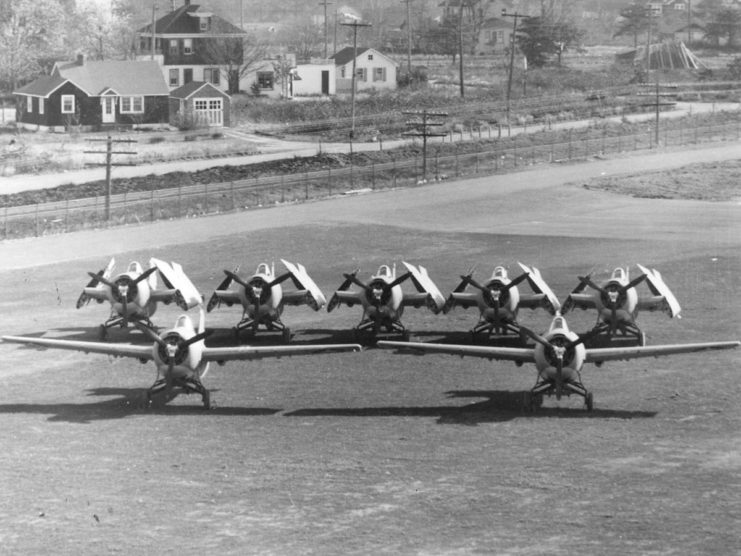
I figured I would do a post on a fighter that to my mind never really got it's accolades because she was overshadowed by her more powerful sibling the F6F Hellcat. I always liked the simple lines of the Wildcat, and in the hands of a good pilot, she could hold her own against the newer fighters that the Japanese had and she went toe to toe with the most feared Japanese fighter, the legendary "Zero".
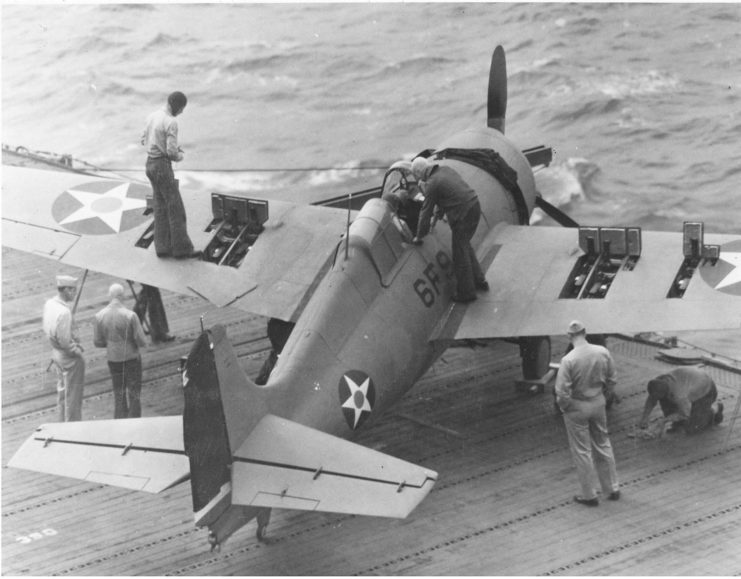
This is a prewar/early WWII version. The "Red" meatball in our national insignia was removed shortly after the war started. There was fear of target misidentification in the haze of combat since the Japanese used the "meatball" on their national insignia.
Despite its slightly odd origins, the Grumman F4F Wildcat was one of the most valuable fighter planes in the US arsenal of WWII.
Go to the Museum of Naval Aviation in Pensacola, they will let you "touch" the airplane...The museum is well worth the visit.
The design for the Wildcat started out as a biplane, as they were
still around for many years between the world wars. It was redesigned as
a monoplane in 1936, but retained many of the features of its previous
design, giving the Wildcat its distinctive, slightly squat look.
Another of the Wildcat’s visually distinctive features was its
entirely riveted fuselage. It gave it an industrial look that was at
odds with the canvas-covered planes of WWI. Welded or flattened rivets
were beginning to be used to make the planes of the 1930s and 40s more
aerodynamic.
The Arrestor hook shown lowered was to snag the Arrestor cable that was strung across the deck of the carrier to show the plane down and stop it before it crashed into the other airplanes that were in front of the carrier
The Wildcat was designed and commissioned as a carrier-borne fighter.
The relatively new and distinctive use of aircraft carriers was
increasingly important, as the world’s most powerful militaries started
to use air power for victory at sea. The limited space available for
taking off and landing and storage of planes on ships created new design
challenges. It meant a different sort of fighter was needed at sea.
Although the Wildcat would become a symbol of American air power, it
was first purchased by the French, who placed an order in early 1939.
Later that year, the US Navy followed suit. In August 1939, they placed their first order for F4Fs with Grumman.
XF4F-3 prototype Wildcat in flight, 21 July 1939.
With the fall of France, the F4Fs destined to join the French Navy
were diverted to Britain reaching Britain’s Fleet Air Arm in July 1940.
Like the Curtiss P-40, the F4F was given different nicknames by the
British and Americans. Most people remember it by its more dynamic
American name, the Wildcat. Initially known to the British as the
Martlet, in January 1944, they too adopted the Wildcat name.
The F4F packed quite a punch due to its extensive arsenal. It carried
six machine-guns in its wings and could also carry two bombs or six
rockets. Its firepower made it popular with the crews flying it.
Less popular with pilots was the F4F’s handling. It was considered a
tricky fighter to control both on the ground and in the air. For the
pilot who could master it, the F4F was well worth the effort, as it was
very maneuverable, a vital asset in the fast-moving action of dog
fights.
One of the main features of the F4F-4 were the Sto-Wing-design folding wings, a Grumman patented design.
The F4F had a maximum speed of 332 miles per hour. It was not one of
the fastest planes of the war, but neither was it the slowest.
The F4F could fly to around 34,700 feet, climbing at 2,000 feet per minute toward its top altitude.
The F4F was a tough plane to bring down. It had a self-sealing fuel
tank and armor plating that gave it greater endurance than many of its
opponents.
The self-sealing tank was particularly crucial to the survival of a
plane. Without it, a bullet through the fuel tank could turn it into a
fireball or force a plane to crash due to lack of fuel. Self-sealing
meant that it took a cannon shot to inflict such devastation.
Wildcat of VF-6 testing out machine guns aboard USS Enterprise, 10 April 1942.
The first Martlets in British service joined No.804 Squadron in the
Orkney Islands, north of Scotland. They were used to control routes from
the North Sea to the Atlantic. In December 1940, two Martlets shot down
a German plane, making them the first American-built, British-piloted
aircraft to do so in WWII
The first F4Fs to go to sea in wartime were Martlets of No.802 Squadron. Operating from on board HMS Audacity on September 20, 1941, they shot down a German Focke-Wolf 200 which was following their convoy.
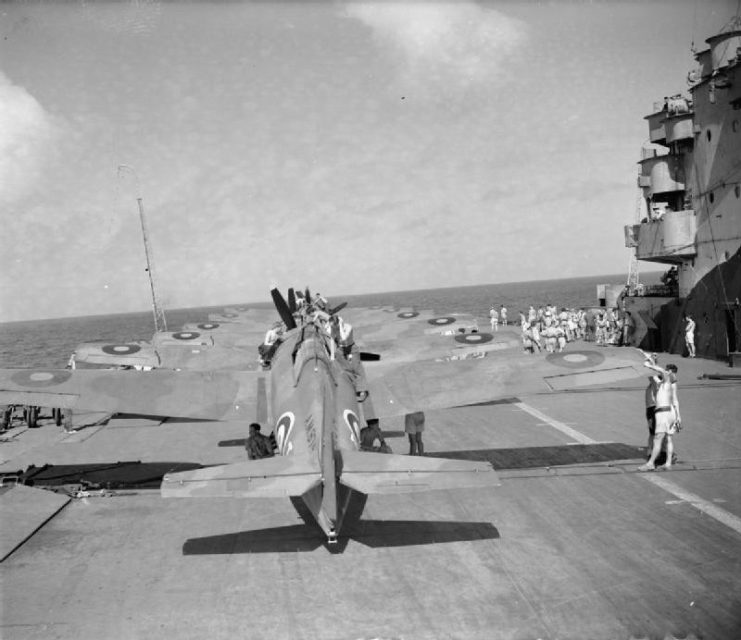
Martlet fighters on the flight deck of HMS Formidable, 1940s.
The F4F was involved in the extensive action in and around the
Mediterranean. The Royal Naval Fighter Unit deployed Martlets over the
Western Desert in Africa, where they fought Italian planes in the fall
of 1941. They tangled with the Italians again in August the
following year while escorting supply ships around Malta.
Further south, Martlets fought against Vichy French planes over Madagascar in May 1942.
By the time America joined the war in December 1941, the F4F was the
most common plane on American aircraft carriers. It was also popular
among US Marine Corps units based on land. Until the arrival of the
Hellcat in 1943, it was the US Navy’s only carrier-borne fighter. It
played a critical role in many of the Navy’s most important actions.
One of the most important land bases that Wildcats operated from was
Henderson Field on Guadalcanal. The site of the first offensive
operations of America’s Pacific war, it was where many Wildcat successes
occurred. One eight-plane flight achieved 72 aerial victories in the
space of only 16 weeks.
The leader of the group, Captain Joe Foss, was one of the most
successful pilots ever to get behind the controls of a Wildcat. During
the fighting at Guadalcanal, he destroyed 26 Japanese planes, five of
them in one day. For his remarkable achievements, he was awarded the
Congressional Medal of Honor.
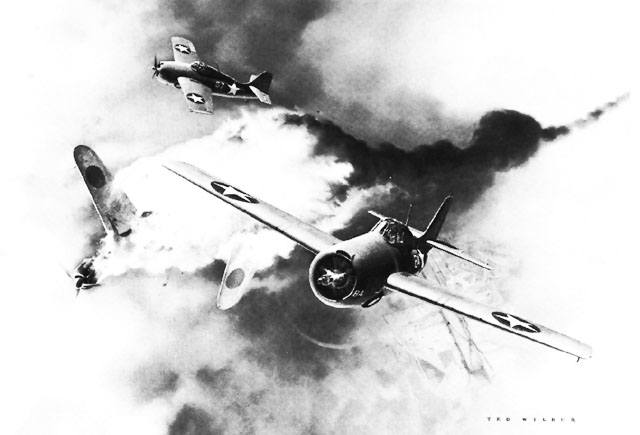
Watercolor of U.S. Marine Captain Joe Foss shooting down a Zero over Guadalcanal in October 1942.
Despite its many successes, the Wildcat struggled against Japanese
Zeros. The US Navy phased it out in favor of the F6F Hellcat in 1943.
Wildcats of Taffy 3 taking off to strafe the Japanese fleet attacking it, the Japanese fleet included the IJN Yamato, the largest battleship ever built. According to reports, the Japanese were stunned by the resistance and the Americans throwing themselves at the enemy with such abandon, the fighting spirit of the Americans forced the Japanese to withdraw thereby saving General McAuthur's beachhead in Leyte Gulf
The last Wildcat victory of the war took place over Norway in March
1945. Wildcats of the British No.822 Squadron shot down four German
Messerschmitt Bf109s
I have wondered about this for a long time, I even to this day can't understand this and I will explain. The U.S.S Pueblo is a Navy ship although an "auxiliary" I believe the term is called. I will give some background, the Pueblo was an intel gathering ship, all nations have them. I have heard of Soviet Trawlers that would shadow American fleet movements and gather intelligence
Soviet Navy Trawler "Fishing"
We played games with them, it was understood that there were rules to this game and the NORKS broke the rules when they seized the ship. I don't blame the Captain having to surrender, trying to save the lives of his crew after getting attacked by overwhelming NORK forces. They seize the ship and try the crew for "spying". What I can't understand is why didn't we bomb the ship, I remember when an American warship was captured by the Barbary pirates, a young lieutenant named Stephen Decatur and a sloop called the "Intrepid" sailed into the harbor and boarded the U.S.S. Philadelphia and tried to sail her away but were unable to so they destroyed the ship. I know that during the Cold war, we had submarines in the Berent sea and by the Kola Peninsula sneak into the Soviet harbors and tap the communications cables. and a bunch of other really sneaky stuff that still is classified to this day. What get me is why didn't we sneak into the harbor, either like the French DGSE did with the Rainbow Warrior and sink the ship rather than keep allowing it to be used as a propaganda trophy by the NORKS. I got this information of the Tripoli raid from "Wiki" Like I said, this is my opinion and not supported by any body else private or government.
On October 31, 1803, Philadelphia, under the command of Commodore William Bainbridge,
ran aground on an uncharted reef (known as Kaliusa reef) near Tripoli's
harbor. After desperate and failed attempts to refloat the ship she was
subsequently captured and her crew imprisoned by Tripolitan forces. In
an elaborate plan put together by Lieutenant Decatur, Decatur sailed for Tripoli with 80 volunteers (most of them being U.S. Marines) intending to enter the harbor with Intrepid without suspicion to board and set ablaze the frigate Philadelphia, denying its use to the corsairs. USS Syren, commanded by Lieutenant Charles Stewart, accompanied Intrepid to provide supporting fire during and after the assault. Before entering the harbor eight sailors from Syren boarded Intrepid, including Thomas Macdonough who had recently served aboard Philadelphia and knew the ship's layout intimately.
On February 16, 1804, at seven o'clock in the evening under the dim light of a waxing crescent moon, Intrepid
slowly sailed into Tripoli harbor. Decatur's vessel was made to look
like a common merchant ship from Malta and was outfitted with British colours. To further avoid suspicion, on board were five Sicilian volunteers including the pilot Salvador Catalano, who spoke Arabic. The boarding party remained hidden below in position, prepared to board the captured Philadelphia.
The men were divided into several groups, each assigned to secure given
areas of the ship, with the additional explicit instruction of
refraining from the use of firearms unless it proved absolutely
necessary.As Decatur's ship came closer to Philadelphia,
Catalano called out to the harbor personnel in Arabic that their ship
had lost its anchors during a recent storm and was seeking refuge at
Tripoli for repairs. By 9:30 p.m. Decatur's ship was within 200 yards of Philadelphia, whose lower yards
were now resting on the deck with her foremast missing, as Bainbridge
had ordered it cut away and had also jettisoned some of her guns in a
futile effort to refloat the ship by lightening her load.
As Decatur approached the berthed Philadelphia he encountered a light wind that made his approach tedious. He had to casually position his ship close enough to Philadelphia
to allow his men to board while not creating any suspicion. When the
two vessels were finally close enough, Catalano obtained permission for
Decatur to tie Intrepid to the captured Philadelphia.
Decatur surprised the few Tripolitans on board when he shouted the order
"board!", signaling to the hidden crew below to emerge and storm the
captured ship.Without losing a single man, Decatur and 60 of his men, dressed as
Maltese sailors or Arab seamen and armed with swords and boarding pikes, boarded and reclaimed Philadelphia
in less than 10 minutes, killing at least 20 of the Tripolitan crew,
capturing one wounded crewman, and forcing the rest to flee by jumping
overboard. Only one of Decatur's men was slightly wounded by a saber
blade. There was hope that the small boarding crew could launch the
captured ship, but the vessel was in no condition to set sail for the
open sea. Decatur soon realized that the small Intrepid could not
tow the larger and heavier warship out of the harbor. Commodore
Preble's order to Decatur was to destroy the ship where she berthed as a
last resort, if Philadelphia was unseaworthy. With the ship secure, Decatur's crew began placing combustibles about Philadelphia
with orders to set her ablaze. After making sure the fire was large
enough to sustain itself, Decatur ordered his men to abandon the ship
and was the last man to leave Philadelphia. As the flames intensified, the guns aboard Philadelphia,
all loaded and ready for battle, became heated and began discharging,
some firing into the town and shore batteries, while the ropes securing
the ship burned off, allowing the vessel to drift into the rocks at the
western entrance of the harbor.
While Intrepid was under fire from the Tripolitans who were now gathering along the shore and in small boats, the larger Syren
was nearby providing covering fire at the Tripolitan shore batteries
and gunboats. Decatur and his men left the burning vessel in Tripoli's
harbor and set sail for the open sea, barely escaping in the confusion.
With the cover of night helping to obscure the enemy gunfire, Intrepid and Syren made their way back to Syracuse, arriving February 18. After learning of Decatur's daring capture and destruction of Philadelphia without suffering a single fatality, British Vice Admiral Lord Horatio Nelson, who at the time was blockading the French port at Toulon, claimed that it was "the most bold and daring act of the Age." Decatur's daring and successful burning of Philadelphia made him an immediate national hero in the US.Appreciation for the efforts of Preble and Decatur were not limited to their peers and countrymen. At Naples, Decatur was praised and dubbed "Terror of the Foe" by the local media. Upon hearing the news of their victory in Tripoli, Pope Pius VII
publicly declared that "the United States, though in their infancy, had
done more to humble and humiliate the anti-Christian barbarians on the
African coast in one night than all the European states had done for a
long period of time." Upon his return to Syracuse, Decatur resumed command of Enterprise.
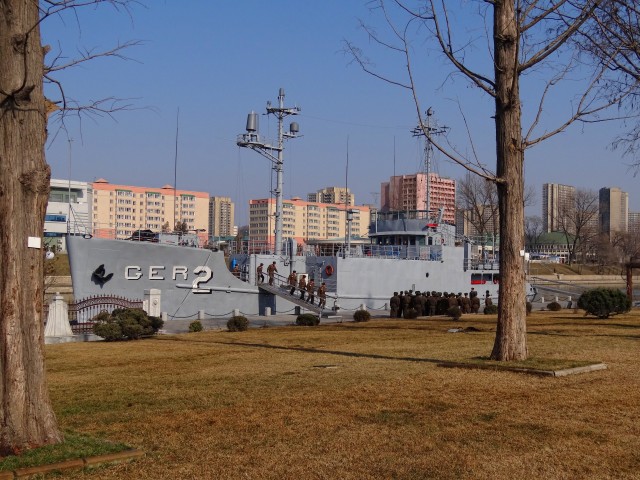
In Pyongyang, the North Korean Government keeps a trophy from 1968.
Moored on the Botong River, alongside the Pyongyang Victorious War
Museum sits the USS Pueblo (AGER-2).
It’s the second oldest still-commissioned U.S. Navy ship, and the only one held captive by another country.
The incident when North Korea seized the Pueblo along with her 83 crew members, killing one of them and wounding many others, occurred on January 23rd,
1968, a week before the start of the Tet Offensive in Vietnam. U.S.
officials believed at the time that the North Koreans were acting upon
instructions from the USSR (though this was confirmed to be untrue years
later) and Cold War tensions were raised to one of the highest levels
since the Cuban Missile Crisis a little more than five years earlier.
The crew was held for 11 months of negotiations between the U.S. and
North Korea and were starved and tortured while in captivity. Many
people reading this are probably not old enough to remember events like
the Cuban Missile Crisis or even the Iran Hostage Crisis (1979-81).
For those who are too young, to give a sense of the intensity and
fear in this situation, keep in mind that President Lyndon B. Johnson
had officials advising him to demand the immediate return of the
hostages from North Korea under threat of Nuclear Attack.
The USS Pueblo in Pyongyang, on display as a floating museum since 2013. By Bjørn Christian Tørrissen –
Doomsday might not have been as close at it was when Russian ships
drew closer and closer to the U.S. blockade around Cuba, but nervous
hands wrung around fingers that were keeping that button squarely in
mind.
The Pueblo wasn’t exactly taking a leisurely cruise around
waters East of North Korea. It was a U.S. Auxiliary General
Environmental Research (AGER) vessel under a program conducted by the
Naval Security Group and the National Security Agency. Lead by Commander
Lloyd M. Bucher, the Pueblo’s crew was there to gather intelligence and signal data from North Korea.
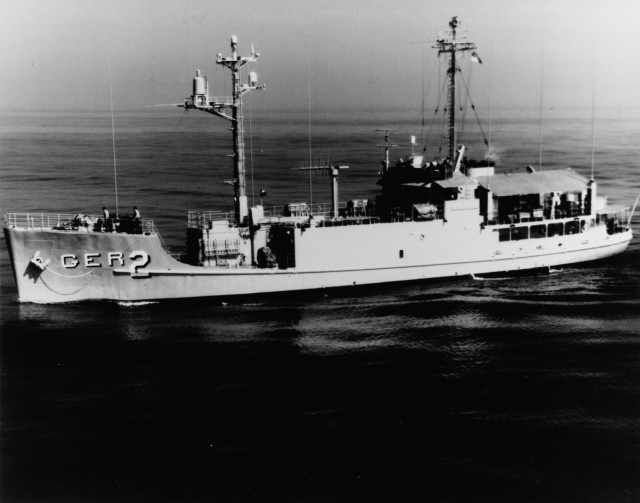
The USS Pueblo in 1967.
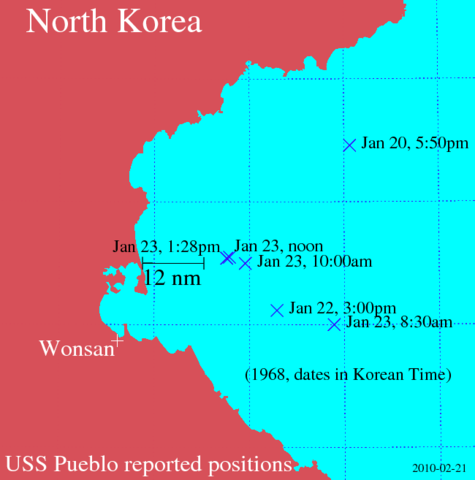
According to U.S. officials, the commander and crew of the Pueblo, and Navy records, the Pueblo was 15.4 nautical miles off the Korean shore on January 20th,
when a North Korean submarine chaser passed nearby. Two days later,
they were again passed, this time by two North Korean fishing trawlers.
Vital to understanding the tensions surrounding this incident is the
failed assassination attempt on South Korean President Park Chung-hee on
the 22nd, of which the crew of Pueblo was not
informed. Thirty-one North Koreans slipped over the border and tried to
infiltrate the “Blue House” where the president resided, but were
thwarted.
The next day, the 23rd, Pueblo was approached by another North Korean submarine chaser whose officers challenged Pueblo’s nationality. When the Pueblo’s U.S. flag was raised, she was ordered to stand down or be fired upon.
North Korean charts depicting their assertions about the Pueblo’s movements.
Commander Bucher tried to maneuver the ship away, in an effort to buy
time for help from other U.S. forces and to destroy sensitive
information held on the ship. The ship was slow, however, and the North
Korean vessel was soon joined by others and MiG-21 fighters. Help never
came.
Though the Pueblo had some light weaponry, Bucher knew a
firefight wasn’t an option, that time was their greatest hope. According
to the Operations Officer of the Pueblo, Skip Schumacher, this was the matchup: “The PUEBLO
had no armor protection whatsoever; its armaments consisted of 10
Browning semi-automatic rifles, a handful of .45 caliber pistols and two
.50 caliber machine guns wrapped in frozen tarps on the starboard and
aft rails. With these tools it was asked to fend off 4 torpedo boats, 2
submarine chasers and MiG jet aircraft. Not very good odds”
As the Pueblo tried to flee, she was fired upon, without so
much as a warning shot. One crewman was killed and 18 injured in the
attack. Bucher broke off the run and surrendered to save the rest of his
crew.
Schumacher also describes a startling realization of the ship’s
vulnerability and the huge game-changer that this incident was as the
North Koreans broke the de-facto rules of the cat-and-mouse,
push-and-pull spy game that existed at the time and opened a chapter of
full-out aggressive action.
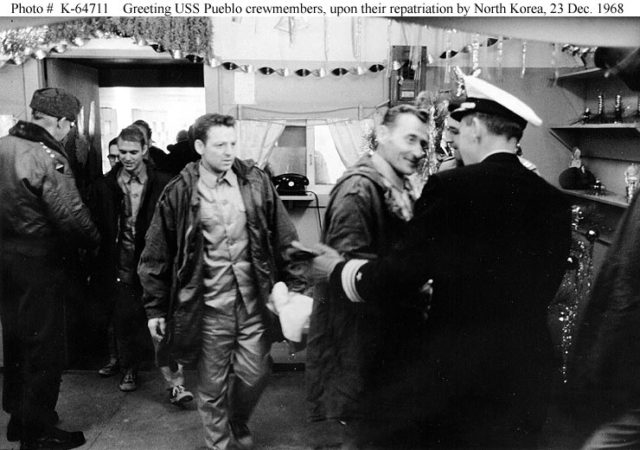
Crew of USS Pueblo upon release on 23 December 1968.
Though the Pueblo always stayed outside the 12 nautical mile
border that International Law claims separates national sovereignty
from international waters, the North Koreans insisted (and do to this
day) that their sovereignty extends to 50 nautical miles and that Pueblo was in violation of this. Nevertheless, it was only after Bucher capitulated and the Pueblo
was escorted to within that 12 miles, that she was boarded by a slew of
high-ranking North Korean officials and the crew was taken into
custody.
The North Korean regime, then as now, leaned heavily on their
propaganda machine to instill their rule in the minds of their people
and other nations. As they were forced to pose in photographs for this
propaganda, the Americans, shot after shot, posed flipping their middle
fingers, telling their captors at the time that it was a Hawaiian good
luck gesture. When the North Koreans found out the true meaning of their
mockery, the torture and starvation of the crew were increased.
Through the almost year-long imprisonment of the crew, slow,
agitating negotiations were held between North Korean and U.S. officials
at Panmunjom, the village where the armistice ending the full-out
conflict of the Korean War was signed in 1953. Cultural and ideological
differences made, what we would call in the West, decent compromise
impossible.
Reported positions of USS Pueblo.
There was added pressure from the South Koreans who were furious with
the Americans for focusing more on their captive crew than on the
blatant and brazen assassination attempt on January 22nd.
They insisted on being a part of the negotiations. Anger and hostility
between the North and South were approaching boiling point, with the
U.S. in a very difficult position.
In the end, U.S. Army Major General Gilbert H. Woodward signed a full apology for the Pueblo
spying on their nation and a promise that it wouldn’t happen again, and
the North Koreans bussed the 82 remaining crew to the DMZ and handed
them over. The apology and promise were hastily retracted.
In the following years, the commander and crew of the Pueblo
were spared a court-marshal, with Secretary of the Navy John Chafee
stating that the crew had been through enough. The North Koreans and
Soviets were able to reverse-engineer the Pueblo’s communication devices, which gave them great insight into the communication of the U.S. Navy until the late 1980s.
The crew also had to wait until 1990 before their almost year-long
ordeal was official recognized by the U.S. government and awards were
given.
I got the idea after reading this article from this Website. I will add my personal opinions and what has happened since then. I remembered being a little kid during the Vietnam War, My dad did 2 tours, in 1968 and 1972 and I remembered the hippies and other leftist spitting on my Dad when he came back in 72. I also remember the societal pressure about wearing uniforms, like it was something to be scorned. I grew up on Military posts and even we were not immune to the culture war that the left had waged on the GI's. I remembered the TV shows and they always showed the military as corrupt, inept and one step above the Keystone Cops. As I got older, I remembered my dad watching the TV as South Vietnam fell and I didn't understand the funk he was in for quite a long time. I also remembered shortly after that in kid years the Axe Murders in Korea. I also started hearing the term "Hollow Army". I didn't ask my dad about it because anytime I asked him about the Army, I got a lot of static and I didn't bother him and so I never really asked. I found out later what it was. The late 70's was a bad time to be in the service, the institution wasn't respected by the country that it was tasked to defend. I remembered the humiliation that we felt when the Iranians seized our embassy and we couldn't do anything about it and the resulting debacle at Desert One and the shame we felt as a nation. It felt like we were going nowhere as a country except more humiliation as the Soviet Union became more aggressive.
In 1980 Ronald Reagan was elected and he expressed open pride in the United States and he immediately pushed through several large budget increases to bring the services back up to bar after years of neglect after the Vietnam war. We had gone to a volunteer service, not drafted and the pay was increased after several public embarrassments of servicemen having to be on food stamps to support their families because the pay and benefits were so bad. By the mid 1980's the service were flush with funds for training, equipment and confidence. Grenada was a positive boost to our morale despite all the problems that were uncovered. I joined in 1985 and went to basic in Fort Lost in the Woods in Misery.(Fort Leonard Woods in Missouri). I remembered hearing about the "fragging" and other disciplinary issues the Army was having at the tail end of Vietnam and the aftermath. My dad was an MP his first tour in Vietnam and was "El CID" the tour in 1972 He did talk about that kind of stuff with his fellow Soldiers, I was a little kid but I did hang around and listen. While I was in basic, they covered in great detail what would happen if we disobeyed the UCMJ and we would be in Leavenworth making gravel for the Colonels driveway. I remembered wondering when I went in would I see the same kind of stuff in the service that I remembered reading about and remembering what my dad talked about. It was a totally different environment than I expected, total professionalism, we trained hard and had excellent morale. This was reinforced when I got sent to Germany to the Stuttgart area. We expected the Soviets to run through the Fulda gap like cockroaches in New York Apartment.
I spent a lot of time inside the 1KM zone during my first tour and the Officers and NCO's were top notch, we trained really hard and we were implementing the new "Airland" battle that the Army was rolling out to disrupt the Soviet echelons if they attacked.
We trained hard for an attack that never came, the Soviet Union collapsed due to economic problems. We tested our tactics and procedures on the Iraqi's as we evicted them out of Kuwait and punished them. Iraq had the distinction of having rotten timing, if they had waited a couple of years then grabbed Kuwait, we may not have been able to do "Desert Storm". After the Soviet Union basically collapsed, the Military was under a lot of pressure to cut back the force for the "Peace dividend" that the politicians were expected to spend on social projects. I and many of my fellow soldiers got sent to the Gulf and we completed the mission. After I got out, I went from job to job, my Military Occupational Specialty had no civilian counterpart. In finally settled down and got married and got hired by Ford Motor Company, and I was in a store looking at books and ran across this one and bought it.
You can buy your own copy off Amazon, it is very good.
I bought this book and read it, and it totally engrossed me, it explained how the Officers that won in the desert what their experiences were, how their peers transformed a shattered military with non existent morale and worn out equipment changed the culture, mindset and ultimately changed how we fight. The book talked about how America changed and this reflected in the quality of men and women that were enlisting and decided to serve.
This were a couple of the reviews of the book.
Freelance journalist Kitfield relies heavily on personal accounts
in this story of the officers who reshaped the U.S. Army and Air Force
after the experience of Vietnam and then led our troops in Operation
Desert Storm. In the 1970s the U.S. began to adjust to a professional
military after depending on the Selective Service system. In the 1980s,
increased defense budgets enabled the modernization of arsenals and the
stockpiling of supplies and equipment, while cumbersome higher command
systems were simplified. By the time of Iraq's invasion of Kuwait in
1990, America's military leaders were eager to demonstrate what 20 years
of reform had wrought. This is a highly favorable account of that
effort.
Copyright 1994 Reed Business Information, Inc.
From Library Journal
The transformation of the American armed forces from the
dispirited shell-shocked military at the close of the Vietnam era to the
superbly trained, highly motivated, and universally respected victors
in the Persian Gulf War is as dramatic a tale as any in American
military history. Kitfield, an award-winning journalist on defense
issues, follows the careers of dozens of army, navy, air force, and
marine officers from their early service years in Vietnam to their
success as commanders in the defeat of the Iraqis. While organizational
and technical issues play a role, the book concentrates on the human
aspect of this startling redirection of the U.S. military. A useful
supplement to Michael Gordon's The Generals' War (LJ 12/94) and Al
Santoli's overlooked Leading the Way (LJ 9/15/93), this is an essential
addition to Vietnam and Persian Gulf War collections. Strongly
recommended for academic and public libraries.
As we draw down after the Wars in Iraq and still fighting the war in Afghanistan, we have had no incidence of "fragging" that I am aware of. I do know that a muslim soldier shot up a tent full of officers right before the invasion of Iraq in 2003, other than that I am not aware of any. I get into arguments that state that we need to "bring back the Draft". I say "NO", You get a far better quality of recruit when people volunteer vs getting drafted. This helps a lot with mindset and discipline, you get far less resentment and hostility from someone that enlisted vs getting told to "Report or else".
I ran across this article and I really liked it so I snagged it.
During its long withdrawal from South Vietnam, the U.S. military
experienced a serious crisis in morale. Chronic indiscipline, illegal
drug use, and racial militancy all contributed to trouble within the
ranks. But most chilling of all was the advent of a new phenomenon:
large numbers of young enlisted men turning their weapons on their
superiors.
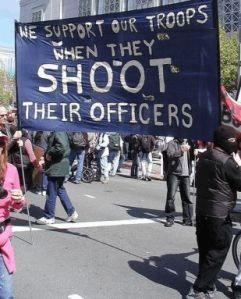
The Vietnam War was one of the least popular in American history. It
was also the least “popular” with the GI’s who were sent to fight it. By
the late 1960’s, news of GI unrest was being carried on TV and in
newspapers around the country and Vietnam vets were speaking at anti-war
demonstrations.
But word of the GI resistance in Vietnam itself trickled back more
slowly – the soldiers flashing peace signs and Black Power salutes, the
group refusals to fight, anti-war petitions and demonstrations, and even
the fragging of officers. What we’ve read in the newspapers, however,
has just been bits and pieces. Seldom have we had a chance to hear the
whole story from the GI’s themselves.
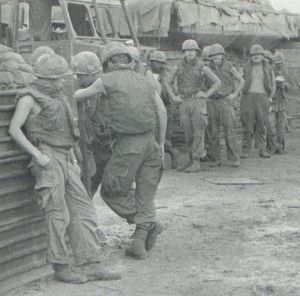
These battle weary troops from the 1st Air Cav. had just staged a “combat refusal” at Firebase Pace.
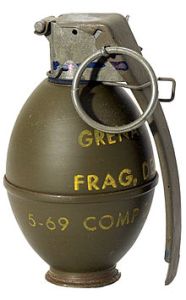
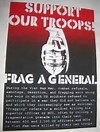
The dictionary defines “fragging” as the term used to describe the
deliberate killing or attempted killing by a soldier of a fellow
soldier, usually a superior officer or non-commissioned officer (NCO).
Fragging often consisted of throwing a grenade into a tent where the
target was sleeping or in the shitters. The word was coined by U.S.
military personnel during the Vietnam War when such killings were most
often attempted with a fragmentation grenade, sometimes making it appear as though the killing was accidental or during combat with the enemy.
The high number of fragging incidents in the latter years of the
Vietnam War was symptomatic of the unpopularity of the war with the
American public and the breakdown of discipline in the U.S. Armed
Forces. Documented and suspected fragging incidents totaled nearly eight
hundred from 1969 to 1972; resulting in 86 deaths and 714 injuries. In
1971, army testimony before Congress cited the following: 126 incidents
in 1969, 271 in 1970, and 333 in 1971. I couldn’t find a count for
1972, but it’s unlikely fragging suddenly ceased. So why purposely try to kill a soldier with a higher rank?
Most fragging was perpetrated by enlisted men against leaders.
Enlisted men, in the words of one company commander, “feared they would
get stuck with a lieutenant or platoon sergeant who would want to carry
out all kinds of crazy ‘John Wayne’ tactics, who would use their lives
in an effort to win the war single-handedly, win the big medal, and get
his picture in the hometown paper.” Harassment of subordinates by a
superior was another frequent motive. The stereotypical fragging
incident was of “an aggressive career officer being assaulted by
disillusioned subordinates.” Several fragging incidents resulted from
alleged racism between African American and white soldiers. Attempts by
officers to control drug use caused others. Most known fragging
incidents were carried out by soldiers in support units rather than
soldiers in combat units.
Soldiers sometimes used non-lethal smoke and tear-gas grenades to
warn superiors that they were in danger of being fragged if they did not
change their behavior. A few instances occurred—and many more were
rumored—in which enlisted men collected “bounties” on particular
officers or non-commissioned officers to reward soldiers for fragging
them.
In short, for all the tales of soldiers assaulting gung-ho officers
they feared would get them killed, a more likely explanation is that
fragging was the work of rear-echelon misfits with anger management and
substance issues who sulked after getting chewed out and decided to have
their revenge. The nature of the war as such likely contributed only
indirectly — its unpopularity discouraged enlistment and compelled the
military to accept more trouble-prone recruits. The prevalence of drugs
couldn’t have helped either — one study of soldiers returning from
Vietnam found one-fifth had been addicted to narcotics.
Contrary to Hollywood’s take on Vietnam, most of the drug and
discipline problems were in rear echelon bases – not in the bush. The
combat units largely remained cohesive. Boredom, poor morale and lack of
discipline were a combustible mix. For fear of being fragged some
leaders turned a blind eye to drug use and other indiscipline among the
men in their charge.
After the Tet Offensive in January and February 1968, the Vietnam War
became increasingly unpopular in the United States and among American
soldiers in Vietnam, many of them conscripts. Secondly, racial tensions
between white and African-American soldiers and marines increased after
the assassination of Martin Luther King in April 1968. With soldiers
reluctant to risk their lives in what was perceived as a lost war,
fragging was seen by some enlisted men “as the most effective way to
discourage their superiors from showing enthusiasm for combat.”
On the evening of October 22, 1970, Company L of the 3rd Battalion,
1st Marine Regiment was engaged in anti-infiltration operations in the
“Rocket Belt,” an area of more than 500 square kilometers ringing the Da
Nang Airbase. The company was set up in bunkers at an outpost on Hill
190, to the west of Da Nang. Assigned to guard duty that night, Private
Gary A. Hendricks settled into his position on the perimeter and made
himself comfortable. Too comfortable, it turned out. A bit later, when
Sergeant Richard L. Tate, the sergeant of the guard, discovered
Hendricks sleeping on post, he gave the private a tongue lashing but
took no further action. Shortly after midnight the next day, Hendricks
tossed a fragmentation grenade into the air vent of Sergeant Tate’s
bunker. The grenade landed on Tate’s stomach and the subsequent blast
blew his legs off, killing the father of three from Asheville, North
Carolina, who had only three weeks left on his tour of duty. The
explosion injured two other sergeants who were also in the bunker.
Journalist Eugene Linden, in a 1972 Saturday Review article,
described the practice of “bounty hunting” whereby enlisted men pooled
their money to be paid out to a soldier who killed an officer or
sergeant they considered dangerous. One well-known example of bounty
hunting came out of the infamous Battle of Dong Ap Bai, aka Hamburger
Hill, in May 1969. After suffering more than 400 casualties over 10
merciless days of attacks to take the hill, the 101st Airborne Division
soldiers were ordered to withdraw about a week later. Shortly
thereafter, the army underground newspaper in Vietnam, GI Says,
reportedly offered a $10,000 bounty on the very aggressive officer who
led the attacks, Lt. Col. Weldon Honeycutt. Several unsuccessful
attempts were reported to have been made on the colonel’s life.
In April 1971, Democratic leader Mike Mansfield of Montana
emotionally spoke to the issue on the floor of the Senate. Mansfield
related details of the death of 1st Lt. Thomas A. Dellwo, of Choteau,
Mont. “He was not a victim of combat. He was not a casualty of a
helicopter crash or a jeep accident. In the early morning hours of March
15, the first lieutenant from Montana was ‘fragged’ as he lay sleeping
in his billet at Bien Hoa. Lt. Richard Harlan was also killed in the
incident. He was murdered by a fellow serviceman, an American
GI. Private E-2 Billy Dean Smith was charged with killing the officers
but was acquitted in November 1972.
On 21 April 1969, a grenade was thrown into the company office of K
Company, 9th Marines, at Quảng Trị Combat Base, RVN; First Lieutenant
Robert T. Rohweller died of wounds he received in the explosion. Private
Reginald F. Smith pleaded guilty to the premeditated murder of
Rohweller and was sentenced to 40 years’ imprisonment; he died in
custody on 25 June 1982.
Why use a grenade?
If you shoot someone, there’s a lot of more forensic evidence. And
the Army is pretty fanatical about keeping track of ammunition. A bullet
can be traced to a particular lot number or a particular gun. You can’t
associate a grenade firing pin with a particular grenade.
With a grenade, it splinters
into thousands of tiny fragments. Trying to piece that together, there’s
no way you’re going to get evidence off of that. Avoiding getting
fingerprints on the spoon [the lever on a grenade that is held down to
prevent it from going off] is pretty easy — just don’t touch the spoon
with the tip of your finger.
Also, with a gun, you have to
be there to shoot it. Whereas with a grenade, you have a certain amount
of lead time. You could set it up as a booby trap if you wanted to, with
a trip wire, or set it against a piece of furniture. There are many
more ways you can make a grenade deadly that you can’t make a gun.
In Vietnam, it was really not
that hard to get your hands on grenades. There were lax standards, which
meant that there were crates of grenades available. You’d make your
stop by the ammunition bunker, and platoon members could grab a couple
or as many as they thought they needed.
Here’s an example of a shooting in a base camp: Sp4 Enoch ‘Doc’
Hampton, an African American soldier, was respected and well-liked by
his fellow soldiers, he was top notch and knew how to take care of them
in the field. The First Sergeant, Clarence Lowder, whom they called “Top
did everything by the book. When on stand down at the basecamp, Top
continuously harassed Doc for the length of his ‘picked out’ hair,
threatening Article 15’s if he didn’t immediately get his hair cut. That
night at chow, Doc Hampton said he was going to the orderly room to see
the First Sgt. “Either I’ll come out alone,” he said, “or neither of us
is coming out.”
Hanusey, the clerk, was working in the orderly room when Doc came
through the doorway. “His face was cold, stone cold,” Hanusey said. “He
looked like a man in the movies who was about to kill.” The barrel of
Doc’s M-16 was pointed downward, his feet planted firmly apart. Slowly
he raised the barrel and fired a full clip into Top. The sergeant’s back
exploded as pieces of flesh and blood spattered all over the orderly
room. Then Doc walked out and headed to the company latrine where he
barricaded himself for a possible shoot-out with arriving MP’s.
Surprisingly, his fellow soldiers also armed themselves and quickly
formed a perimeter around the latrine to protect their brother in arms
and preventing the MP’s from reaching Doc. The siege was short-lived
when a single shot sounded from the latrine…Enoch ‘Doc’ Hampton took his
own life.
How many soldiers were arrested for fragging?
Only a few ‘fraggers’ were identified and prosecuted. It was often
difficult to distinguish between fragging and enemy action. A grenade
thrown into a foxhole or tent could be a fragging, or the action of an
enemy infiltrator or saboteur. Enlisted men were often close-mouthed in
fragging investigations, refusing to inform on their colleagues out of
fear or solidarity. Only about 10 percent of all fragging incidents
actually ended up being adjudicated. Although the sentences prescribed
for fragging were severe, the few men convicted often served fairly
brief prison sentences.
For every actual fragging incident, there was an untold number of
threats of fragging. These threats were made in various forms, such as
the surreptitious placement of a grenade or grenade pin, or perhaps the
detonation of a nonlethal gas or smoke grenade, in the potential
victim’s quarters or work areas. Officers who survived fragging attempts
often did not discover the identity of their attackers, and as a
consequence they lived in constant fear the attacks would be
repeated. According to Captain Barry Steinberg, an Army judge who
presided over a number of fragging courts-martial, once an officer had
been threatened with fragging, he was intimidated to the point of being
“useless to the military because he can no longer carry out orders
essential to the functioning of the Army.”
Twenty-eight
soldiers were arrested in Vietnam and tried for fragging a superior
officer. Ten were convicted of murder and served sentences ranging from
ten months to thirty years with a mean prison time of about nine years.
In summary, eighty percent of the murders happened at base camps, not
in the field; (b) 90 percent of the assaults took place within three
days after an argument with the victim; (c) offenders typically felt
they had been unfairly treated; (d) 88 percent of attackers were drunk
or high when they did it; (e) on average they had been in Vietnam for
six months; (f) 26 of the 28 were volunteers, not draftees; (g) only
five had graduated from high school; and (h) many were loners or had
psychological problems.
But since the start of the wars in Iraq and Afghanistan, the military
has charged only one Soldier with killing his commanding officer, a
dramatic turnabout that most experts attribute to the all-volunteer
military.