Webster

The Constitution was made to guard the people against the dangers of good intentions." --American Statesman Daniel Webster (1782-1852)


Wednesday, March 11, 2020

Two U.S.Soldiers meet somewhere in the Twilight zone...

I was reading Quora and ran across this and I thought it was very neat.  I didn't write this, I wish I had, I considered it very well done.   The Pics are compliments of "google"


Two US Soldiers meet along a drizzly road somewhere in the Twilight Zone. One is the point man for his Airborne Infantry Platoon from the 82nd Airborne recently dropped in mid-September of 1944 near Nijmegen. The other is the point man for an Airborne Infantry Platoon patrolling among the mountains of Afghanistan in January 2020.
“Halt! Who goes there?” the man in plain herringbone fatigues hissed, raising his Garand to his shoulder and aiming at the man appearing from the fog.
The man in the fog paused, barely able to make out the other man. “Specialist Smith, Third Brigade Combat Team, 82nd Airborne.”
“Advanced to be recognized!” the other man said.
Specialist Smith walked forward out of the fog.
“Whoa!” the other man said, recognizing a green-and-black version of his own unit patch and the US flag, but not the pattern of uniform, helmet, or weapon.
Specialist Smith did his own double-take.
“Jesus, man, why are you still wearing your life-preserver? What sort of rank is specialist?”
“Life preserver? What? Uh… Interceptor Armor. It’s… “ Specialist Smith said, confused for a second. He recognized the uniform and the unit marking the other man wore, but still couldn’t figure out why he was there. “Specialist… It’s a rank between PFC and Sergeant.”
“What? That’s a Corporal.”
“Well, sort of. A Corporal is an NCO, a Specialist… gets the same pay, but not the authority. Like Technicians.” Smith said, remembering reading about Technician Grades.
“You’re not from the 505th.”
“508th Parachute Infantry. 3rd Brigade Combat Team.”
“Why don’t you guys have the same ranks?”
“I hate to tell you this, but you’re wearing a uniform from a long, long time ago, from where I stand.”
“What?”


“It’s 2020. This is Afghanistan. The rest of my unit is just down the hill from here.”
“Bullshit. It’s ‘44… NINETEEN forty four and…” the man in herringbone fatigues started. He paused when he looked behind and around him and noticed he couldn’t see the trees. “This is Germany… Or it was.”
He looked at his companion a little closer. His helmet looked off, he’d never seen that particular camouflage pattern before, but he could hear the slight southern twang in Specialist Smith’s voice that meant he wasn’t a German…
“Sprechen Sie Duetsh?” he asked.
“Ein bisschen” Specialist Smith said.
The man in fatigues raised his rifle again.
“Hey! I speak a little German. My grandmother’s German. Grandpa married her while he was stationed in Germany in the ‘70’s.” Specialist Smith said, raising his hand in a stopping gesture. “You’re literally from World War Two, aren’t you?”
Both men looked at each other for a long moment.
“We beat the Germans, right?”
“Most definitely. Unlike last time though, the Russians take the Eastern half of Europe and turn them Communist though. The US stations divisions in Europe, Germany mostly, until, well, today. A lot of soldiers come back from Germany with German wives. My grandpa just happened to be one of them.”
“Really? Do we fight the Russians too?”
“Not exactly directly. Turns into a proxy war for 40 or 50 years, but we win eventually when they economically collapse.”
“Why didn’t we…?”
“Ummm… there’s this weapon they come up with in… when are you from?”
“1944.”
“A year from when you’re from. It’s a big, nasty bomb that blows up cities… and the Russians end up figuring them out pretty quick too. So we avoid going to war with them directly. Still doesn’t keep them from raising a massive Red Army in East Germany and the rest of Eastern Europe.”
The old soldier looked skeptical.
“The good news is that after we kicked the Nazi’s out, the Germans haven’t invaded anyone since World War 2 or fought on the other side from us ever.”
“Is there a World War 3?”
“Not so much. Just a bunch of drag-on regional wars.”
“We beat the Japs?”
“Yeah. That bomb I mentioned… total gut punch to them after we drop two on them. Didn’t even have to invade Japan.”
“Don’t tell me, 70 years later we have divisions there too…”
“No… Well, Navy Carriers are based out of Japan and the Marines have a base in Okinawa.”
“Do we fight the Japs again?”
“Nope. Two nukes and they turn first-world pacifist and American ally for 70 years.”
“At least there’s that.”
“We lose any wars?”
“Couple of draws. One place—Korea—is still technically a war, but no one’s fired a shot since the 1950’s. Another place… Vietnam… was just weird.”
“Okay, Korea I heard about. Vietnam?”
“Um… French Indochina in your day. Southeast Asia. Right now, the Vietnamese—part of French Indochina—are fighting the Japanese. After the war, World War 2, the French go back in and try to play empire and the Vietnamese keep on fighting. Half the country becomes Communist and we end up trying to keep them from taking over the South and we do for almost 10 years.”
“Then what?”
“The politicians decide to pull US troops out and the North Vietnamese come in and take over in two years or so.”
“Oh.”
“Guerilla war. Not like the one you fought in. My other grandfather was Vietnam vet. They would go out, win, but it was nothing but farmland and jungle, so they’d pull back and the Vietnamese would just roll back in. Nothing to hold and couldn’t kill them all.”
“Still drafting people, huh?”
“Nope, got rid of that after Vietnam. Military’s all volunteer now. I just… it just seems like a family business at this point. One grandfather did a couple of tours in Vietnam, another was career Cavalry, I have uncles and brothers in the Marines.”
“Wow. I can’t imagine wanting to be…”
“It’s a service thing. I’ve got a little guy at home with the wife right now. When I see him on Skype sometimes, I don’t know if I would ever want him to be a soldier.”
“Skype?”
“I… uh… how do I… Um… you know what television is, right?”
“I seen one.”
“Moving pictures on a screen, right?”
“Yeah.”
“So, almost everyone has a screen now that’s portable and you can connect to other people with it sometimes. So when we’re back in base, I can connect mine to my wife’s at home and I can see my little guy.”
“That’s kinda’ sharp. Some people at home I’d love to see.”
“Actually, see and hear. It’s got sound.”
“No shit, it’s television.” the older man said and they both laughed. “Still, what is this get-up you’re wearing? Looks like the Mae Wests we were issued for the big jump in June?”
“Oh, it’s body armor. It’s got plates in it that’ll stop rifle fire.”
“Must be some armor.”
“It is. Hurts like a sonofabitch when it does. Takes the wind out of you.”
“Better than dying though.
“Most definitely better than dying.”
“What kind of rifle you got?”
Specialist Smith looked around. There still was nothing but fog, but it felt… somewhere different than Afghanistan. He pulled the magazine out, pulled the charging handle to the rear, locked the bolt back, and handed it to the other man.
The other man put his arm through the sling on his own Garand, hanging it from his shoulder before taking the other man’s carbine.
“It’s an M4 Carbine. Smaller caliber, a .223 caliber bullet.” Smith said, picking the ejected round up off the road and holding it up. “Shoots flat and fast. Pretty good at short range, but we have to use some heavier guns for long range.”
“What’s this… oh… it’s a scope.” the old man said, looking through it at the fog. “Not too heavy.” He looked at the front behind the sight where a boxy device was clasped to the rails. “What’s this?”
“Oh, it’s an aiming light.” Specialist Smith reached into a pouch and pulled out his night vision goggles. “These are night vision goggles. They take what little bit of light there is in the dark and amplify it. These clip to my helmet like this.” He said, clipping them to the mount on the front of his helmet. “That box has a special light on it that I can see with these goggles and lets me aim in the dark without someone else able to see it.”
“Damn. That’s a good idea.” the old man said. “I guess they probably would have a lot of new things in the future.”
“Yeah, and some of the same problems too.” Specialist Smith said, unclipping his NODs. and putting them away. “Stuff still weighs a ton and you got to haul it around on your back.”
Both men shared a laugh.
The fog seemed to be thinner now. Both men’s head were on swivels, remembering where they had been.
Specialist Smith held out his hand for his carbine.
The old soldier looked at it with a slightly jealous leer. “Sure you need this?”
Specialist Smith nodded and the old soldier handed it to him.
Specialist Smith popped the magazine back into place and cycled the action, thumbing the safety on in true unconscious competency.
The fog was almost clear now. The old guy gave Specialist Smith a nod.
“See you around, old timer.” Specialist Smith said. and popped him a salute. “All the way!”
“Airborne!” the old man said, fading into mist and returning both whence and where they came.

Monday, March 9, 2020

Monday Music "Gansta Paradise" and a bonus of Weird AL


I am continuing my string of "bugaloo" songs.  This discussion was started in the "Monster Hunter Nation, Hunters Unite", it is a facebook group with enthusiast of the ILOH "International Lord of Hate" A.K.A Larry Correia.  We were talking about what song would we use if we looked out of our window or glanced at our security camera and saw this.....


One of the alphabet bois lining up to take down your house...What would be your "Valhalla" song and you would set it up to play as you load up magazines and prepare yourself.
  I am not a fan of "gangsta Rap", I tend to like the "Old School" rap that was prevalent before Gangsta Rap exploded on the scene in the early 90's  and quickly replaced the "Old School" rap that was popular.  I do like a few songs and this one is one of them.. It tells of a story of a "OG" and the lifestyle and choices he is making and forced to make.    Well I decided to "roll" with Coolio instead.  This song is for Momma Fargo back when she liked rollin "Dirty in her G-Ride" or the "Barbie Mobile." in " Da Hood".
       I am sure this song was in her repertoire of songs to blend in the hood.  
"Gangsta's Paradise" is a song by American rapper Coolio, featuring singer L.V.. The song was released on Coolio's album Gangsta's Paradise, as well as the Dangerous Minds soundtrack in 1995. It sampled the chorus and music of the song "Pastime Paradise" by Stevie Wonder (1976).
The song was also listed at number 69 on Billboard's Greatest Songs of All-Time and number one biggest selling single of 1995 on U.S. Billboard. In 2008, it was ranked number 38 on VH1's 100 Greatest Songs of Hip Hop. Coolio was awarded a Grammy for Best Rap Solo Performance, two MTV Video Music Award's for Best Rap Video and for Best Video from a Film and a Billboard Music Award for the song/album. The song was voted as the best single of the year in The Village Voice Pazz & Jop critics poll.
The song has sold over 5 million copies in the U.S., UK, and Germany alone,[4][5][6] and at least 5.7 million worldwide, making it one of the best-selling singles of all time. Coolio has performed this song live at the Billboard Music Awards with L.V. and Stevie Wonder, at the Grammy Awards with L.V., and also with Dutch singer Trijntje Oosterhuis.
The music is a reworking of Stevie Wonder's "Pastime Paradise", a song from his album Songs in the Key of Life. "Gangsta's Paradise" uses the same melody, but a different orchestration of the same music. Coolio's main contribution to the song was in changing the original's attack on living in the past or future (and not dealing with the pressing issues of the present) to the story of a young African-American "gangsta", regretting the life he has chosen.
The song begins with a line from Psalm 23:4 from the Bible: "As I walk through the valley of the shadow of death", but then diverges with: "I take a look at my life / And realize there's nothin' left." Adding to some of the religious overtones are choral vocals in the background.
This song is one of the few Coolio tracks that does not feature profanity.


The music video for the song was directed by Antoine Fuqua of Propaganda Films, and featured Michelle Pfeiffer reprising her earlier role in Dangerous Minds.
When Coolio won the Best Rap Video at the MTV Video Music Awards in 1996, he said in a press conference that Bone Thugs-n-Harmony deserved the award for "Tha Crossroads".

The single reached number one in the United States, United Kingdom, Ireland, France, Germany, Italy, Sweden, Austria, Netherlands, Norway, Switzerland, Australia, and New Zealand, making it Coolio's most successful single. Following Coolio's appearance in the UK TV show Celebrity Big Brother 2009 Gangsta's Paradise re-entered the UK singles chart peaking at #31. In the United States, the single spent twelve weeks in the top two of the Billboard Hot 100, of which three were spent at #1 and nine at #2, putting "Gangsta's Paradise" in joint fourth place for the most weeks spent at #2 by a single in the chart's history.
 
There are several parodies of the song, including "Amish Paradise" by "Weird Al" Yankovic, which was released the following year, reaching number 53 on the U.S. chart. Coolio claimed that he did not give permission for the parody, which led to disagreements between the two. Yankovic claimed that he had been told Coolio had given the go-ahead through his record label, and apologized. Because of this incident, Yankovic now only does parodies by artists that he has spoken with directly, rather than through intermediaries. Photos from the XM Satellite Radio booth at the 2006 Consumer Electronics Show suggest Yankovic and Coolio may have made amends.
The director of the music video for “Amish Paradise” was “Weird Al” himself. “Weird Al” has directed many of his music videos since 1986.
The music video for "Amish Paradise" is very similar to the "Gangsta's Paradise" music video, although several concepts have been parodied. These include:


  • When Yankovic states that Amish shun electricity, several Amish stomp on electronic devices, such as CDs, floppy disks, laptops and a Slim Whitman LP album.
  • When Yankovic says he is up at 4:30 in the morning milking cows, he is shown milking a cow directly into a bowl of cereal instead of a milk pail. A box of corn flakes can be seen next to him. The Kellogg's brand name is covered.
  • In the next scene, when Jebediah is "feeding the chickens" he is giving them pizza.
  • The line "Tonight we're gonna party like it's 1699," is a not-so subtle jab at Prince and his song "1999". Prince is one of the very few artists in the music industry who has consistently refused to let Weird Al record parodies of his songs.
  • When Al is churning butter, a woman walks by, and he is seen churning faster in an arguably suggestive manner.
  • When the man is sawing and checking his sundial watch (on a cloudy day), the man behind him is playing golf (the follow-through of which resembles the use of a scythe).
  • When Al says "We sell quilts at discount price," a wooden booth is shown selling quilts, with a sign that says 'OUR PRICES ART INSANE!!!' in a parody of 'Crazy Eddie' advertisements.
  • At one point Al is seen reading a fake Lancaster, Pennsylvania, newspaper, with the headline "Much Butter Was Churned". This is a homage to the film Witness, which takes place in Lancaster County, home to perhaps the most well-known Amish communities.
  • In one part, two boys are looking at a supposed "Amish Babes" porn magazine (the cover slogan says "Plow My Field!"), but in the centerfold all the woman is showing is her leg up to her knee, insinuating that this is considered to be scandalous among the Amish.
  • When the young Amish children are on Yankovic's knee, they each have a beard, even though they appear to be about 6 years old.
  • Al's face is seen, with him sweating more every time a close up is taken to mock how L.V. is sweating profusely in Coolio's video.
  • When Yankovic states he's "scoring points for the afterlife," he takes off his hat to reveal a hairstyle very similar to that seen on the cover of his album Bad Hair Day. These are both parodies of Coolio's trademark hairstyle.
  • On the back of the carriage just before the sign reading, "Welcome to Lancaster," there's a "bumper" sticker stating, "How am I driving?" Other signs are seen saying among other things "BE GOOD", "NO FUN", "SIN-FREE ZONE", and "Mind Your Manners".
  • The man in white shirt and glasses attempting to use the vintage telephone (and in turn being coated with dust) is fashioned after a photograph of 1960s comedian Allan Sherman.
  • The lyrics "No phone, no lights, no motorcar - not a single luxury... like Robinson Crusoe, it's primitive as can be" are originally from the closing theme song to Gilligan's Island.
  • Near the very end, Yankovic is shown walking away from a barn while everything around him moves backwards in a rewinding fashion; for this effect, the scene was recorded normally while Weird Al lip syncs the words backwards, so when the scene is shown backwards, his lips sync with the song itself. The inspiration for this scene was the video for the rap group Pharcyde's "Drop", which was filmed in the same manner, and the backwards scene performed in the movie Top Secret!
  • The video features Florence Henderson in the role originally portrayed by Michelle Pfeiffer. Reportedly, Henderson jumped at the chance to be featured in the parody, after seeing the Coolio video.
  • Al's parents Nick and Mary Yankovic are featured in the music video.
  • The video shows many aspects of regular Amish life, such as raising a barn (the scene directly parodies Witness). However, when the barn is raised, the frame falls towards Yankovic, who is standing where a gap in the frame is. He has acknowledged that this gag is a Buster Keaton homage. Keaton performed this stunt in Steamboat Bill Jr.


Saturday, March 7, 2020

Some features of the Yamato class Battleships

I have blogged about Battleships before on my blog, I have blogged about the Yamato class Battleships before, there is something about an all gun Warship, I suppose that I am a traditionalist. 


I clipped this article from the NGB

The Yamato class battleships hold a special place in naval history. Popularly known as the biggest battleship to ever go to sea and carrying the most powerful guns, it is little wonder why these dreadnoughts are so endearing. However, there was so much more to these battleships that is less known to many. In this article, we will look at five great features of the Yamato class battleships! Without any delay, let us begin.

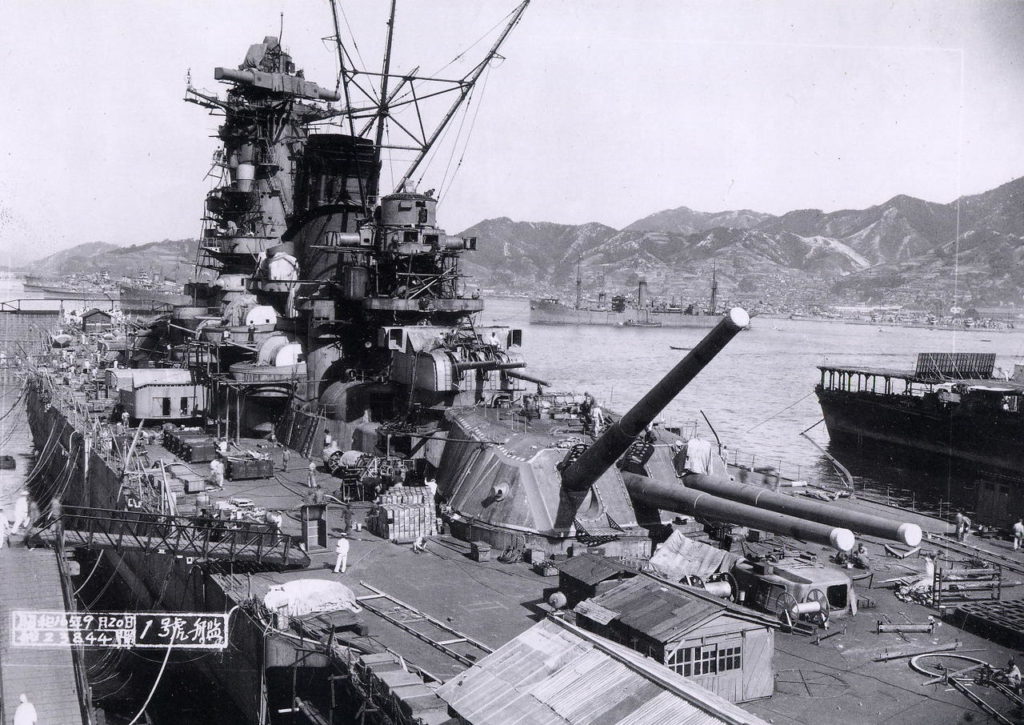
The Yamato class was the first battleship to utilize 18.1″ guns as well as the first Japanese battleship to carry triple gun turrets for the main battery. To accommodate three of the gigantic 18.1″ (46cm) guns, the Yamato class required an equally large turret. In addition, to protect against the most powerful guns that the Allies could muster would require armor of exceptional thickness. Japanese designers lavished incredible attention to the layout of the turret. The result was the most advanced turret design ever fitted to a Japanese battleship as well as one of the most impressive among any navy.
yamato class
Soon to be the biggest battleship in the world. Yamato undergoing fitting out at the Kure Naval Arsenal on September 20, 1941. Her aft 46cm gun turret is easily seen in the picture.
A popular description of the turrets of the Yamato class is that they weighed more than a destroyer. At just over 2,730 tons, it is little surprise that the biggest battleship carried the biggest turrets. Carrying three guns that weighed over 360,000lbs apiece and a massive slab of armor that was almost 26″ thick would result in a hefty turret. However, despite the immense weight of the turret and the massive 18.1″ (46cm) guns inside of it, the overall size was impressively compact.
Compare the turret of the Yamato class with the American Iowa class battleships:

Yamato ClassIowa Class
Turret Length56′ 1″50′ 7 1/2″
Turret Height 13′ 7″ 9′ 10″
Turret Weight2730 tons1708 tons


Turret Armor Front25.6″17″ + 2.5″
Turret Armor Side9.8″9.5″ + .75″
Turret Armor Roof10.6″7.25″ + .75″
Turret Armor Rear7.5″12″ + .75″


Individual Gun Weight363,000lbs 267,900lbs
Gun Length69.3′68′
Rate of Fire 1 round per 35 seconds1 round per 30 seconds
Loading Angle3 Degrees5 Degrees
Elevation Rate8 Degrees per Second12 Degrees per Second
Train Rate2 Degrees per Second 4 Degrees per Second
Despite the larger guns and heavier armor, the Yamato class turret was not that much larger than that found on the Iowa class. That is an impressive feat of engineering unto itself.
Even more impressive than the size of the turret was the equipment inside of it. The Yamato class utilized a unique sliding cradle behind each gun. The shells, weighing up to 3,218lbs, were lifted up to a tray at the end of the cradle. The entire cradle then slid forward on rails, moving the tray to the breech where it would be rammed inside the chamber. Then, the cradle would retract backwards. This allowed the powder tray to lift all six powder bags, each weighing 121.25lbs (55kg), into position behind the breech. A separate rammer would then ram all six charges into the chamber with a single stroke. A person would not have to touch any of the powder bags while loading the gun. This system reduced the number of men working inside the turret and allowed for an excellent rate of fire of up to one round per 30 seconds, though 35 seconds was more practical.
The Yamato class enjoyed one of the most compact turrets available to a battleship despite the fact that it carried the largest naval guns ever mounted to a battleship. In addition, the layout was excellent and the equipment inside was superb. A great achievement for Japanese designers!

As a warship designed to engage the most powerful battleships likely to be brought against it, the Yamato class featured a tremendous amount of armor protection. Almost 23,000 tons of armor was used on the Yamato class and Japanese designers intensively studied the most effective methods for utilizing this armor.
Armor Class Armour Figures
Belt:Yamato 410mm (16.1″)
Musashi 400mm (16″)
Lower Belt:200mm (7.9″)
Traverse Bulkheads:340mm (13.4″) – 300mm (11.8″)
Deck: 200mm (7.9″) – 230mm (9″)
Conning Tower:500mm (19.7″)
Barbettes: 380mm (15″) – 560mm (22″)


Turrets:
Front:650mm (25.6″)
Top:270mm (10.6″)
Sides:250mm (9.8″)
Yamato class were the first production battleships in Japan to adopt the “All or Nothing” armor principle. This ensured that Armor was maximized at the areas that needed it most while it was minimized in less important areas of the battleship. Therefore, the most vulnerable areas of the Yamato class (Magazines, machinery) were encased in a heavily armored box known as a citadel. The citadel was flanked by the armored belt (16″ & angled at 20 degrees) and capped by the armored traverse bulkheads (11.8″ – 13.4″) forward and aft. The upper section of the citadel was covered by the armored deck (7.9″ – 9″). This armor scheme was sufficient to provide an immunity zone against 46cm (18.1″) shells at ranges between 21,800 and 32,800 yards. The deck was designed to resist the momentum of a 1000kg (2200lb) bomb dropped from 3,400 meters. A monstrous amount of armor to protect from some serious weaponry.
When using the “All or Nothing Principle”, the armor was to be condensed to the vitals. Japanese designers took this a step further by seeking ways to make the vitals even smaller, allowing for the armour protection to be enhanced to its absolute maximum. They succeeding in shrinking the length of the citadel to a mere 55% of the ship’s overall length, a remarkable achievement. While this would seemingly leave 45% of the ship’s hull exposed, Japanese designers countered this by extensively compartmentalizing with some 1147 different compartments (1065 below the armored deck). The citadel was also designed to provide an immense amount of buoyancy, enough to keep the ship afloat even with the bow and stern heavily flooded. This helped mitigate the effects of damage to the hull, ensuring that the Yamato class could withstand damage and keep fighting.
The Yamato class was not just protected against threats above the waterline, they also featured the greatest underwater protection fitted to a Japanese battleship. A torpedo belt 5.1 meters (16.7′) deep protected the ship from torpedoes and mines. The torpedo belt was backed by the ship’s 200mm lower belt, designed to protect against shells striking the hull underwater (However, this feature turned out to be a liability in practice) and act as the main holding bulkhead. Outside of the ship’s torpedo belt, further protection against flooding was provided by the extensive compartmentalization mentioned already. Flooding would be contained to the compromised areas while the rest of the hull would remain watertight and buoyant. Using her volume, compartments, and a vast system of pumps, the Yamato class were expected to withstand a torpedo strike and still return themselves to an even keel despite the flooding.

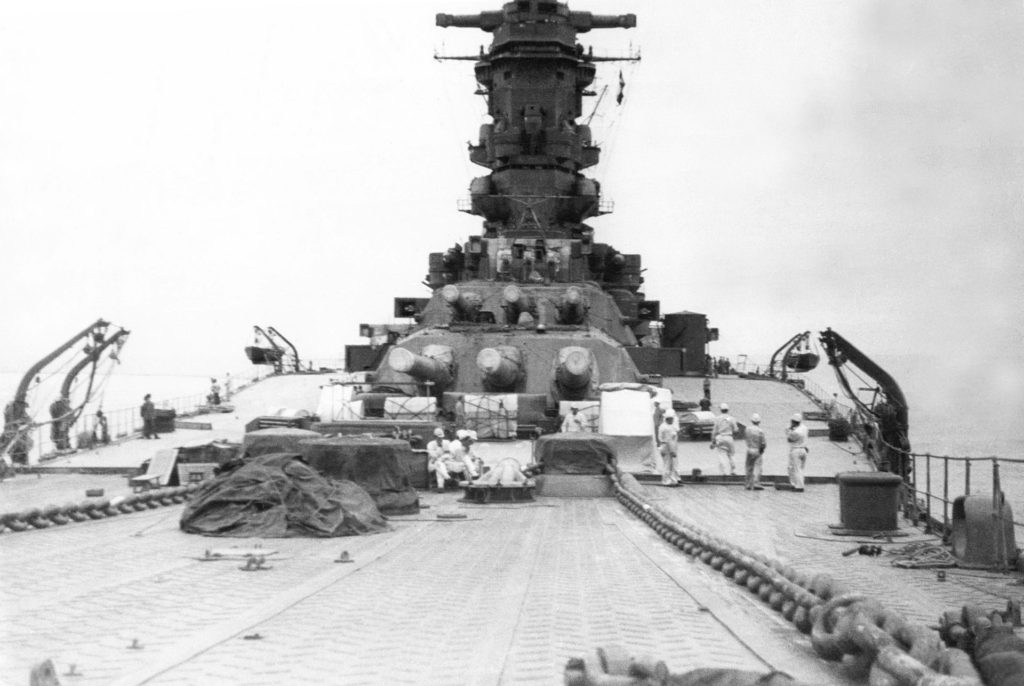
A unique feature of the Yamato class was the gentle slope of the deck in the vicinity of the forward 46cm turrets. After sloping downwards, the deck would curve gracefully upwards again all the way to the ship’s bow.
The bow and forward hull of the battleship Musashi. The slope of her forward deck is easily seen in this photograph.
Don’t let the beautiful lines fool you, the purpose of this bow was more than aesthetics! The sloping deck helped reduce the height of the turrets as well as the barbettes they rested on. Each main battery turret, weighing over 2500 tons, could make the ship very top-heavy if they were located higher up on the ships’ hull. The deck allowed them to be lowered. Though the height reduction was modest, maybe only around 10′, it still contributed to the ship’s overall stability.
The deck also helped contribute to the protection of the Yamato class. By lowering the turret height, the height of the barbettes could also be lowered as well. This meant a reduction in the barbettes exposed outside of the citadel, increasing protection. This also saved having to armor taller barbettes, saving tonnage that could be used for protection elsewhere on the battleships.
Overall, the use of a sloping deck was not particularly advanced, but it was extremely effective and a further testament to lengths Japanese designers were willing to go to enhance the ship’s capabilities.

biggest battleship
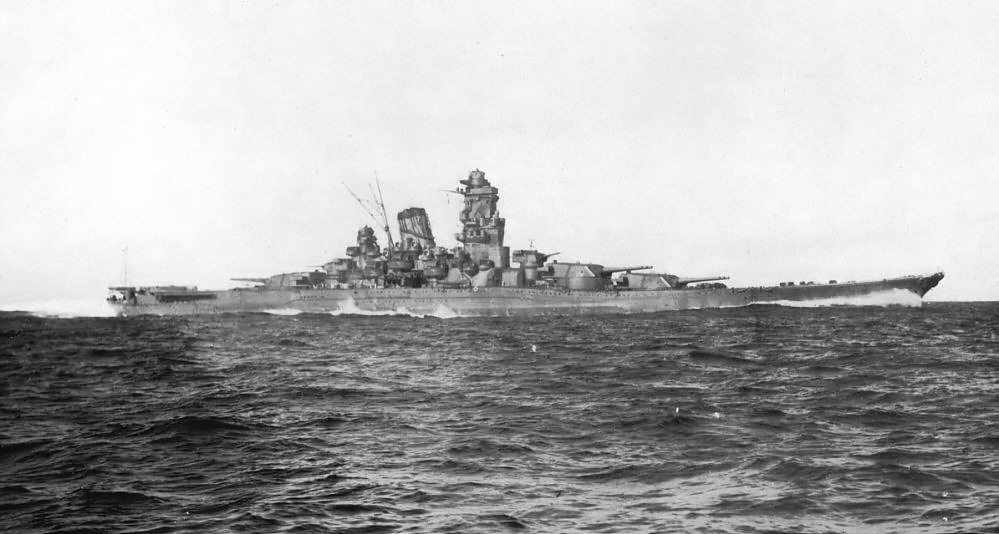
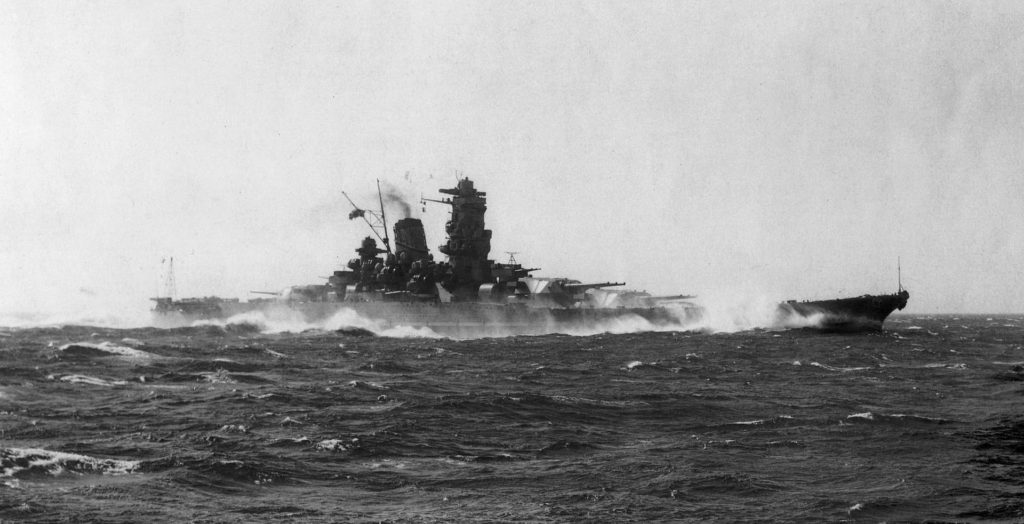
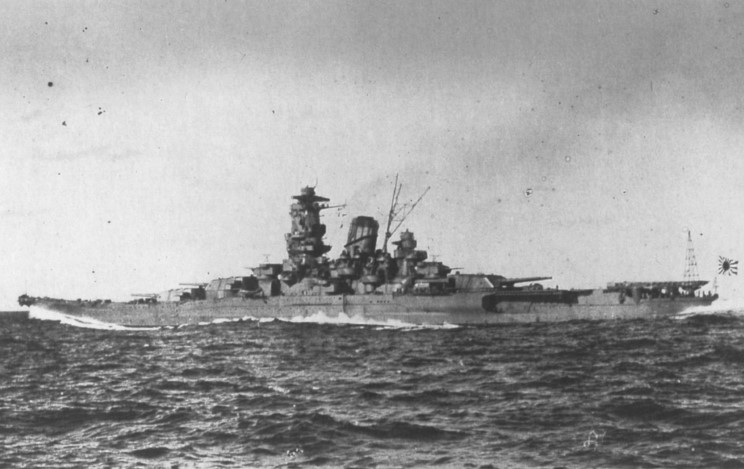
The biggest battleship is also remarkably agile! Yamato steaming at high speed while she was undergoing trials on October, 30, 1941.
Despite being the biggest battleship, the Yamato was relatively fast for her gargantuan size. Generally, the phrase “biggest battleship” and “fast” do not go well together in the same sentence. However, Japanese designers successfully managed to squeeze every bit of speed they could from the class.
Japan started with developing a hull that was as hydrodynamic as possible. During the development phase, some fifty different models tested to find the ideal hull shape. Japan went even further and applied features such as a bulbous bow to further enhance the hull form. The result was an extremely efficient hull of a design unique among Japanese dreadnoughts.
The powerplant of the Yamato class was provided by twelve Kampon boilers supplying steam (of 700 degrees) to four turbines. These turbines each drove their own shaft connected to a screw of 6m (20′). Though the system was rated at 150,000shp, Yamato was able to generate 153,553shp on her trials. This was enough to propel the huge battleship to 27.5 knots. Musashi exceeded this figure when her powerplant reached 166,500shp and drove her to 28 knots.

YamatoNorth CarolinaRichelieuBismarckKing George V
Powerplant:150,00shp121,000shp155,000shp148,116shp110,000shp
Speed:27.5knots28 knots32 knots30 knots28 knots
Range:7200nmi17400nmi9500nmi8870nmi15600nmi
While the Yamato class would not be setting any speed records, they were still impressively fast given their size. Even more importantly, most battleships only enjoyed a knot or so advantage over the Yamato class.
Overall, the fact the Japanese designers were able to squeeze so much speed from the Yamato class is a major feat unto itself. Even with massive guns and incredible amounts of armour protection, the Yamato class was capable of achieving respectable top speed, making the ships relatively balanced.
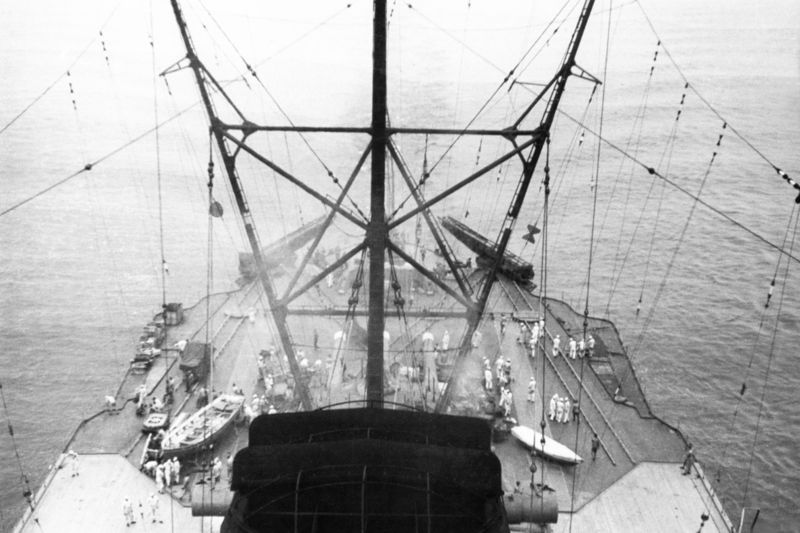
The Japanese Navy placed a lot of thought into the design of the Yamato class. One area of consideration was the effect that the muzzle blast of her 18.1″ guns would have upon equipment stored on her decks. Japanese designers developed several innovative ways to reduce the damage from muzzle blast. One of the most interesting methods involved the storage of the battleship’s spotting aircraft and boats.

The stern of the battleship Musashi. Her aircraft hangar is located between the twin catapults at the stern. The aircraft could also be moved about the deck on a system of rails.The Yamato class utilized a lowered quarterdeck. Aircraft were stored inside a below-decks hangar where they could be rolled via rails to a hold located on the quarter deck. From there a crane would hoist them out and place them on one of the battleship’s catapults or on a system of rails mounted on the weather deck.
The ship’s boats were stored in no less than four hangars. Smaller boats were stored in two smaller hangars mounted on either side of the aircraft hangar. The boats would be rolled on their own system of rails to the quarterdeck. The same crane that serviced the aircraft would also handle the smaller boats.
Larger boats were stored in two large hangars mounted inside the hull. A hatch could be opened that allowed the boats to be moved outside via an overhead rail and crane system. The overhead system allowed the boats to be moved outside the hull and lowered into the water directly. This same system could then be used to lift the boats out of the water and moved back inside the hull.
Sea trials of the world’s biggest battleship at the time. This photo shows off one of the battleship’s boat hangars located alongside the #3 turret.
Both the ship’s boats and aircraft, safely tucked away inside the hangars, were granted a significantly higher level of protection than they would be on other battleships. Though the hangars were mounted outside the citadel, meaning they were still vulnerable to bombs and heavy shells, they were still protected against shrapnel, aircraft gunfire, and the elements. It also allowed the 18.1″ guns to fire without fear of damaging the delicate equipment.
The placement of the aircraft and boats at the stern allowed for uncluttered decks. Additional deck space allowed for more anti-aircraft guns and other equipment to be installed. Other battleships during the War generally had to give up their ship’s boats to free up space. The downside to her hangars was that they consumed interior volume. However, due to the immense size of the Yamato class, the loss of space did not affect crew accommodations that badly, if at all.
Overall, the Yamato class might have enjoyed the most superior accommodations for her aircraft or ship’s boats without affecting her fighting ability

For Yamato and Musashi, they had a lot more going for their design rather than simply holding onto the title of being the world’s biggest battleship. They were technological marvels compared to the dreadnoughts that came before them. Japan’s naval designers gave considerable thought about the overall design and developed several innovative ways to better enhance the capabilities of the class. Sadly, the quiet careers of the ships somewhat overshadows their enormous potential. Still, the Yamato class hold a special place in the minds of many naval historian enthusiasts and for good reason!

Friday, March 6, 2020

Some Mistakes made in War movies...

There have been some really good war movies, from Zulu, Both Midways, A bridge too far, Siege of Firebase Gloria, Full Metal jacket and a bunch others, but there have been some dogs out there.
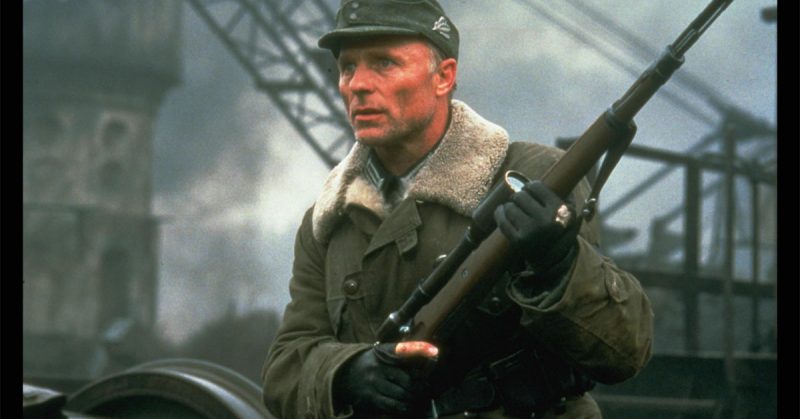
FILM 'ENEMY AT THE GATES' BY JEAN-JACQUES ANNAUD (Photo by Siemoneit/Sygma via Getty Images)
One of the biggest bombs of Ben Affleck’s career, and there have been several, happens to be one of the most error-ridden war movies Hollywood has ever produced: Pearl Harbour (2001). It wasn’t just a bad Affleck film, it is one of several films to come out of Hollywood’s “dream factory” that can’t seem to get it consistently right when telling wartime narratives.
Of course, filmmakers have to enhance stories to lure audiences into theatres. But accuracy is often sacrificed in the process. In Pearl Harbour, Affleck’s character is a member of the Air Force who joins the Eagle Squadron.
In reality, that couldn’t happen. Neither would he have flown a Polish plane, as he does in the film. This movie is riddled with as many errors as bullets, and bad reviews followed swiftly upon its release.
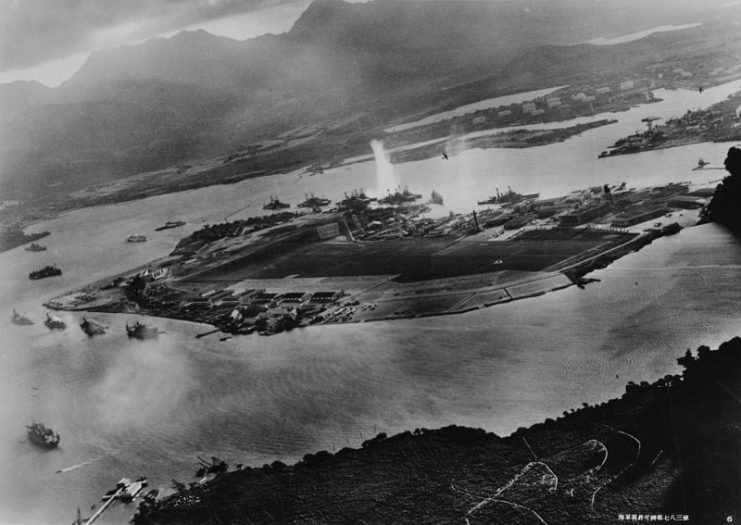
Photograph of Battleship Row taken from a Japanese plane at the beginning of the attack. The explosion in the center is a torpedo strike on USS West Virginia. Two attacking Japanese planes can be seen: one over USS Neosho and one over the Naval Yard.
Hollywood sometimes falls prey to serving as propaganda, and there is no better example than the 1968 John Wayne film, The Green Berets. In truth, the film was trying to sell the public on an unpopular war in Vietnam.

Almost everything about the movie, from its use of forests instead of a jungle, is wrong.  I remembered seeing bleachers by the "Vietnamese Village", it was filmed at Fort Benning. Wayne’s performance is unbelievable: he is ageing, overweight, and distracted, a man who would never be allowed in the field in the real army.
Even a Best Picture winner like The Hurt Locker can get it wrong. Veterans complained that this depiction of a bomb disposal squad in Iraq bore no resemblance to reality. In the film, the soldiers are unsupervised and surly to officials, neither of which is fair or accurate, according to army personnel.
World War II is probably the most fertile ground for filmmakers, but that also makes it ripe for creative reinvention.
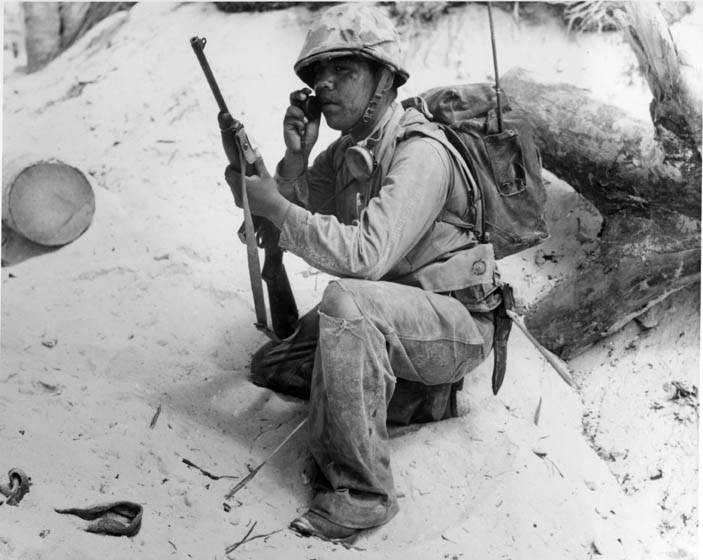
Windtalkers, a 2002 film about the role of Native Americans in WWII, depicts them helping U.S. forces send each other coded messages in Navajo. But it also shows them as disposable. Their bodyguards are told to kill them rather than let them fall into enemy hands. This film failed to find an audience, except perhaps on Netflix.
A Navajo Code Talker relays a message on a field radio. The code talkers served in the South Pacific during World War II and were kept a secret until 1968 when the Navajo code was finally declassified.
Some errors are less egregious than others. In 2006, Flyboys dramatized the battle between U.S. pilots and the German Luftstreitkräfte
but used the wrong planes. Producers said it was so audiences could tell one side from the other, which seemed fair enough until it was revealed that a military advisor on the film had made up his service record.
A 2000 film, U-571, earned a rebuke from the highest-ranking member of the British government at the time, Prime Minister Tony Blair. The film credited America with decoding the Nazi Enigma machine in 1941. The U.S. had not even entered the war by then, let alone done any code breaking.
That success was achieved by the Royal Air Force, prompting Britain’s PM called the movie “an insult.” The Imitation Game followed a few years later, a much-acclaimed film that told the true story of the first Enigma machine, and was nominated for several Oscars.
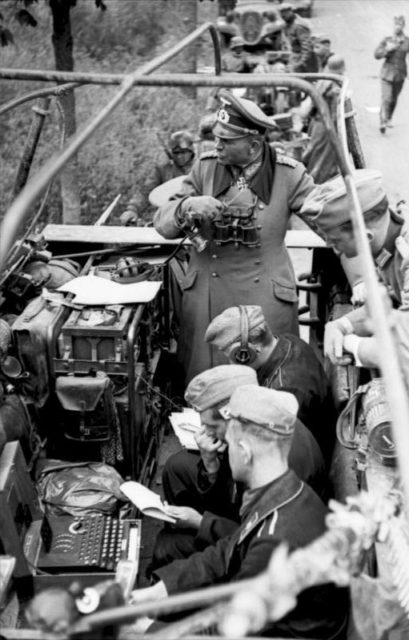
Heinz Guderian with an Enigma machine in a Sd.Kfz. 251 half-track being used as a mobile command center during the Battle of France. By Bundesarchiv, Bild  CC-BY-SA 3.0.
Enemy At The Gates (2001) told a story of World War II from a different angle, that of a Soviet sniper. The movie is based on the real soldier, Vasily Zaytsev, but is believed to contain two critical mistakes.
Firstly, it shows the Red Army severely ill-equipped, which wasn’t true. Secondly, it depicts a one-on-one encounter between the Russian sniper and his Nazi opponent, which experts believe likely didn’t happen.
The Battle Of The Bulge, released in 1965, is a much-admired movie, but it got plenty wrong too. This epic film shows the famous battle being fought on flat land, but the real one happened in a forest. The film battle was shot in “easy” weather while the real one was plagued with snow and rain. Finally, the tanks on the Nazi side were clearly American made.
Vasily Zaytsev, left, and soviet snipers equipped with Mosin-Nagant M1891/30 with PE scope in Stalingrad, December 1942.
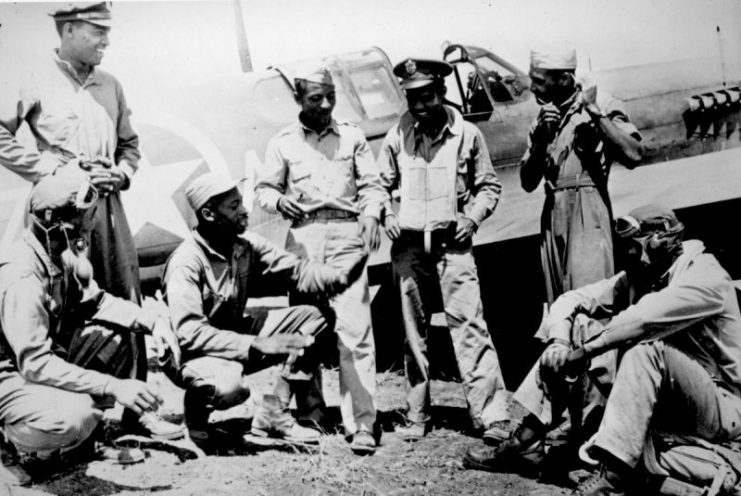
A movie about WWII that tried to be less downbeat than most was Red Tails, released in 2002. It told the story of the first African American air squadron, but in its desire to be positive, it made errors. In reality, the squad had no aces and, 25 bombers lost their lives to enemy forces. However, the film doesn’t depict this, implying instead that the team had a perfect survival rate.
Pilots of a U.S. Army Air Forces fighter squadron, credited with shooting down 8 of the 28 German planes, 1944.
,Presenting the Armed Forces in a negative way has become something of a popular approach these days, as in Jarhead, released in 2005. This film is about the first Gulf War, and is set in the 1990s.  I saw that movie and it pissed me off almost as bad as the "Three Kings" movie with George Clooney during the First Gulf War, I had a very poor reaction to that movie, I considered it "crap".  Officials claim that the severe training methods shown, during which one soldier dies, are unfair. They believe the film makes army life look unnecessarily tough, and argue that soldiers would not be left to die on the battlefield. Officials went on record to make known their displeasure.
    I am sure that there are others but these are the ones that jumped out at me.  

Thursday, March 5, 2020

Cleaning airplanes and the Coronavirus


I am a chemtrail technician in the aviation industry, and a friend of my wife has asked her a question "How is your husband doing?" and my wife was surprised by the question and asked her "Why, what is the matter?" and she was told" Is your husband ok? he works on airplanes and they are carriers of  the coronavirus".  My wife was perplexed so I explained that I work on the domestic planes, not the international planes, and we are doing the maintenance that is longer than the overnight checks, but less than the "C" or "L" checks that are required by the manufacturer and the FAA.  We use all the PPE(Personal Protection Equipment) that is required for our safety.   I am not overly concerned, I am more concerned about going to events with a lot of people that might be sick and not do the right thing and stay home than working on airplanes.  Wash your hands, wash your hands, wash your hands... 
      I shanelessly clipped these from "Simply flying, a blog about Aviation and flying.
The coronavirus outbreak has triggered a surge of cabin cleaning frenzy among airlines. With measures inspired in equal amounts by public safety and self-preservation, they are now turning to hospital-grade disinfectants to kill any lingering viral particles.
Cathay Pacific Hong Kong Getty Images
Cathay Pacific is implementing strict disinfectant protocols after every flight. Photo: Getty Images

Airlines are taking extra precautions to make sure travelers will not be exposed to the coronavirus on flights. The standard cleaning procedures have been upgraded and airlines are now using products capable of stopping STDs and the MRSA superbug. 
Particularly powerful disinfectants have been used by Qantas, Korean Air, and Singapore Airlines on the planes used to evacuate people from the Chinese city of Wuhan, and from the Diamond Princess cruise ship after its quarantine in Yokohama, Japan. 
The Qantas Boeing 747 that was used for the evacuation flights was cleaned for 36 hours, using a substance called Viraclean. Pillows, blankets, and headphones were all tossed out, and all the cabin surfaces sprayed with the disinfectant twice, and then wiped down again for good measure. The plane’s air filters, similar to those used in surgical theatres, were also replaced.
Korean Air favored a cleaning solution known as MD-125, which is said to knock out 142 bacteria and viruses, including salmonella, avian flu, and measles.
Cathay Pacific, of course, flying in and out of Hong Kong, is cleaning and disinfecting cabins, seats, galleys, and washrooms after every flight. This includes IFE screens, tray tables, baby bassinets, and armrests. The airline has seen half of its fleet parked due to the virus outbreak.

Cleaning a plane
Airlines are taking great care to clean their planes to halt the spread of the coronavirus. Photo: Getty

Singapore Airlines also disinfects surfaces on all flights from Hong Kong and mainland China. Furthermore, they implement a measure known as “fogging” on all flights arriving from these destinations. During this process, a team of two or three staff fogs the cabin with a chemical named Calla 1452, which has been proven effective against avian flu, the H1N1 virus, and SARS.
Delta Air Lines is also fogging the cabins of all incoming flights from Asia and Italy with an undisclosed “EPA-registered disinfectant on all flights which is rated to combat many communicable diseases” It plans to expand the use of the technique to all flights arriving from countries where the coronavirus is present.
Its fellow US carrier United Airlines is using an upgraded cleaning process on all international flights that was implemented during the Ebola outbreak in 2014. Every hard surface that has been touched by a passenger is wiped down with disinfectant after every international flight. Also, any plane that has carried a person infected with the coronavirus is taken out of service for complete sterilization, a spokesperson from the airline said to the Los Angeles Times.
Cabin crew wears protective gear for Korean Air
Cabin crew from Korean Air wears protective masks as advised by IATA. Photo: Getty Images

IATA has produced a document with guidelines for airlines on how to prevent the spread of the coronavirus. These detail how every surface of the aircraft should be cleaned for stopover times under and over an hour, as well as for stops overnight. 
They also include other directives for the aircraft’s crew. For example, temperature screening passengers with a non-contact infrared thermometer to detect anyone with fever, protective equipment for crew members, and onboard emergency quarantine measures.
Amid the worldwide coronavirus outbreak, airlines are taking some precautions when it comes to minimizing the risk of infection. Delta Air Lines, in particular, is taking some big steps when it comes to sanitizing its aircraft. Simple Flying takes a look.
Delta WiFi hotspot name
Delta is taking steps to minimize passenger infection risk. Photo: Delta Air Lines

Delta Air Lines has posted information about its aircraft sanitation procedures. Delta’s aircraft cleaning teams are trained to use high-grade, United States Environmental Protection Agency (EPA)-registered disinfectants on flights.
Back in February, Delta used fogging techniques on the few remaining flights from Asia to the United States. In addition, Delta has deployed these fogging techniques on flights from Italy and is sourcing additional machines to disinfect more transatlantic flights.
Advertisement
Coronavirus, evacuation, quarantine
Like other airlines, Delta is using a fogging technique to sterilize aircraft. Photo: Getty Images
In addition, Delta has provided its ground cleaning crews with a 19-point checklist on cabin cleanliness. These points include disinfecting cabin surfaces, as well as areas of high customer contact such as seats, seatback pockets, and tray tables. This also includes spaces in the galleys and lavatories. Again, these sanitizing procedures use high-grade EPA-registered disinfectants.
When it comes to flights landing in the United States from Asia, Delta is also utilizing additional sanitizing procedures. All tableware, cutlery, dishes, and glassware undergo separate disinfection prior to being washed.
Cutlery, glassware, tableware, and dishware are undergoing separate disinfection prior to being washed. Photo: Jay Singh/Simple Flying
All unused inbound supplies are being discarded. Bedding and headphones undergo a separate washing and sanitizing process from other bedding to minimize the risk of cross-contamination.
Advertisement
Bedding from these flights are undergoing a separate sanitizing process from other linen. Photo: Jay Singh – Simple Flying
When it comes to galley equipment, carts and carriers from inbound Asia flights are also undergo separate sanitizing and washing processes to minimize cross-contamination. Delta also has, onboard, Tidy Kits. Within these kits are gloves, disinfectant wipes, small mops, trash bags, and a trash pickup device for lavatory cleaning.
In addition, Delta is stocking more wellness items on its flights to and from Asia. This includes items like hand sanitizer, gloves, and surgical masks. Passengers in all cabin classes will find amenity kits that contain hand sanitizer or cleansing towelettes.
Passengers should check their amenity kit for hand sanitizer and tissues. Photo: Jay Singh/Simple Flying

For most passengers, one concern may be air circulation onboard the aircraft. All of Delta’s international widebodies and narrowbodies like the 737s, 757s, A319s, A320s, and A321s have air circulation systems. The 717s, on the other hand, use 100% fresh outside air.
Delta Air Lines Salt Lake
Most of Delta’s narrowbodies have air circulation systems. Photo: Getty Images
These systems bring outside fresh air that is sterilized in a high-temperature compressor and ozone purifier. This mixes with the existing cabin air that recirculates through an industrial-grade HEPA filter. According to Delta, these filters can extract viruses as small as 0.01 micrometers while coronaviruses range from 0.08 to 0.16 micrometers.
While Delta is taking precautions to ensure its aircraft are thoroughly sanitized, passengers can still take additional measures. This includes wiping down your seat area again with a disinfectant clothing and washing your hands after you cough, sneeze, or use the restroom. In addition, passengers should maintain their general wellbeing in flight. One simple way of doing this inflight is to make sure that you drink plenty of water.