Several things going on, We had Fathers day recently and my son being a good kid that he is treated his Dad to club level Atlanta United tickets, I was surprised and touched that he did that and I asked him "Why?" and he looked kinda at his feet and said "Well this is your first Fathers Day without your Dad and I wanted to do something nice for you." I was extremely touched, I have a good Son and I am proud of him and that a teenager had a bit of empathy was telling.
Our first stop was our usual stop, the Krasnovian Embassy of Waffles and Friendship. Then off to the Benz to watch the Game,
The seats were really good, but with people standing, you couldn't sit down so you were almost obligated to stand unless you wanted to watch the action on the Jumbotron.
Then we went here to the club area to get food and drinks, no pushy crowds and the bathrooms were clean...I can see why people pay extra for club seats. And while I was there I did buy a hat
I needed something that goes with my "Lucky Shamrock" Atlanta United Scarf, that I wear to the games along with my Dutch Camouflage goretex jacket that was one of my souvenirs that I had collected during my time stationed in Germany. It pays to lose over 120 pounds and I can wear stuff that I haven't worn on over 20 years.
Now I had gotten a couple of things for the my Focus, First off, remember my Post I did changing my foglights from incandescent to LED, Well I did another mod on the car, I changed the foglight covers to the "basketweave" style. That is what the European Focus Mark 3.5 uses. The cars share a lot of components and styles, but there are some differences.
I also decided to work in my bonus room, that is the room that has all my books, Military souvenirs and other things in, I spent several hours putting stuff away, and squaring the room away so it looked decent again. I have been meaning to do it for a long time and finally did it. While I was doing it, I was playing my old cassette player from the traditional stereo that we GI's always buy from the PX playing music from the 80's CD's that I burned to cassette while I drove the Autobahn.
Well back to the Focus again, I had ordered a month prior LED high beams to replace the factory bulbs, and so I pulled out the owners manual...
Then I turned on the headlights including the Highbeams, I wanted to make sure that they would work without my cranking up the car...
On my Truck and older vehicles, you can turn on the lights without any fuss, but the new cars like my Focus are more computer sensitive so I wanted to make sure.
I opened the box of H11 LED bulbs for my High beams....
The Headlights assembly are held in place with 2 torx screws. I started loosening the first one...As you can tell, I am wearing gloves, as per habit I wear gloves as to not leave a residue on the bulbs from my skin which will shorten the lifespan of the bulb.
I then started loosening the second one......
I then grouped the screws in a cubby on the fascia above the radiator as to not lose them.
And slid the Headlight assembly forward, compared to earlier cars, this was easy. I am glad I recall on some of the earlier cars, changing lightbulbs can be quite an endeavor.
I immediately located the cover for the highbeam on the drivers side...opened it up..
Ruh Roh Shaggy, it don't match the plug that I thought it would...so I fish the bulb out...
It don't match........crap....what did I mess up.... I did some digging and discovered that the LED bulbs I bought for my Highbeams will work for my "lowbeams"...Oh Well I changed my Lowbeams instead...
This is what it looked like plugged it, it is literally "Plug and Play".
I put it back in place, and it slid in easily..So I walked around and turned it on...
It works, you can see the difference between the bulbs.
I went and repeated the process, this is what the light looks like inside the headlight assembly housing before I put the cover back on.
I repeat the process on the other side, this is my tightening the torx screws on the headlight housing.
Tightening the 2nd Torx screw......
Looks a bit different with the LED headlights, I will order some H1 LED headlights to "do" the highbeams.
This is the pic of the car with the LED headlight and foglights....it was a cheap and easy mod on the car.
I had decided to build a shadowbox with the flag from my Dads memorial service, and I had put it together, and I had sent some pics to Old NFO for some ideas, and he made some really good suggestions and I incorporated them into it and it made it look really good, Thanks Jim. I don't have all his unit patches, but I will eventually get them. I had "squiggled" out the name for obvious reasons, I am very proud of my Dad, but I do prize my anonymity.
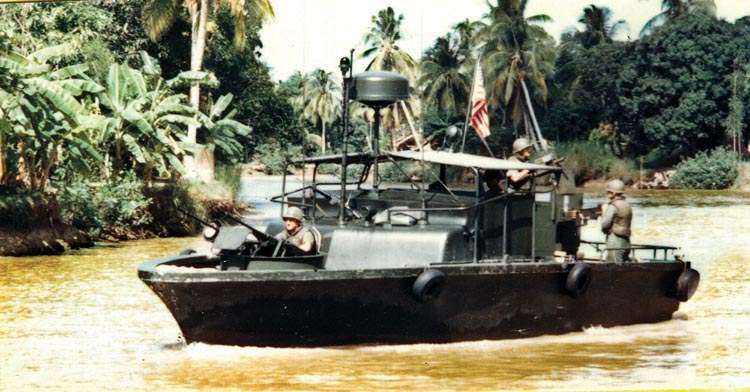
I remembered seeing a PBR at Patriots Point when my son was in the cub scouts, the entire place is worth the visit and the time. Especially when the scouts can stay overnight on the U.S.S. Yorktown. granted it was in Enlisted quarters with the steel decks but still it ranked up there in the "cool" factor. I remember seeing a PBR on the TV for the first time in the Movie "Apocalypse Now" when Martin Sheen character rode in one to go kill the rogue colonel. I had remembered asking my Dad if he had rode in one of those in the course of his duties and he had commented that he did as part of his duties with the "Tropic Lightning"during his first tour. All he said was "it was interesting".
The U.S. Navy deployed a variety of small boats to South Vietnam during the Vietnam War,
but perhaps the best known of these is the river patrol boat. The
“patrol boat: riverine,” or Navy PBR, was the first watercraft built for
the so-called brown water navy in Vietnam. During the height of the
conflict, Navy personnel scouted the rivers and canals of the sprawling
Mekong Delta for communist guerrilla forces, arms, and ammunition. In
addition to patrolling, Navy PBRs participated with Navy and Army troops
in hit-and-run raids, reconnaissance patrols, and day and night
ambushes.
The origins of the
Navy PBR can be traced to Hatteras Yacht Company of New Bern, North
Carolina, which in 1965 responded to a U.S. Navy request for a prototype
for a small patrol boat to operate in shallow waters. The Navy’s Bureau
of Ships sought a prototype for what it designated as “patrol boat,
river” that could achieve speeds between 25 to 30 knots, draw only nine
inches of water, and skim over sandbars. The boat would be crewed by
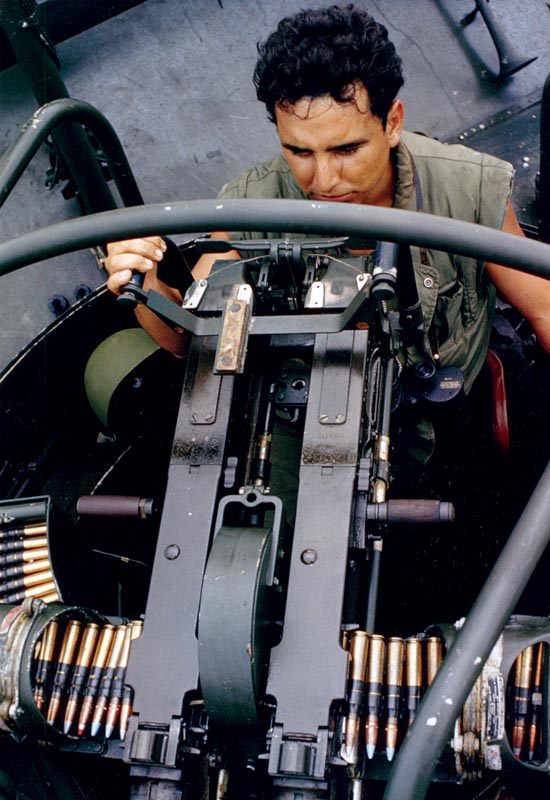
four sailors and have heavy armament. Its armament would consist of a
twin .50-caliber machine gun in an armored forward turret, as well as a
.30-caliber mounted gun in the aft section. Additionally, the boat would
need to be able to reverse direction, turn on a dime, and come to a
quick stop from full speed within a few boat lengths.
Hatteras
stated its intention to build a 28-foot fiberglass hull powered by
water-jet pumps as opposed to screw propellers. The water pumps would
enable the new boat to go into shallow water. The Navy put the PBR
contract out for bid, and eight companies responded with bids. United
Boat Builders of Bellingham, Washington, ultimately won the contract.
The company built the PBR around its existing 31-foot fiberglass hull.
This boat became PBR Mark I. The Navy initially requested 120 PBRs.
Eighty of the Navy PBRs were assigned to the Mekong Delta and 40 to the
Rung Sat Special Zone south of Saigon
The
dark-green Mark I was powered by twin General Motors 220-horsepower
diesel engines and water jet pumps supplied by Jacuzzi Brothers. The jet
pumps shot out streams of water from nozzles located below the
waterline on the stern. The jets of water had sufficient thrust to
propel the boat. Steering was accomplished by rotating the nozzles left
or right. For stern propulsion, a so-called u-gate slipped down over the
nozzles and rerouted the flow 180 degrees, which propelled the boat
backward. When fully loaded, the boat topped out at 14,600 pounds and
could reach a speed of 25.7 knots.
The builder installed ceramic
armor designed to deflect bullets up to .30 caliber around the
coxswain’s flat and at the weapons stations. The boat’s heaviest weapon,
the twin .50 caliber, was installed in an open turret in the bow. In
the fantail area, a single machine gun was affixed to a pedestal.
Amidships on both sides of the boat were open-ended receptacles to which
could be mounted either an M-60 machine gun
or an MK-18 grenade launcher. A similar receptacle built into the aft
machine mount allowed an MK-18 to be piggybacked with the stern machine
gun.
In addition to the mounted machine guns, the crew also took along M16 rifles,
M-79 grenade launchers, handguns, and hand grenades. The boat came
equipped with a Raytheon 1900/N radar system and two AN/VRC046 FM
radios.
Crewman
aboard a fiberglass-hulled Mark II River Patrol Boat watch closely for
enemy activity during a mission in the Mekong Delta. Navy PBRs worked
together with helicopters and ground units to interdict the flow of
enemy troops and supplies on rivers and canals.
The
hull could be repaired quickly and easily. It was designed so that
enemy rounds would pass through it without exploding. There was no solid
surface that would cause detonation.
The
Navy PBR Mark I was not immune to problems. When fully loaded, the Mark
I drew 22.5 inches of water, which greatly exceeded the nine inches
originally requested. Added to that, the Mark I never attained the
desired speed of 25 knots. This was because the jet pumps put a heavy
strain on the boat’s diesel engines. Added to this, Styrofoam blocks
that kept the boat high in the water frequently became waterlogged as a
result of seepage through the hull.
The four-man crew for the Navy
PBR included a first-class petty officer who served as the boat’s
captain. Owing to battle casualties and other reasons, both chiefs and
second-class petty officers also captained the boats. The other crew
members were an engineman, a gunner’s mate, and a seaman.
Large
numbers of communist forces operated in the Mekong Delta region, not
only because it contained half of South Vietnam’s population and was
responsible for half of the country’s rice production, but also because
of its close proximity to Saigon. The communists routinely transported
men and supplies through its 3,000 miles of waterways. As they did so,
the communists actively recruited in the region and extorted funds from
the local people to finance their operations. Communist forces carried
out an estimated 1,000 small-scale attacks each month in 1966 on
government posts and villages in the Mekong Delta.
A
sailor mans his twin air-cooled, belt-fed .50 caliber machine gun mount
while patrolling for Viet Cong activity. The weapon was positioned in
an armored forward turret.
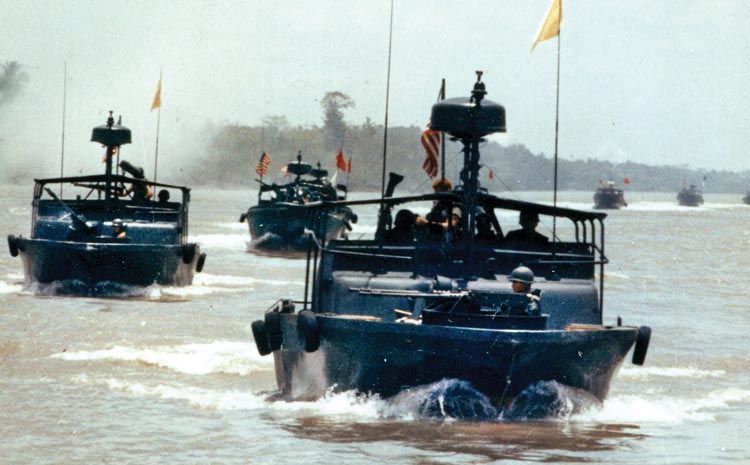
One
of the fundamental tactics developed for the Navy PBRs was to operate
in pairs while conducting patrols. The two boats would travel in a
column, with the trailing boat following 400 to 600 yards behind the
lead boat. This way the two boats were close enough to cover each other.
The crews conducted patrols and searches during the day and at night.
When searching a vessel at night, the boat conducting the search
approached the suspect craft at high speed, illuminated the vessel, and
ordered all occupants to show themselves on the near side of the
watercraft.
The PBRs sought to stay in the middle of the channel
to maintain as much distance between the boat and shore as possible in
case enemy forces were lurking in the foliage. During a search, the crew
of the PBR kept a .50-caliber machine gun trained on the shore opposite
the vessel being searched in case it was fired upon from behind.
The
U.S. Navy launched Operation Game Warden on December 18, 1965, and
established a River Patrol Force in South Vietnam to maintain military
curfews and implement the interdiction program in both the Mekong Delta
and Rung Sat Special Zone. As part of the program, PBR crews routinely
stopped and searched suspect sampans to see if they were transporting
guerrilla troops or smuggling military provisions for communist forces.
The
River Patrol Force, also known as Task Force 116, was composed of a
number of river divisions. Each division had two 10-boat sections. The
River Patrol Force operated from LSTs (landing ships, tank) that served
as floating bases complete with troop quarters. The PBRs served as the
core watercraft for these riverine divisions. The first batch of Navy
PBRs arrived in country in March 1966 during the continuing buildup of
U.S. forces in South Vietnam.
A
flotilla of Navy PBRs fires on enemy positions during Operation Bold
Dragon III in March 1969. PBRs were capable of delivering Navy SEAL
teams and other ground troops to remote locations in the Mekong Delta.
To
furnish close air support for the PBRs in the delta, the Navy activated
Helicopter Attack Squadron 3 at Vung Tau. In addition, Navy SEAL
platoons operated with the River Patrol Force, giving it the ability to
conduct clandestine intelligence operations.
Navy PBR crews
routinely used tape recorders and loudspeakers to announce curfew hours
and issue instructions to Viet Cong who might wish to defect. They also
performed humanitarian missions, such as transporting medical personnel
to isolated villages and wounded villagers to field hospitals.
After
their initial experience using their new watercraft, PBR crews made
some key improvements to the weapons systems on the boats. First and
foremost, they replaced the .30-caliber machine gun aft with a
.50-caliber to reduce the necessity of having to carry two different
types of ammunition. They also added an M-18 grenade launcher and
stripped most of the armor from the forward machine-gun position to
improve the gunner’s field of vision.
A joint service Mobile
Riverine Force began operating in June 1967. The principal
organizational elements of the force were Navy Task Force 117 and the
U.S. Army’s Ninth Infantry Division’s Riverine Forces. The riverine
force was capable of deploying 150 miles from its base within 24 hours.
It possessed a 5,000-man combat force that could engage the enemy
immediately upon arrival at its destination. The riverine force’s
initial anchorage was at Vung Tau on the coast southeast of Saigon, but
it eventually moved to Dong Tam in the upper Mekong Delta.
The
advent of the Mobile Riverine Force in the delta marked a shift in the
balance of power in the region, with the allies gaining superiority over
the communists. The Riverine Force fought five major actions during
1967, in which it killed 1,000 communist troops. The enemy frequently
fought in battalion strength in the larger of these engagements. In
addition to small arms, they used a variety of heavy weapons, including
machine guns, rocket launchers, and recoilless rifles.
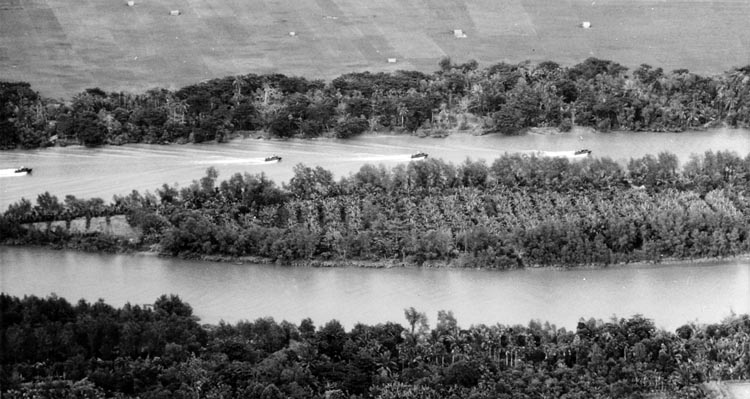
Navy
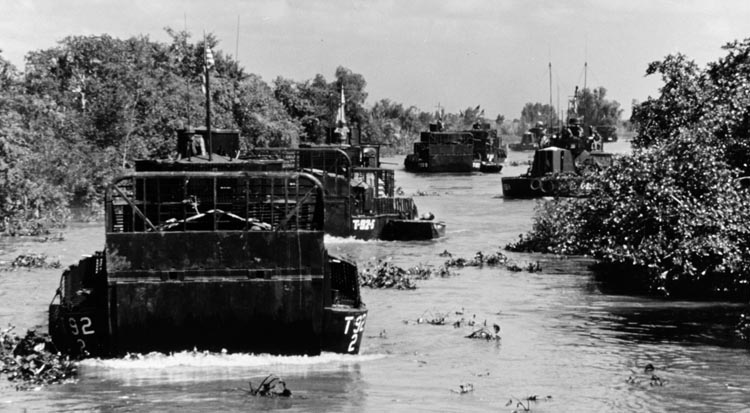
PBR boats cruise past Tan Dinh Island, trying to draw fire from enemy
fortifications along the river bank. Once the boat crews had pinpointed
the enemy positions, helicopter gunships would attack the strongpoints
from overhead.
The Mobile Riverine Force
conducted a series of major combat operations, including Coronado I
through XI from 1967-1968, Giant Slingshot from 1968-1969, and Sealords
from 1968-1971. The purpose of these operations was to isolate and
destroy Viet Cong and North Vietnamese units and dismantle their
infrastructure in the Mekong Delta and the Capital Military District.
Armored
PBRs of the Mobile Riverine Force on a mission in the Mekong Delta in
1967. A 5,000-man rapid-reaction force was established that year to deal
with large-scale enemy threats.
In
September 1967, the River Patrol Force obtained a new, completely
modified Navy PBR, the Mark II. The new model had larger, improved water
jet pumps made from a metal less prone to corrosion. Additionally, the
boats boasted a new circuitry system for the forward twin .50-caliber
machine guns. The boat was also capable of much higher speeds than its
predecessor. Not long after the introduction of the Mark II, a new Alfa
model was introduced with even more upgrades. By early 1969 there were
250 river patrol boats in South Vietnam, including 130 Mark II and Mark
II Alfa PBRs, as well as 120 Mark I PBRs.
Communist troops
attacked more than 100 of South Vietnam’s cities and towns on January
31, 1968, during the Vietnamese Lunar New Year holiday known as Tet. The
size and the ferocity of the Tet Offensive put U.S. and South
Vietnamese forces on the defensive.
In the Mekong Delta region,
the communists attacked 64 district capitals. The Tet Offensive resulted
in an uptick in riverine units being used for fire support, troop
transport, and amphibious assault. Up until Tet, PBRs typically called
for naval or aerial assistance and then withdrew until help arrived
before re-engaging the enemy; however, the Navy loosened the rules of
engagement during Tet: If the patrol officer in charge of the PBR
decided his boat could stand and fight, he had the discretion to do so.
Another change in doctrine occurred regarding where the PBRs patrolled.
Before Tet, PBRs generally stayed in the main rivers of the delta
region, but during the communist offensive they began to operate in
canals and other narrow waterways.
A
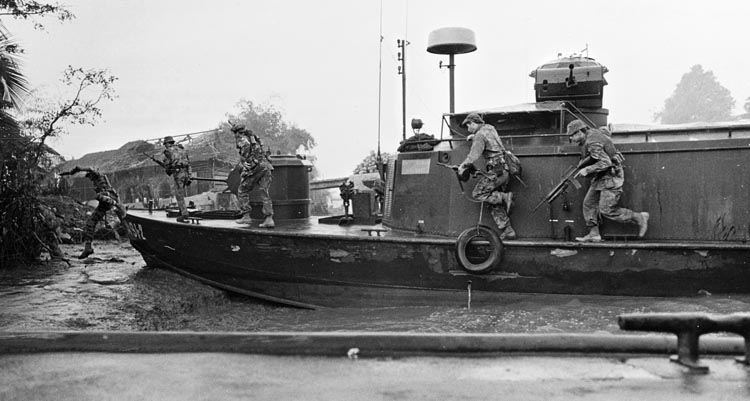
SEAL team debarks from a PBR to destroy bunkers and round up Viet Cong
during a raid in Kien Hoa Province. PBRs were powered by water-jet
pumps, as opposed to screw propellers, which enabled them to operate in
extremely shallow water.
The PBRs in the Vietnam
War played a key role in riverine operations and achieved positive
combat results. In the course of their patrols and operations, U.S. Navy
riverine forces killed 3,000 communist soldiers and sank, damaged, or
captured upward of 6,500 boats.
Some key statistics offer insight
into the hazards of PBR service. One of every three PBR sailors was
wounded during his tour of duty. Yet this in no way deterred the
volunteers who clamored to serve aboard the boats. Volunteers for the
PBRs came from all U.S. Navy rates, ratings, and ranks. Furthermore,
morale among the PBR crews remained high throughout the conflict.
For
these reasons, the Navy PBR crews that served during the Vietnam War
were highly respected by sailors and soldiers alike. “We were volunteers
[and] patriots,” said Petty Officer Jere Beery, reflecting on his
service on a PBR. “We were gung-ho as hell. We looked for trouble.”
I first read about the Six Day war in High School when Israel launched a preemptive strike against several Arab countries that were planning on attacking them, but the Israelis struck first because they knew if the Arab countries got their act together and struck together, it would overwhelm their defenses and push them into the sea and crush the Israeli State which was the dream of the Pan Arab alliance.
By the summer of 1967, the modern state of Israel laid claim to a
short but bloody history. After declaring independence in spring 1948,
the nascent Jewish state was invaded by a coalition of Arab nations bent
on the destruction of Jewish settlements. Following a brief but fierce
war that saw the death of nearly one percent of its population, Israel
secured a grudging armistice with the Arab belligerents. The agreement
brought an end to large-scale fighting, but failed to secure Arab
recognition of Israeli independence, making further conflict inevitable.
In
less than a decade, Israel once again found itself locked in a shooting
war with its largest Arab neighbor. In response to Egyptian blockades
of the Suez Canal and the Gulf of Aqaba, Israel launched an invasion of
the Sinai Peninsula on October 29, 1956. The attack was coordinated with
the British and the French, who dropped airborne forces near the Suez
in the hopes of seizing the canal.
The affair ended in an
embarrassing foreign-relations disaster for Great Britain and France as
they were forced to accept a cease-fire due to pressure from the United
States and the United Nations. Israeli forces had been stunningly
successful during the ground campaign, seizing Sinai in short order. The
IDF, though, had not been able to capture one of the most heavily
defended of the Egyptian positions, the strategically vital high ground
near the seemingly insignificant crossroads of Abu Agheila. The position
was taken only after being abandoned by the Egyptians.
That brief
war, though, was not without long-term ramifications. The fact that
Britain and France had been forced to withdraw their troops due to
political pressure only emboldened the Egyptians, and anti-Israeli
rhetoric ramped up in the years that followed. As a result, the
peacekeepers of the United Nations Emergency Force (UNEF) were
garrisoned in Sinai in order to keep the belligerents at arm’s length.
At
the time, Egypt was experiencing a wave of nationalist fervor, largely
due to the ascendance of Colonel Gamal Abdel Nasser, one of the most
charismatic leaders in the Middle East. Nasser had assumed the
presidency of Egypt in 1954, just two years after he had helped
orchestrate a successful coup. Nasser used powerful rhetoric that
espoused greater unity for the Arab world, retribution for displaced
Palestinians, and the reduction of the State of Israel.
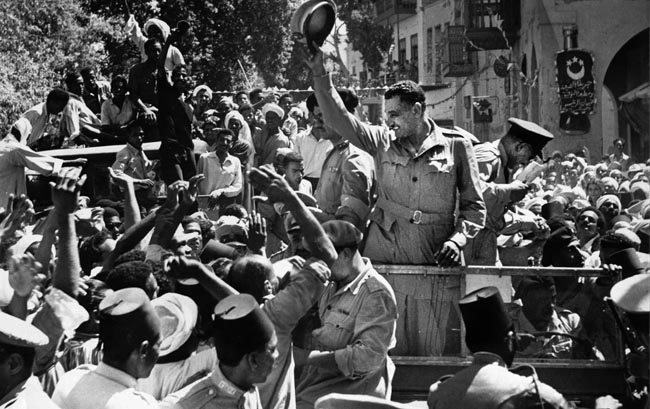
Egyptian President Gamal Abdel Nasser believed the United States would restrain Israel from making an attack on Egypt.
Nasser’s
magnetic charm also crossed national boundaries, and his promotion of
pan-Arab unity found a wide audience across the region. By the
mid-1960s, Nasser’s mounting influence in the Arab world was a source of
grave alarm to Israel’s intelligence services. By 1964, IDF analysts
predicted that a renewed war with an emboldened Egyptian army would
likely occur as early as 1967.
Due to his previous professional
contacts within the Egyptian Army, Nasser promoted a number of personal
cronies to the highest ranks, chief among them Field Marshal Abdel Hakim
Amer. Former vice president of Egypt and overall commander of Egyptian
forces, Amer had seen extensive combat service. First commissioned in
the Egyptian army in 1939, Amer had served against Israel in both 1948
and 1956 and had commanded Egyptian troops that intervened in the North
Yemen Civil War.
Unfortunately, cronyism and statist paranoia
gripped much of the Egyptian senior officer corps. Amer likewise
appointed personal cronies or conferred promotion based on political
considerations. A number of senior officers were known to possess a
greater interest in Cairo nightlife than the military arts. Intelligence
operatives spent much of their time monitoring suspect Egyptian
officers rather than gathering intelligence on the Israelis. Ultimately,
the misplaced focus on politics ensured that the Egyptian senior
command bore a greater resemblance to an elite club of uniformed
sycophants than a cadre of professional combat leaders.
Despite
the shortcomings of the high brass, the Egyptian military possessed a
vast arsenal of fearsome weaponry due to an alliance with the Soviet
Union. Nasser’s increasingly hostile stance to the Western powers made
him an attractive ally to the Soviets, who regarded him as a
non-capitalist revolutionary democrat. Nasser and Amer were designated
as Heroes of the Soviet Union in 1964 and awarded accompanying medals.
Such
symbolic honorifics were accompanied with more concrete support in the
form of modern weaponry. Since the close of the Sinai conflict, the
Soviets had bestowed billions of dollars worth of military aid on the
Arab states. The Arabs in the region fielded 1,700 tanks, 2,400 pieces
of artillery, and 500 jet aircraft. Nearly half of the armaments went to
Egypt, Israel’s most dangerous foe. Greater Arab unity likewise
increased the threat to Israel. In October 1966, for example, Egypt and
Syria secured a diplomatic rapprochement and signed a mutual defense
pact.
The explosive combination of Arab military alliance and
anti-Zionist rhetoric resulted in a dangerous powder keg for the greater
Middle East. Misled by erroneous Syrian intelligence that pointed to an
Israeli buildup on its northern border, Nasser and his generals grew
increasingly jingoistic during the spring of 1967. On May 19, Nasser
made the ominous move of requesting the removal of the 3,500 United
Nations peacekeepers stationed in Sinai. With United Nation troops out
of the way, Egypt began preparations for an inevitable war in Sinai.
The
Middle East faced an irreversible crisis when Egypt ordered the closure
of the Straits of Tiran—the strategic waterway that controlled the Gulf
of Aqaba—on May 21, 1967. With Israeli access to the Gulf of Aqaba
denied, Israel’s southern port of Eilat was entirely cut off from
international waters. Widely regarded as an act of war, the closure of
the Straits of Tiran was almost certain to result in conflict, and
Nasser was unambiguous regarding the intention of his decision. “It will
be total, and the objective will be Israel’s destruction,” he said,
referring to a possible outbreak of war.
As diplomatic efforts
(including proposed mediation) continued to fail, more Arab powers
readied for war. In addition to Egypt and Syria, Jordan and Lebanon
began mobilizing their armed forces. Even distant Muslim states
including Iraq, Kuwait, Morocco, Libya, Saudi Arabia, and Tunisia either
mobilized or contributed token forces to the fight against Israel.
Ahmad ash-Shuqayri, chairman of the Palestine Liberation Organization,
gave voice to the mounting desire for war with an ominous public
statement. “We shall destroy Israel and its inhabitants,” he said. “As
for the survivors, if there are any, the boats are ready to deport
them.”
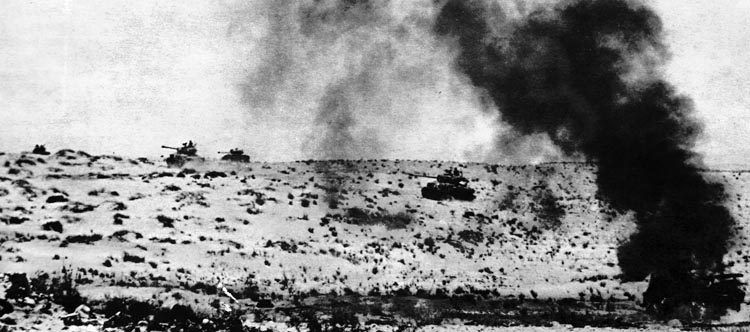
A
column of Egyptian tanks moves into the Sinai Desert on May 7, 1967,
joining divisions already positioned on the Egyptian-Israeli border.
Despite
the overall lax condition of the Egyptian Army, the Israeli high
command harbored a deep respect for the fighting mettle of the average
Egyptian soldier. Largely due to Israel’s experience in failing to crack
the defenses of Abu Agheila in 1956, the Egyptians were particularly
feared for their willingness to fight tenaciously from fortified
positions. Russian military engineers helped the Egyptians construct
imposing fieldworks at key strategic positions across the vast expanse
of Sinai.
A virtual panic gripped the highest echelon’s of
Israel’s government as the nation braced itself for what could become a
struggle for survival. Because any conflict would inevitably result in
the IDF waging a war on multiple fronts, Israeli military doctrine
stressed initiative and aggressive tactics as a part of an overall
strategy of destroying numerically superior Arab armies before they had a
chance to respond. In many respects, Israeli tactics ironically copied
the blitzkrieg of Nazi Germany in World War II.
In the years
leading up to the Sinai Campaign in the Six Day War, the IDF was
transformed into a more mobile force that gravitated toward an
armor-dominated army, as opposed to an army made up of predominantly
infantry. Brigadier General Israel Tal, commander of the Israeli Armored
Corps, was a key developer of his nation’s armored doctrine. In large
part due to Israel’s small population, Tal favored heavy tanks and
firepower at the expense of lighter and faster tanks. Such an approach
offered Israeli tank crews better protection, as well as the upper hand
during long-range armored duels.
Due to friendly relations and
consequent arms contracts with the Western powers, tanks such as the
American Patton and the British Centurion fit the bill. Israeli tankers
received rigorous training in maneuver and gunnery. “After the air
force, armor is the factor that decides the fate of battles on land,”
said Tal. “The task of armor is to carry the battle into the enemy’s
territory and thus obtain a quick decision.”
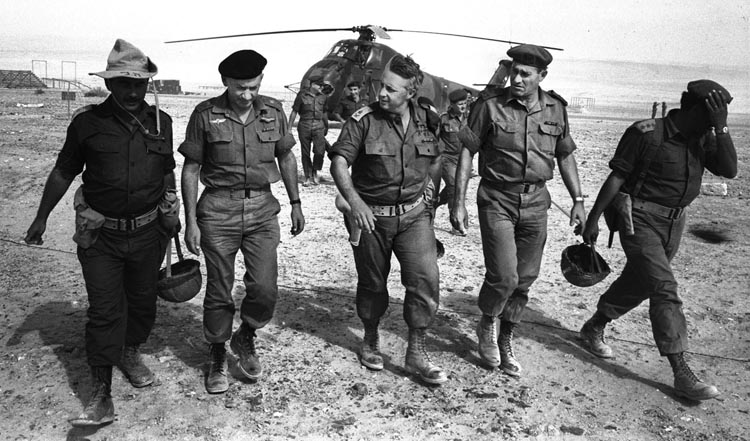
General
Ariel Sharon, center, confers with his subordinates just days before
Israel’s launch of a preemptive strike into the Sinai.
In
any pending conflict, though, the vaunted Egyptian fieldworks in the
vicinity of Abu Agheila could not simply be bypassed. With the
assistance of Soviet advisors, Egyptian engineers had constructed a
substantial barrier that would stall any potential Israeli advance with a
robust defense in depth.
In front of the forward base at Umm
Katif, Egyptian infantry manned two mutually supporting lines of
trenches. The trenches were further bolstered by artillery positions,
mortar pits, dug-in tanks, and bunkers. To the north, immense sand
dunes, which were deemed impassable to armor, were considered effective
flank protection. The eastern approaches to the position, the most
likely avenue of an Israeli attack, were protected by wide belts of mine
fields and barbed wire. Abu Agheila, which commanded the central route
across Sinai, was likewise the most heavily fortified position on the
peninsula.
Actually, the formidable task of cracking the defenses
at Abu Agheila had commanded the attention of the Israeli high command
since 1956. The Israeli Command and Staff College staged exercises each
year against mock Abu Agheila fortifications, and the exercises were
updated each year based on fresh intelligence of the ever-evolving
Egyptian defenses. Most Israeli field commanders and staff officers were
consequently familiar with the Abu Agheila defense complex. In keeping
with Israeli doctrine, which promoted aggressive initiative from junior
officers, participants in the program were encouraged to develop their
own tactics in launching assaults.
Such intensive preparation for
war, paired with reckless saber-rattling across the border, resulted in a
fateful decision by the Israeli cabinet. In a series of tense meetings
in a Tel Aviv bunker on June 4, Israeli military officers were nearly
unanimous on the need to launch a preemptive attack on Egypt, which was
continuing the Sinai buildup in preparation for launching its own
attack. Quite understandably, the politicians demurred.
In the
corner of the conference room, Brig. Gen. Ariel Sharon brooded. Sharon,
who commanded one of the Israeli divisions mustered on the Sinai Front,
was worried by the political indecision that left front-line troops in
the lurch. Combat units were “moving here and there, crossing each
other’s paths and taking up positions, only to move back from them a day
later and take up different ones,” recalled Sharon. “The army did not
look as if it knew what it was doing.”
Sharon took a grimmer view
of the closure of the Straits of Tiran, and regarded it as a provocation
that demanded an inevitable military response. “We have the power to
destroy the Egyptian Army, but if we give in on the free-passage issue,
we have opened the door to Israel’s destruction,” he said. “We will have
to pay a far higher price in the future for something that we in any
case had to do now.”
For the frontline commanders, continued
diplomatic dawdling only invited a tougher fight. Every day that passed
allowed the Egyptians more time to dig in and prepare. For his part,
Sharon was exasperated by the waiting game. “The Army is ready as never
before,” he said. “All this fawning to the powers, begging for help,
undermines our case. If we want to survive here, we have to stand up for
our rights.”
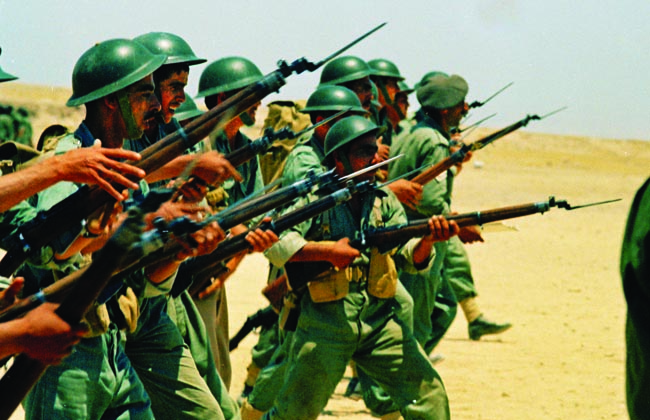
Jordanian troops drill on the Israeli border on June 1, just a few days before the start of the war.
By
the evening of June 4, such reasoning had swayed the government’s
cabinet ministers, who, at last, opted for war. “The government has
determined that the armies of Egypt, Syria, and Jordan are deployed for a
multi-front attack that threatens Israel’s existence,” stated the
official orders. “It is therefore decided to launch a military strike
aimed at liberating Israel from encirclement.”
Those orders
unfolded with startling force early on the morning of June 5, 1967. In a
desperate attempt to neutralize Egypt’s formidable air power, the
Israeli Air Force launched a stunning series of preemptive attacks on
enemy airfields throughout Egypt. Known as Operation Moked, the attack
caught the Egyptians entirely by surprise. In a matter of hours,
approximately 200 Israeli aircraft conducted multiple attacks that
eventually destroyed 338 Egyptian aircraft, most of which were never
able to get off the ground. Subsequent attacks destroyed all 29 aircraft
of the Jordanian Air Force, as well as 61 Syrian planes.
With the
Arab air fleets out of commission, the Israelis were free to push their
ground forces into Sinai free from the threat of aerial attack. Overall
command of the Sinai Front was assigned to Brig. Gen. Yeshayahu Gavish.
Gavish had three ugdah (divisions) at his immediate disposal. The
Israeli right flank along the Mediterranean coast was commanded by Brig.
Gen. Israel Tal, who led a division that was to sweep along the primary
coastal route across Sinai. In the center, Brig. Gen Avraham Yoffe, a
tough veteran who had seen extensive combat since he was 16 years old,
led two armored brigades. On the left, Ariel Sharon commanded an
imposing ugdah, the 38th Armored Division, which was a mixed outfit of
four brigades that included armor, infantry, airborne, and artillery
units.
A career army man, Sharon was a barrel-chested bull of a
warrior to whom fighting had become a way of life. A native Israeli who
had been born in British Palestine in 1928, Sharon was just 14 when he
joined the Haganah militia. During the Israeli War of Independence, he
served as a junior officer. Prone to lead by example, he was badly
wounded in action with Jordanian troops.
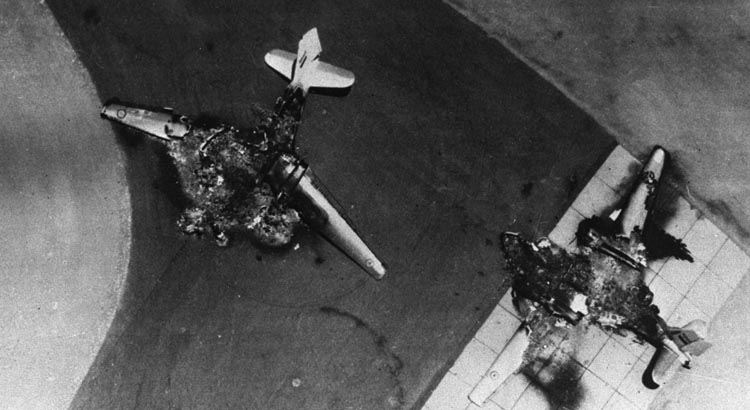
The Israeli Air Force destroyed the Egyptian Air Force in a stunning pre-emptive strike on the first day of the war.
Sharon
was given command of a special forces outfit, Unit 101, in 1953. His
tenure at the head of the commandos, though, would leave an indelible
stain on his career as an officer. In October 1953, Sharon led an
operation into the Jordanian West Bank that targeted Palestinian
terrorists. During the fighting, more than 60 civilians were reportedly
killed.
During the 1956 Sinai Campaign, Sharon commanded an elite
unit of paratroopers that seized vital ground at the Mitla Pass. As a
professional soldier, Sharon was regarded as a keen student and
meticulous planner. On the battlefield, he earned the reputation as a
hard-driving combat leader who was willing to personally lead his men
into tough fighting.
Sharon’s objective was the imposing complex
of Egyptian defenses around Abu Agheila, which commanded the central
route across Sinai. The Egyptians were convinced that the main Israeli
attack would be farther south, leading them to leave their forces spread
woefully thin at Abu Agheila and the forward position of Umm Katif.
Against the 8,000 Egyptians of the 2nd Infantry Division, Sharon had
concentrated 14,000 Israeli troops.
Sharon also possessed a keen
advantage in armor: 150 tanks consisting of a mix of Centurions, Super
Shermans, and the lighter French AMX-13s. By comparison, the Egyptians
could muster just 66 T-34’s. The Egyptians did possess an advantage in
artillery, fielding a fearsome array of Soviet 122mm cannons and 152mm
howitzers which easily outclassed the Israeli artillery.
Sharon
had developed a meticulous and audacious plan for the reduction of the
impressive Egyptian defenses. A keen student of military tactics, he not
surprisingly opted for a massive flanking movement against the Egyptian
stronghold. Following an airborne assault aimed at silencing the enemy
artillery, Israeli artillery would unleash a punishing barrage on
Egyptian positions. Armored columns would harass the enemy’s flanks
while the main thrust, largely consisting of infantry, would strike the
Egyptians from the north. The main attack would use the cover of sand
dunes which the Egyptians considered impassable.
Clearly aware
that Israeli troops had been stalled by the Abu Agheila defenses in
1956, Sharon had formulated an extremely complex plan in the hopes of
completely overwhelming the Egyptian defenders. The success of the
entire plan, though, would depend on near-perfect timing, the
coordination of various columns, and a dose of good luck.
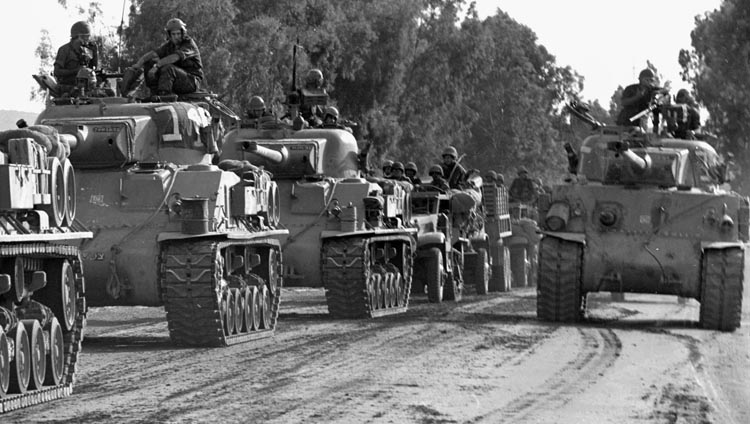
Israeli
armor prepares for the advance into the Sinai Desert. The Israelis
entered the Six-Day War with more than twice as many tanks as the
Egyptians.
Sharon would have more than his share
of good fortune in the unfolding battle. His main force crossed the
border on June 5 and made for Abu Agheila. South of Umm Katif, Sharon
launched a diversionary attack toward Egyptian positions at Qusaymah.
Although he attacked Qusaymah with just two reserve battalions and a
handful of tanks, the Egyptians became increasingly convinced that any
direct attack on Abu Agheila was unlikely, and focused their attention
on points south.
Taking advantage of the Egyptian confusion,
Sharon put his complex plan in motion. On the right, Colonel Natke Nir’s
task force struck off on one of the most crucial and dangerous parts of
Sharon’s grand plan. Nir commanded an independent armored battalion,
which was to swing to the north of the Umm Katif positions along an
insignificant desert trail known as the Batur Track. His objectives were
to reduce an Egyptian outpost at Point 181, then fall on the rear of
Abu Agheila, seizing Ruafa Dam, cutting off the route of retreat and
blocking the roads to any Egyptian reinforcements.
Nir commanded
an assortment of heavily armed troops, which included mechanized
infantry, mortar, and rocket teams, as well as reconnaissance and
engineering units. The hard-hitting core of his unit consisted of 45
Centurion Mark V tanks, whose wide tracks made them well suited for the
dangerous flank attack along the sandy wastes of the Batur Track. More
important, the Centurions, armed with 105mm main guns, packed the
necessary punch for a shooting match with Soviet-made armor.
Due
to scant intelligence, Nir was unsure what resistance would be
encountered at Point 181, but as his tanks approached the high ground,
they received a warm reception and were driven back after fierce
fighting. After calling in air support from the IAF, Nir struck again.
While his infantry fixed the Egyptians from the front, Nir sent his
armor on wide flanking attacks against the Egyptians.
In the face
of the multi-pronged attack, Egyptian defenses at Point 181 collapsed,
once again opening the Batur Track to Nir’s armor. The brutal fight for
the position had cost Nir several of his subordinate officers and eight
tanks.
The operation to seize Abu Agheila continued at sundown,
when a daring helicopter-borne infantry attack was launched from Israeli
positions. Sharon had planned for three waves of six helicopters to
land 200 paratroopers in the enemy’s rear. The craft were carrying
elements of the 80th Paratroop Brigade under the command of Colonel
Matt. Matt’s elite paratroopers were tasked with the vital operation of
silencing enemy artillery, consisting of deadly Soviet-made 130mm
cannons, before the Egyptian guns could decimate Sharon’s advancing
armor and infantry.
Sharon shared a special bond with his
paratroopers. A former paratrooper himself, the general continued to don
the red beret of the Israeli airborne. War correspondent Yael Dayan was
present when Sharon conferred with Matt just prior to the attack.
Sharon’s voice “changed some when he talked to the parachutists’
commander,” said Dayan. “He knew them all by first name, and they were
his men, and somehow he gave me the feeling he was talking to a brother
in whose hands he entrusted a hard job.”
Despite Sharon’s
confidence in his paratroopers, the operation was indeed a hard job from
the outset. During the flight to the landing zone, nearly half of the
helicopter pilots lost their bearings in the darkness, veered far off
course, and never succeeded in landing their loads of paratroopers at
the designated target. After a harrowing flight over the desert, the
rest of the helicopters touched down about two miles northwest of the
Egyptian artillery park in terrain considered impassable to the
Egyptians. Matt’s paratroopers, each of whom was laden with a heavy load
of weaponry and equipment, began the arduous trek toward their target.
Although
the paratroopers were highly conditioned warriors, they struggled under
heavy loads as they trudged through the sand dunes. Urged on by their
officers, the men pressed forward. With no warning, Egyptian artillery
and mortar fire began landing on the planned route of attack, sending up
great plumes of sand and dust. Matt kept his head despite the
tremendous crash of artillery. “I guessed from the location of falling
bombs that the enemy was firing blind, not having actually seen us, only
hearing the unfamiliar noise of the helicopters in their rear area,”
said Matt.
Lt.
Col. Mordecai Zippori’s 14th Armored Brigade eliminated Egyptian
forward outposts at Abu Agheila in two hours of hard fighting.
Despite
the occasional burst of Egyptian illumination rounds, the paratroopers
struggled to find their way in the dark; but as Matt pressed forward,
the enemy position was clearly located by the telltale muzzle flashes of
Egyptian artillery. Matt and his men reached the perimeter of the
Egyptian artillery park at 12:00 AM. They then formed up for the planned
assault.
As the Israelis rushed forward, they could not believe
their luck. The artillery position they were about to assault, which had
no protective minefields or barbed wire, was wide open to attack. Matt
had given orders to individually assault each enemy gun, and as the
paratroopers entered the position, they split up to target their
objectives. The Egyptian gun crews had been taken entirely by surprise
and panicked in the confusion. The Israelis likewise targeted enemy
ammunition bunkers, which were soon engulfed in flames. In minutes, the
Egyptian gun crews had scattered in confusion, and much of the artillery
was destroyed or disabled.
A convoy of Egyptian supply trucks,
illuminated by their own headlights, arrived unexpectedly at the
artillery park just as the Israelis had overrun the position. The
disoriented Egyptian drivers had no warning and drove into the mouth of a
deadly ambush. Riddled with Israeli small arms fire, trucks careened
out of control or burst into flames.
While Matt was shocked by the
carnage his men had inflicted, the operation to silence the Egyptian
guns had been a remarkable success. For his part, Matt had regarded his
assignment as sure to result in a tough fight, and he was elated with
his success. As his men mopped up and gathered their dead and wounded,
Matt received a radio communication from Sharon, who ordered the
paratroopers evacuated. The main attack could proceed unfettered by the
threat of an impenetrable Egyptian artillery screen
Israeli columns would make the most of the advantage. Sharon gave
orders for his artillery to open fire on the Egyptians at 10:00 PM. His
arsenal of firepower consisted of 105mm and 155mm howitzers, 120mm and
160mm mortars, and British 25-pounders. As he glanced across the desert,
he issued legendary orders for his gunners. “Let everything tremble,”
he said.
A sheet of flame lit up the desert floor as the guns
opened up, raining down an unrelenting storm of fire on the Egyptian
defenses. For nearly half an hour, the Israelis unleashed the most
intense artillery bombardment in the history of the IDF. Even Sharon, a
career soldier, was amazed by the tremendous show of firepower. “I have
never seen such a fire in all my life,” he said.
In the hope that
the fierce shelling had softened up the Egyptian defenses, Sharon
unleashed the troops of his main assault. Thundering toward the Egyptian
lines were the tanks of Lt. Col. Mordecai Zippori’s 14th Armored
Brigade, containing two battalions of Super Sherman tanks mounting 105mm
guns. Zippori’s task was to seize forward Egyptian observations posts
and then use his armor as fire support for the infantry attack on the
main Egyptian trenches. Zippori’s tankers had faced determined
opposition at the forward Egyptian post at Tarat Umm Basis, which was
occupied by the elite members of Egypt’s 2nd Reconnaissance Battalion.
The Egyptians broke after two hours of fierce fighting, and Zippori’s
brigade continued to steamroll startled enemy outposts as it drove
forward.
Israeli momentum, though, soon ground to a halt. Although
the IAF began launching sorties against the enemy defensive complex
centered on Abu Agheila, Egyptian artillery was able to maintain a heavy
and accurate fire against the advancing Israeli armor. To avoid sending
his tanks into a killing zone, Zippori ordered his tank crews to stop
the advance.
Earlier that afternoon, Sharon ordered his infantry,
the Kuti Brigade commanded by Colonel Yekutiel Adam, to cross the
frontier and move toward Umm Katif. Adam’s three battalions, one of
which was a part-time reserve outfit, had ridden to the front in a
curious parade of civilian vehicles. After reaching Tarat Um Basis, the
foot soldiers dismounted and trudged a dozen miles through sand dunes to
the north of the enemy.
Adam’s brigade, which was tasked with
assaulting the lines at Umm Katif, had taken up its assault positions on
the Egyptian left by 10:00 PM. Adam opted to throw his two regular
battalions into the initial assault and hold back his part-time
reservists as a general reserve in case of emergency. Once again, the
Egyptians would be confounded by the direction of the attack, which came
from sand dunes that were considered impassable. To the north of the
Umm Katif position, the Egyptians had planted no mines.
Rushing in
from the dunes in the black of night, Adam’s men slammed hard into the
trenches, quickly folding the Egyptian left. The Egyptians, though,
quickly regrouped and put up a stiff fight; brutal hand-to-hand combat
ensued in the trenches. The Egyptian colonel in command of the defenses,
whose command bunker was located in the second line of trenches,
frantically tried to order artillery strikes against the
Israeli-occupied first trench. His position, though, was overrun by the
advancing Israelis, who captured the command staff.
Despite the
determined defense of much of the Egyptian infantry, the tactical
surprise gained by the Israelis began to tell. Israeli infantry rapidly
moved through the trenches. In the confusion of the night fighting, the
foot soldiers averted friendly fire incidents by use of colored
signaling flashlights. Each battalion had a specific color. One was red,
another green, and yet another blue. By 1:00 AM on June 6, the Israelis
sat astride the central route and began assaulting the southern half of
the Umm Katif defenses. Clearly sensing that he was poised for victory,
Adam ordered his reserve battalion into the fight.
The situation
quickly degenerated for the Egyptians. Soon after Adam’s successful
assault of the trenches, Israeli engineers succeeded in opening a hole
in the minefields and barbed wire to the east of Umm Katif so that
Israeli armor could advance. The operation would be a difficult one,
though. As a lead platoon of tanks inched its way through the gap, one
of the tanks struck a mine and was disabled, blocking the path. The
engineers frantically worked to widen the breach for the remainder of
the tanks. Only the mounting confusion in Egyptian ranks saved the
stalled tanks from annihilation. Three hours later, Israeli tanks were
pouring through the gap and widening the Israeli breach of the Umm Katif
position.
After a harrowing nightlong journey through the sand
dunes north of Abu Agheila, Natke Nir finally succeeded in getting his
Centurion tanks in position for an assault on Egyptian troops stationed
at Ruafa Dam. His attack, which rolled in from the west, came as a
complete shock to the startled Egyptian defenders, whose attention had
been focused on the main attack coming from the east. In short order,
the Egyptian position collapsed, and Nir struck east in order to link up
with the Israeli main body.
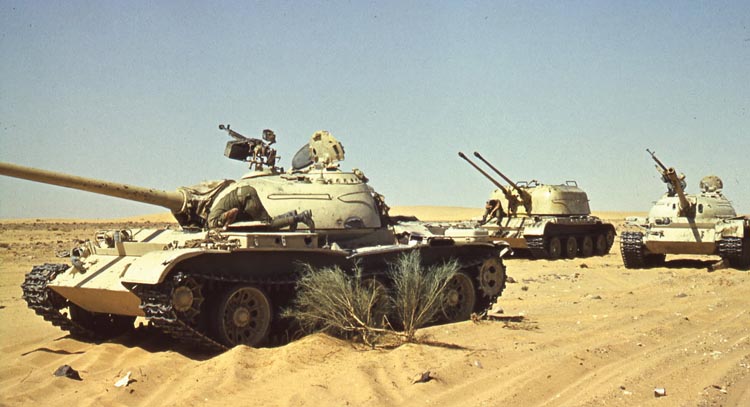
Captured
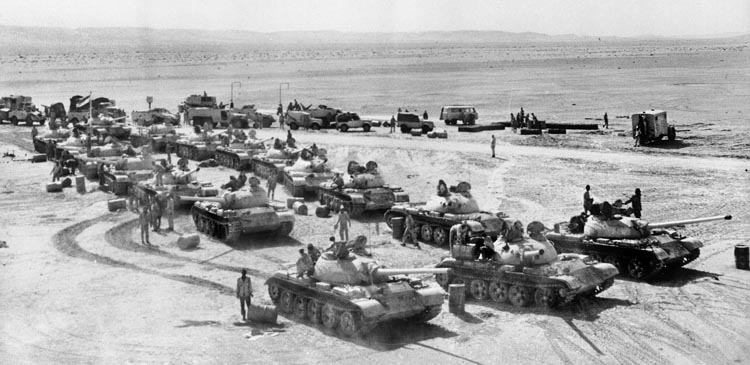
Egyptian armor parked in the Sinai desert. The Israelis’ remarkable
victory had exceeded military planners’ most optimistic timetables.
At
that point, the Egyptian defenses began to hopelessly unravel. For two
hours, Egyptian tankers waged a determined but uncoordinated fight with
the closing vise of advancing Israeli armor. By the early morning hours,
only isolated detachments of Egyptians continued to fight, but they
were quickly overwhelmed. The Egyptian defensive works of the Abu
Agheila complex, once considered one of the strongest defensive
positions in the world, had fallen in a single night of fierce fighting.
The
loss of Abu Agheila, paired with startling Israeli victories farther
north, brought about the entire collapse of the Egyptian defense of the
Sinai Peninsula. In Cairo, a demoralized Field Marshall Amer panicked
and ordered his entire army to give up the fight, make for the Suez
Canal, and regroup on the west bank. By the early afternoon, Egyptian
forces were in full flight to the west, with hard-driving Israeli
armored columns hot on their heels.
Far from letting the Egyptians
escape, the Israelis sent smaller armored forces in a mad dash for the
few strategic passes through the mountains of western Sinai. Once again,
decisive action enabled the Israelis to gain control of the only
Egyptian escape routes. Although a good number of Egyptians escaped, the
outcome of the fighting in Sinai had proved nothing short of
catastrophic. The Egyptian Army had lost 80 percent of its tanks,
artillery, and trucks. The Egyptians also suffered 11,000 men killed,
wounded, or captured. In the Abu Agheila sector alone, the Egyptians
lost 2,000 men and 60 tanks. In contrast, the Israelis lost 40 men and
19 tanks in that sector.
The remarkable victory in Sinai had
outpaced the most optimistic of Israeli timetables and exceeded even the
wildest dreams of Sharon. The 38th Armored Division’s remarkable
success at Abu Agheila not only secured Ariel Sharon’s reputation as a
cunning strategist, but also was a key factor in the crushing Israeli
victory during the 1967 Arab-Israeli War, which lasted less than a week.
During the conflict, later styled the Six Day War, the IDF stormed to
stunning wins on every front.
In addition to occupying the Sinai
Peninsula and the Gaza Strip, the Israelis crushed Syrian columns in the
northeast, securing possession of the strategic Golan Heights. Israeli
possession of the Golan ensured that Jewish farmers, who had faced
perennial shelling from Syrian artillery on the heights, would enjoy a
level of security heretofore unknown.
Similarly, the Israelis
delivered crippling blows to enemy troops in the West Bank. Despite
stubborn Jordanian fighting, the IDF badly wrecked Jordanian columns.
The fighting left Israel in control of all territory west of the Jordan
River, which included the holy city of Jerusalem, the most treasured
prize in the Middle East.
I
am continuing my string of "bugaloo" songs. This discussion was
started in the "Monster Hunter Nation, Hunters Unite", back in November
of 2019? it is a Facebook group with enthusiast of the ILOH
"International Lord of Hate" A.K.A Larry Correia.
We were talking about what song would we use if we looked out of our
window or glanced at our security camera and saw this.....
One
of the alphabet bois lining up to take down your house...What would be
your "Valhalla" song and you would set it up to play as you load up
magazines set up the Tannerite Rover, turn on the water irrigation system and fill it with gasoline instead of water and prepare yourself.
I
figured it would scar the alphabet boys if they come busting in and
hearing a song about people standing for their beliefs and willing to
fight for them no matter the cost, Good Music unlike that crap they
listen to now. What can I say, My humor is warped....just a bit. Next
week will be "Give it up" by Kacey of K.C of the Sunshine Band...How Appropriate,
LOL, Now that should really cause some psych evals., hehehe, some poor
ATF guy trying to explain the attraction to his mother because he is imaging
himself as The savior of the American way rather than working for an
agency that have the initials of a convenience store. Now because we
ain't gonna answer that door. They can kick it in and start "the
Dance" Glypto Dropem made
this song suggestion and I thought it was pretty cool. I am very
unhappy that the various .gov agencies have been weaponized by Obunger
and continued to this day by the alphabet agencies because they don't
like
people that ain't on the democrat plantation. Well I kinda like my
freedom and stuff and that is anathema to the deep state and their
operatives.
The J. Geils Band/ˌdʒeɪˈɡaɪlz/ was an American rock band formed in 1967, in Worcester, Massachusetts, under the leadership of guitaristJohn "J." Geils. The original band members included vocalistPeter Wolf, harmonica and saxophone player Richard "Magic Dick" Salwitz, drummer Stephen Bladd, vocalist/keyboardistSeth Justman, and bassistDanny Klein. Wolf and Justman served as principal songwriters. The band played R&B-influenced blues rock
during the 1970s and soon achieved commercial success before moving
towards a more mainstream radio-friendly sound in the early 1980s, which
brought the band to its commercial peak. After Wolf left the band in
1983 to pursue a solo career, the band released one more album in 1984
with Justman on lead vocals, before breaking up in 1985. Beginning in 1999, the band had several reunions prior to the death of its namesake, J. Geils, on April 11, 2017.
The band first released several Top 40 singles in the early 1970s, including a cover of the song "Lookin' for a Love" by The Valentinos (which reached No. 39 on the Billboard Hot 100 in 1972), as well as the single "Give It to Me" (No. 30 in 1973). Their biggest hits included "Must of Got Lost" (No. 12 in 1975), "Come Back" (No. 32 in 1980), "Love Stinks" (which reached No. 38 in 1980 and was featured in several films), "Centerfold" (No. 1 in 1982), and "Freeze-Frame" (No. 4 in 1982).
Bloodshot is the third studio album by American rock band The J. Geils Band. The album was released on April 12, 1973, by Atlantic Records. It was the breakthrough release for the band, reaching #10 on the Billboard 200 album chart in the United States, a peak that the band would not surpass until their 1981 multi-platinum album Freeze Frame. The single version of "Give it to Me", which had a very different ending from the album version, reached #30 on the U.S. Billboard Hot 100 and #15 on the Cash Box Top 100.
Original US vinyl copies of Bloodshot were issued using red vinyl instead of the customary black, and utilized matching red 1950's style Atlantic Records
labels. The band would continue to use these vintage-style Atlantic
labels, in different colors with each album release, throughout their
remaining tenure with the label.
This song was recorded live in 1975 in San Francisco at the Winterlands
I couldn't get any more information on the song or anything else. That is the thing about songs and bands back then, they usually didn't give any backstory on the song to accompany the video.
On this day back in 1776 the 13 Colonies decided to make a break of it and form their own country. We have been fighting the Crown for a year at this point, but we still viewed ourselves as "loyal Subjects" and hoped that King George the III and his ministers would see reason and "lighten up", but too much blood has been spilt at this point and the founders figured "Why not go for broke, if we lose anyway, we will swing from the yardarm as traitors to the crown at this point", so they sent a "Declaration of Independence" announcing our Independence from the crown and made the fight "official.
In Congress, July 4, 1776
The unanimous Declaration of the thirteen united States of America,
When in the Course of human events, it becomes necessary for one people
to dissolve the political bands which have connected them with another,
and to assume among the powers of the earth, the separate and equal
station to which the Laws of Nature and of Nature's God entitle them, a
decent respect to the opinions of mankind requires that they should
declare the causes which impel them to the separation.
We hold these truths to be self-evident, that all men are created
equal, that they are endowed by their Creator with certain unalienable
Rights, that among these are Life, Liberty and the pursuit of
Happiness.--That to secure these rights, Governments are instituted
among Men, deriving their just powers from the consent of the governed,
--That whenever any Form of Government becomes destructive of these
ends, it is the Right of the People to alter or to abolish it, and to
institute new Government, laying its foundation on such principles and
organizing its powers in such form, as to them shall seem most likely to
effect their Safety and Happiness. Prudence, indeed, will dictate that
Governments long established should not be changed for light and
transient causes; and accordingly all experience hath shewn, that
mankind are more disposed to suffer, while evils are sufferable, than to
right themselves by abolishing the forms to which they are accustomed.
But when a long train of abuses and usurpations, pursuing invariably the
same Object evinces a design to reduce them under absolute Despotism,
it is their right, it is their duty, to throw off such Government, and
to provide new Guards for their future security.--Such has been the
patient sufferance of these Colonies; and such is now the necessity
which constrains them to alter their former Systems of Government. The
history of the present King of Great Britain is a history of repeated
injuries and usurpations, all having in direct object the establishment
of an absolute Tyranny over these States. To prove this, let Facts be
submitted to a candid world.
He has refused his Assent to Laws, the most wholesome and necessary for the public good.
He has forbidden his Governors to pass Laws of immediate and
pressing importance, unless suspended in their operation till his Assent
should be obtained; and when so suspended, he has utterly neglected to
attend to them.
He has refused to pass other Laws for the accommodation of large
districts of people, unless those people would relinquish the right of
Representation in the Legislature, a right inestimable to them and
formidable to tyrants only.
He has called together legislative bodies at places unusual,
uncomfortable, and distant from the depository of their public Records,
for the sole purpose of fatiguing them into compliance with his
measures.
He has dissolved Representative Houses repeatedly, for opposing with manly firmness his invasions on the rights of the people.
He has refused for a long time, after such dissolutions, to cause
others to be elected; whereby the Legislative powers, incapable of
Annihilation, have returned to the People at large for their exercise;
the State remaining in the mean time exposed to all the dangers of
invasion from without, and convulsions within.
He has endeavoured to prevent the population of these States; for
that purpose obstructing the Laws for Naturalization of Foreigners;
refusing to pass others to encourage their migrations hither, and
raising the conditions of new Appropriations of Lands.
He has obstructed the Administration of Justice, by refusing his Assent to Laws for establishing Judiciary powers.
He has made Judges dependent on his Will alone, for the tenure of their offices, and the amount and payment of their salaries.
He has erected a multitude of New Offices, and sent hither swarms
of Officers to harrass our people, and eat out their substance.
He has kept among us, in times of peace, Standing Armies without the Consent of our legislatures.
He has affected to render the Military independent of and superior to the Civil power.
He has combined with others to subject us to a jurisdiction foreign
to our constitution, and unacknowledged by our laws; giving his Assent
to their Acts of pretended Legislation:
For Quartering large bodies of armed troops among us:
For protecting them, by a mock Trial, from punishment for any
Murders which they should commit on the Inhabitants of these States:
For cutting off our Trade with all parts of the world:
For imposing Taxes on us without our Consent:
For depriving us in many cases, of the benefits of Trial by Jury:
For transporting us beyond Seas to be tried for pretended offences
For abolishing the free System of English Laws in a neighbouring
Province, establishing therein an Arbitrary government, and enlarging
its Boundaries so as to render it at once an example and fit instrument
for introducing the same absolute rule into these Colonies:
For taking away our Charters, abolishing our most valuable Laws, and altering fundamentally the Forms of our Governments:
For suspending our own Legislatures, and declaring themselves invested with power to legislate for us in all cases whatsoever.
He has abdicated Government here, by declaring us out of his Protection and waging War against us.
He has plundered our seas, ravaged our Coasts, burnt our towns, and destroyed the lives of our people.
He is at this time transporting large Armies of foreign Mercenaries
to compleat the works of death, desolation and tyranny, already begun
with circumstances of Cruelty & perfidy scarcely paralleled in the
most barbarous ages, and totally unworthy the Head of a civilized
nation.
He has constrained our fellow Citizens taken Captive on the high
Seas to bear Arms against their Country, to become the executioners of
their friends and Brethren, or to fall themselves by their Hands.
He has excited domestic insurrections amongst us, and has
endeavoured to bring on the inhabitants of our frontiers, the merciless
Indian Savages, whose known rule of warfare, is an undistinguished
destruction of all ages, sexes and conditions.
In every stage of these Oppressions We have Petitioned for Redress in
the most humble terms: Our repeated Petitions have been answered only
by repeated injury. A Prince whose character is thus marked by every act
which may define a Tyrant, is unfit to be the ruler of a free people.
Nor have We been wanting in attentions to our Brittish brethren. We
have warned them from time to time of attempts by their legislature to
extend an unwarrantable jurisdiction over us. We have reminded them of
the circumstances of our emigration and settlement here. We have
appealed to their native justice and magnanimity, and we have conjured
them by the ties of our common kindred to disavow these usurpations,
which, would inevitably interrupt our connections and correspondence.
They too have been deaf to the voice of justice and of consanguinity. We
must, therefore, acquiesce in the necessity, which denounces our
Separation, and hold them, as we hold the rest of mankind, Enemies in
War, in Peace Friends.
We, therefore, the Representatives of the united States of America,
in General Congress, Assembled, appealing to the Supreme Judge of the
world for the rectitude of our intentions, do, in the Name, and by
Authority of the good People of these Colonies, solemnly publish and
declare, That these United Colonies are, and of Right ought to be Free
and Independent States; that they are Absolved from all Allegiance to
the British Crown, and that all political connection between them and
the State of Great Britain, is and ought to be totally dissolved; and
that as Free and Independent States, they have full Power to levy War,
conclude Peace, contract Alliances, establish Commerce, and to do all
other Acts and Things which Independent States may of right do. And for
the support of this Declaration, with a firm reliance on the protection
of divine Providence, we mutually pledge to each other our Lives, our
Fortunes and our sacred Honor.
I haven't done an article about WWI in a bit so I found this one and dusted it off and posted it.
Commerce raiding has been employed for many centuries by various nations in the hope of denying the enemy vital supplies.
During World War one and two the German U boats became arguably the
most famous commerce raiders of all time, their tenacity and vigor twice
nearly led to the capitulation of Great Britain and consequently they
became the most noted and studied part of modern naval warfare. During
World War one the U boat was in its infancy, its tactics not yet fully
refined or realized and Germany, not occupying France meant that only a
handful of vessels had the ability to attack British and French shipping
far beyond the waters of Europe and North Atlantic.
World war
two would bring the most well-known episodes of commerce raiding, such
vessels and men like the Admiral Graf Spee, The U boat aces Otto
Kretschmar, Gunther Prien and many others would go down in history as
some of the most successful commerce raiders of their respective war.
History
always notes the famous battles and ships, Battles such as Jutland and
ships such as the Emden and Dresden, but arguably the most successful
surface commerce raider of world war one must be the rather unremarkable
SMS Wolf.
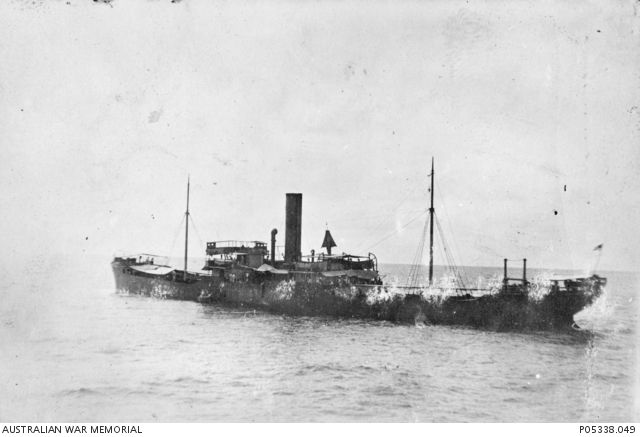
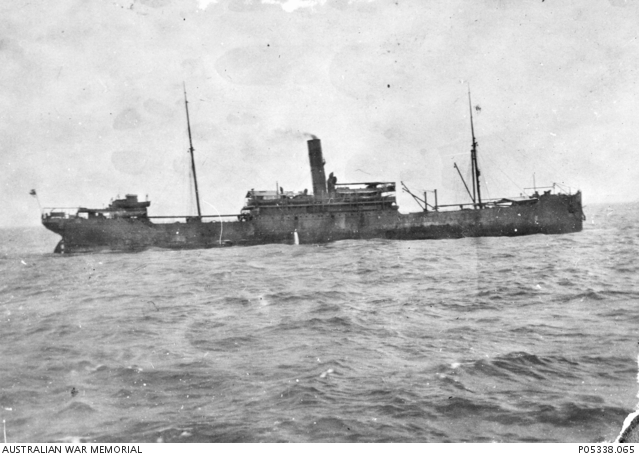
SMS Wolf picture from the Australian War Memorial
She wasn’t a Battleship, cruiser or submarine but a rather bland,
boring looking freighter that was launched in 1913 at Flensburg as the
Wachtfels for the DDG Hansa line. She was taken over by the Kaiserliche marine and re named SMS Wolf being commissioned on the 16th may 1916.
The
Wolf was quite unremarkable and limited in her features and
capabilities but that didn’t stop the Kaiserliche Marine putting her to
good use, in fact these attributes were to be her best attributes.
The Wolf was a modest ship at 135 meters long 17 meters wide and
displacing 11,200tons, she was powered by 3 coal burning boilers
generating steam for the single VTE engine turning a single 4 blade
screw, her top speed was around 11 knots. The wolf could bunker
8,000 tons of coal and at a steady 8 knots she used roughly 35 tons of
coal per day giving her a huge range of 32,000 nautical miles.
Between
1914 and 1916 the Wolf was heavily modified and posses a formidable
armament, eight 5.9inch guns and three 2 inch guns made up her main
battery, she was also fitted with four 20 inch torpedo tubes and carried
465 mines in her hold.
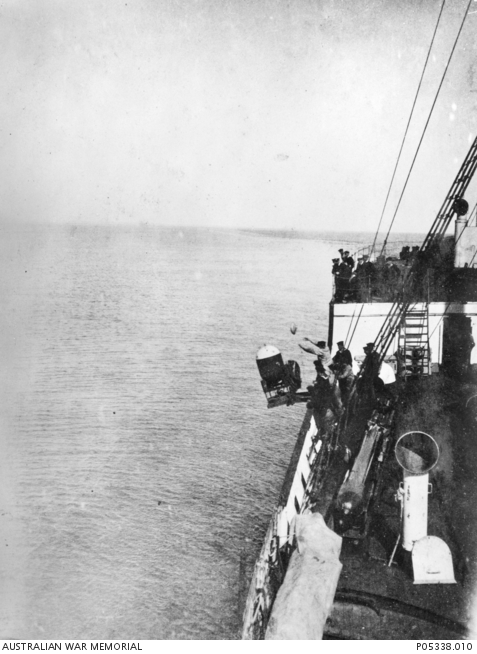
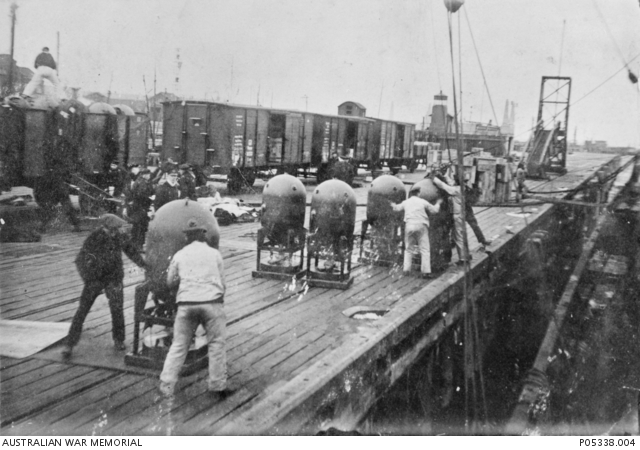
Wolf Laying Mines picture from Australian war memorial
Wolf loading mines in Kiel Picture from Australian War memorial
The armament was more than enough to take on the allied
merchant ships, but wolf had no armour herself thus her orders were not
to engage allied warships. Also fitted was a single Friedrichshafen FF.33 Sea plane for scouting, this was dubbed the little wolf by the crew.
The wolf could also change her appearance, she had masts the retracted
or erected as well as a fake funnel to disguise who she really was.
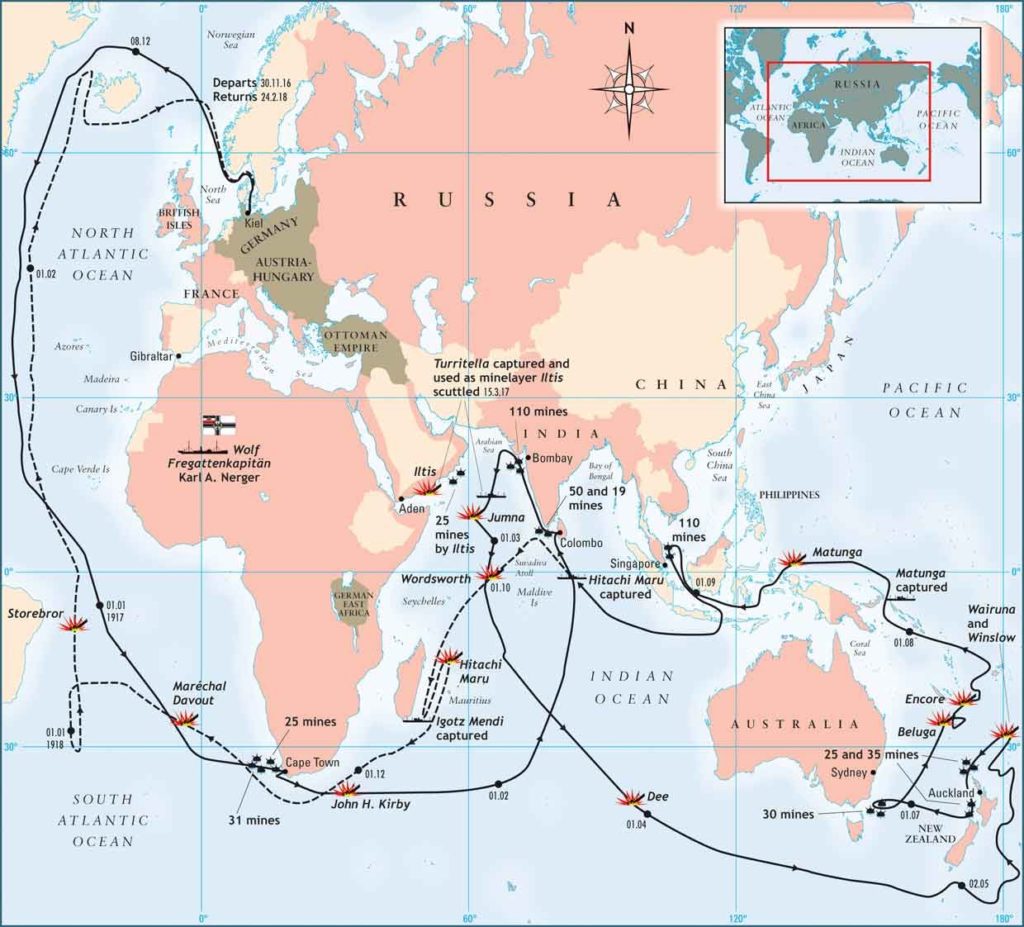
On November 30th 1916 in total secrecy the SMS Wolf
slipped her moorings in Keil and headed out to sea with Kapitan zur See
Karl August Nerger in command and a crew of 348 men on board. She
quietly transited the Norwegian coast disguised as a British Freighter
and slipped past the Royal Navy blockade rounded Scotland and slipped
quietly into the North Atlantic turning south.
After a few weeks
at sea the crew crossed the equator and performed a crossing the line
ceremony paying tribute to King Neptune it was a time of relaxation and
enjoyment for the crew but soon the mission would start.
Rounding
the cape of good hope she laid some mines close to the port of Cape
town, this would cause the loss and damage of some ships notably, the
Spanish ship Carlos de Einzaguirre struck one of her mines and sank in
four minuets with the loss of 134 people this included 12 women and 5
children.
she proceeded on into the Indian ocean laying mines in
Colombo Ceylon (modern day Sri Lanka), Mumbai India, and Singapore again
she got success in each location. To avoid capture she never
stayed in one place for too long and never put into port, after the mine
laying she headed towards the Pacific Ocean and laid more mines off
ports in Southern Australia, New Zealand, and Indonesia.
While
laying mines she also engaged other merchant vessels capturing cargos
and prisoners and even taking over the freighter Turritella sending her
out as a second raiding vessel, she was later captured but Wolf wouldn’t
have it all easy. On September 26th 1917 she sighted
the 6,560 ton Japanese Freighter Hitachi Maru she fired a single shot
asking the vessel to come about, the Wolf was met by return gun fire
from the Japanese ship and a total of 14 rounds were fired at the
Hitachi Maru killing 16 and wounding another 6 before the captain
surrendered his ship. Later Captain Tomonaga of the Hitachi Maru
so ashamed that his ship had been captured committed suicide by jumping
over the side.
Hitachi Maru after capture picture from Australian war memorial
Once she had expended all her mines the Wolf set course for home,
however she had little coal reserves to make the long journey, one of
her last captures the Spanish ship Igotz Mendi, she was carrying
5,000tons of coal destined for the Royal Navy. At least 1,000tons
of coal was transferred to the Wolf while under way and both ships
headed for the Cocos Islands where the Ingotz Mendi was painted grey,
and a prize crew took her over and sailed with the wolf towards Germany.
The
long voyage home saw the ships return through the Atlantic, around
Iceland and down the Norwegian coast, again avoiding the British
Blockade. While transiting Danish waters the Ingotz Mendi ran
aground in thick fog, a Danish gunboat arrived and removed the crew and
prisoners but the ship remained hard aground.
The Wolf continued on entering her home port of Keil carrying her captured cargos and 467 prisoners’ of war on February 24th
1918 after travelling over 100,000km on a voyage lasting 451 days (15
months) at which time she never put into a port or made a single radio
transmission, it became the longest deployment of the war. The wolf
had captured and sunk 14 ships totaling over 38,000tons, she is also
credited with a further 13 ships hitting her mines totaling nearly
76,000tons.
The Wolf would only make one other foray before wars
end this time in the Baltic, at wars end she was ceded to France as
reparations and became Antinous she was scrapped in 1931.
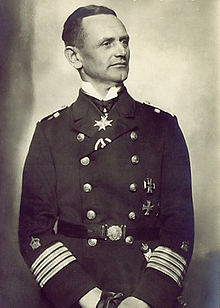
Herr Captain Karl August Nerger
Her Captain Karl August Nerger for his exploits would be awarded the
Prussian Pour la Merit and the Bavarian Military order of Max Joseph he
would survive the war only to be beaten to death on August 15th 1945 in the now soviet controlled former concentration camp at Sachsenhausen.
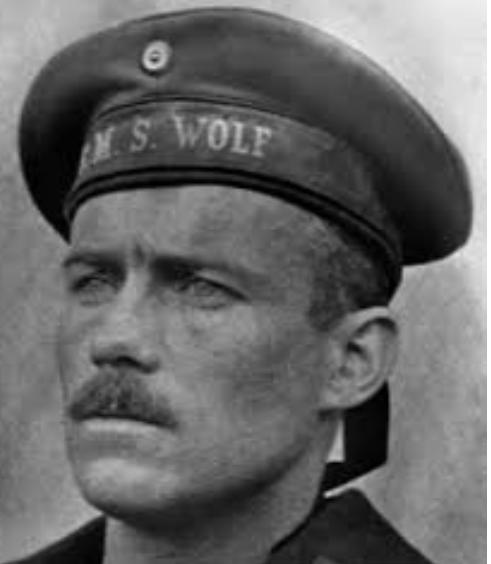
Another Notable Crewmember Theodore Plievier
Theodor Plievier took part in the Wilhelmshaven mutiny of 1918 and after leaving the navy went on to write several books.
In 1933 under the new National Socialist government came to power his
books were banned and burnt, he fled to France and later Sweden before
settling in the Soviet Union where, during world war two he interviewed
captured German prisoners. After the war he moved to Switzerland and died on March 12th 1955.